The Limits of Hindutva
Significant opposition to the Hindu nationalist project in India has recently emerged. But the Indian Left has to go beyond a “progressive” nationalism to build something bigger.
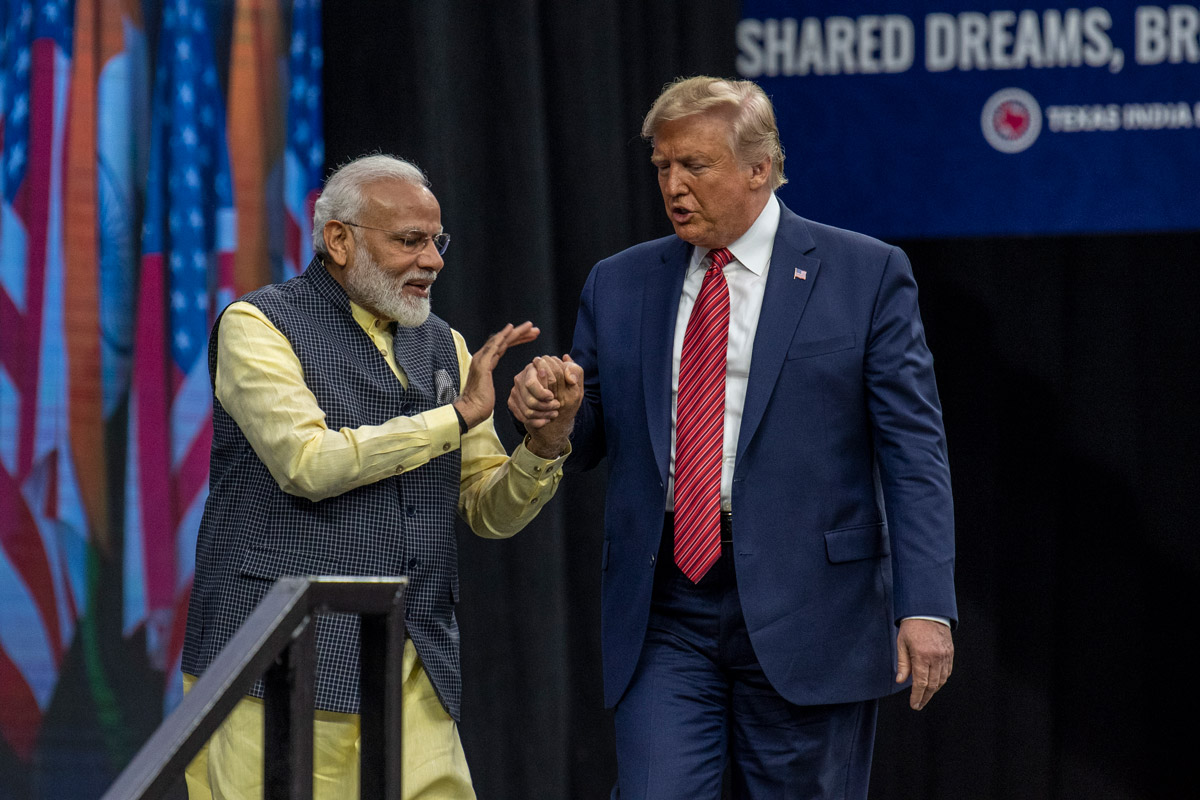
Indian prime minster Narendra Modi welcomes President Donald Trump during a rally on September 22, 2019 in Houston, Texas. (Sergio Flores / Getty Images)
The seemingly unstoppable consolidation of the Hindutva project by the Hindu Nationalist Bharatiya Janata Party (BJP) has entered into a deadlock. With the passing of the contentious Citizenship Amendment Bill, a wave of mostly youth-led protests has gripped the country. Despite brutal and authoritarian repression by the Indian state, the demonstrations have been ongoing.
The encouraging aspects of these protests have been their spontaneity and their capacity to formulate their opposition against the Hindu-Right in broad socio-economic and political terms. There is an urgent need to take account of this rare opening and understand the significance of these developments.
Consolidation of the Populist Right
The BJP came to power in 2014 under the leadership of Narendra Modi and was reelected in 2019 with an increased majority — a dark outcome for the Indian Left. Even those who despise the Indian National Congress and hoped that this would finally cement the demise of its dysfunctional and self-obsessed aristocratic Gandhi family leadership were disappointed. The comatose survival of the Gandhi family is only symptomatic of a generalized organizational and political paralysis of the Left.