India’s Supreme Court Ruling Is Another Victory for Hindu Nationalism
The latest decision from the Supreme Court in India has legitimized the destruction of the Babri Mosque. Meanwhile, mainstream parties and commentators refuse to call it what it is: the latest stage in an accelerating process of Hindu ethno-nationalism.
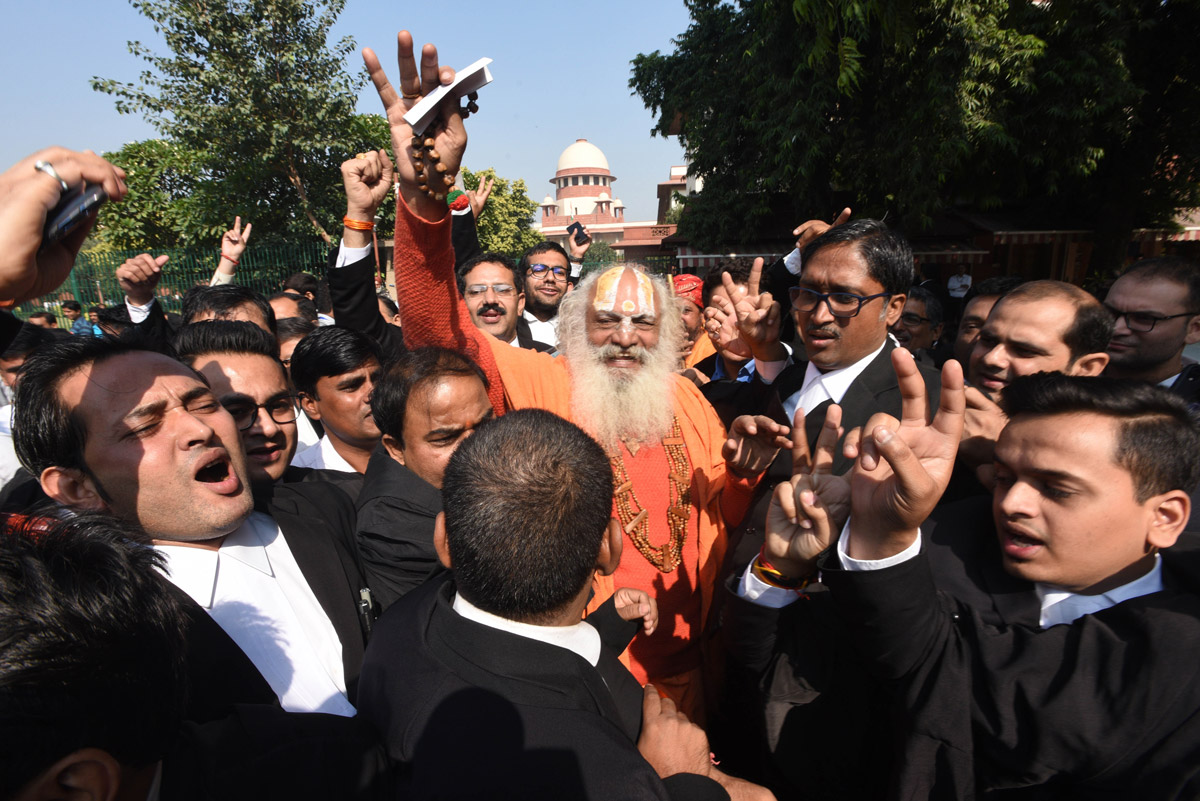
Mahant Dharam Dass and lawyers celebrate after the Supreme Court verdict in the Ram Janmabhoomi–Babri Masjid case, on November 9, 2019 in New Delhi, India. (Sonu Mehta / Getty Images)
Two weeks ago, on November 9, a five-member bench of the Indian Supreme Court gave a unanimous verdict legitimizing the unlawful demolition of the Babri Mosque in Ayodhya in Uttar Pradesh. As far back as 1992 that the sixteenth-century mosque (masjid) was destroyed, and a small, makeshift Hindu temple put in its place, only now has it reached the Supreme Court. The bench’s ruling marks a dark day in the annals of Indian jurisprudence and constitutes a serious acceleration in the ongoing process of establishing an ethno-nationalist Hindu state in India.
The Rise of Hindutva
The desecration of the Babri Mosque dates back to 1949 shortly after independence when Hindu idols glorifying the god-king Ram were criminally installed within the mosque but never removed. The Rashtriya Swayamsevak Sangh (RSS, National Volunteer Corps), partly inspired by Italian and German fascism, was set up in 1925 and espoused an organic nationalism based on Hindu-ness. This came at the exclusion of Christians and above all Muslims; the latter were seen as the real enemy, whose “invasions” and conversions over the last twelve hundred years are claimed to be responsible for weakening India and obstructing the fulfillment of its destiny.
Since independence in 1947, the various organizations making up the Hindu nationalist Sangh Parivar “family” have had a substantial cadre force that numbered, at a conservative estimate, several hundred thousand. It was also deeply implanted in Indian society, especially in the Hindi heartland and in western India.