Seattle, “the Soviet of Washington”
Decades before Amazon dominated the city, Seattle was the fiery site of labor unrest, radical action — and the US's only true general strike.
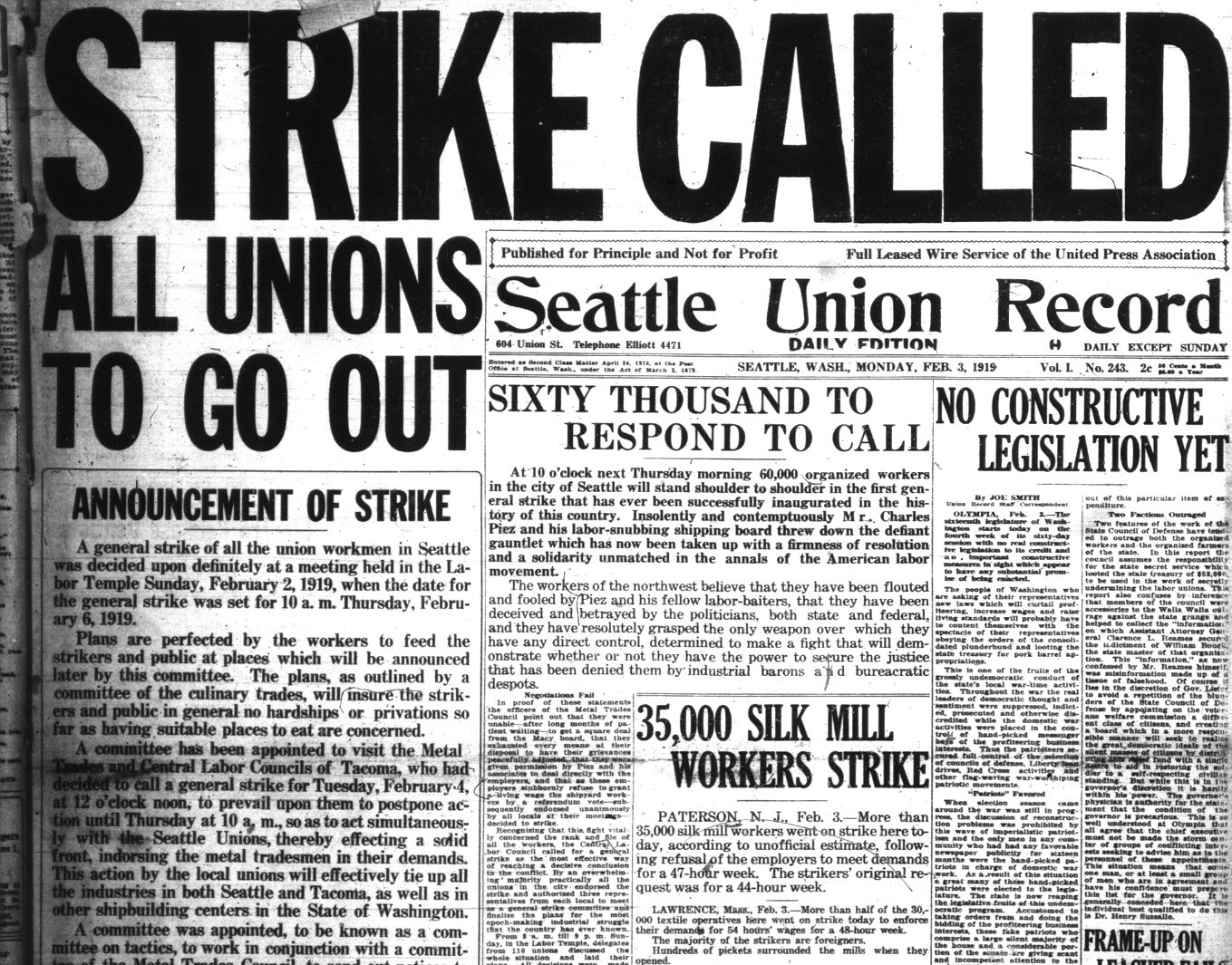
The front page of the Seattle Union Record at the beginning of the Seattle General Strike, February 3, 1919.University of Washington
Seattle gleams under the grey skies that characterize its climate. Container ships from China wait in Elliott Bay to unload, while tour boats head out to Alaska’s shrinking glaciers. The Great Wheel towers over Pier 57, and there are tourists everywhere. Two gigantic sports arenas dominate the southern end of the waterfront, where in times past seamen brawled and the longshoremen struck the great ships — losing in 1916, winning at last in 1934. The football stadium is the prize of Microsoft co-founder Paul Allen, who obtained the public funding for its construction. The best seats in the house sell for more than $1,000 and the approaches are lined with upscale bistros and bars. Just south of Lake Union, Allen’s Vulcan real estate company is building a head-office complex for another tech firm, Amazon, complete with interlinked spherical glasshouses enclosing a miniature rainforest. Facebook and Google are also moving in. Powered by these new developments, the Emerald City has the fastest growing population of any major urban area in the US. The world’s two richest men, Jeff Bezos and Bill Gates, both reside here.
Seattle flourishes, then — it is an important place. But can we ask: what sort of place? A stage set, perhaps, for the new Gilded Age, in which corporate wealth and “vibrant” street life can distract the eye from all manner of social contradictions. Seattleites don’t mind the rain; in fact, they love the outdoors. However, public space is at a premium and access to its beaches severely restricted. Tech workers take great pride in Seattle’s high rating for “livability,” yet the cost of housing is rising even quicker than in the Bay Area and the traffic is often unbearable. Hundreds sleep on the street each night. Tent cities appear, reminiscent of the 1930s “Hooverville” shanty town erected in the mud flats south of the business district, and just as unwelcome to the authorities. Meanwhile elsewhere in the city, second homes abound.
Still, there are ghosts dwelling here: old memories — dimly held, to be sure. Here is Yesler Way, once better known as Skid Road because of the logs rolled downhill along its course to Henry Yesler’s sawmill on the shore. Nowadays a nondescript thoroughfare dotted with cafes frequented by tourists, including a branch of the city’s ubiquitous Starbucks chain, it used to heave with disreputable saloons, brothels, and flophouses, making Skid Road synonymous with any district where the down-and-out may gather: places that are rough, sometimes radical. The Industrial Workers of the World put down roots in this quarter among loggers, itinerant farm workers, and miners bound for the Yukon, as well as the shipyard workers who led the Seattle General Strike of February 6–10, 1919, the only true general strike in US history and the one occasion when American workers have actually taken over the running of a city — the sort of endeavor which earned this state, now given over to the billionaires of the new economy, the appellation “the Soviet of Washington.”