Law, Order, and Repression in Greece
Athens’s Exarcheia neighborhood has long been known as a center of political dissent. But the incoming right-wing government’s attacks on its “lawlessness” are a bid to whip up moral panic — and the pretext for a massive extension of police power.
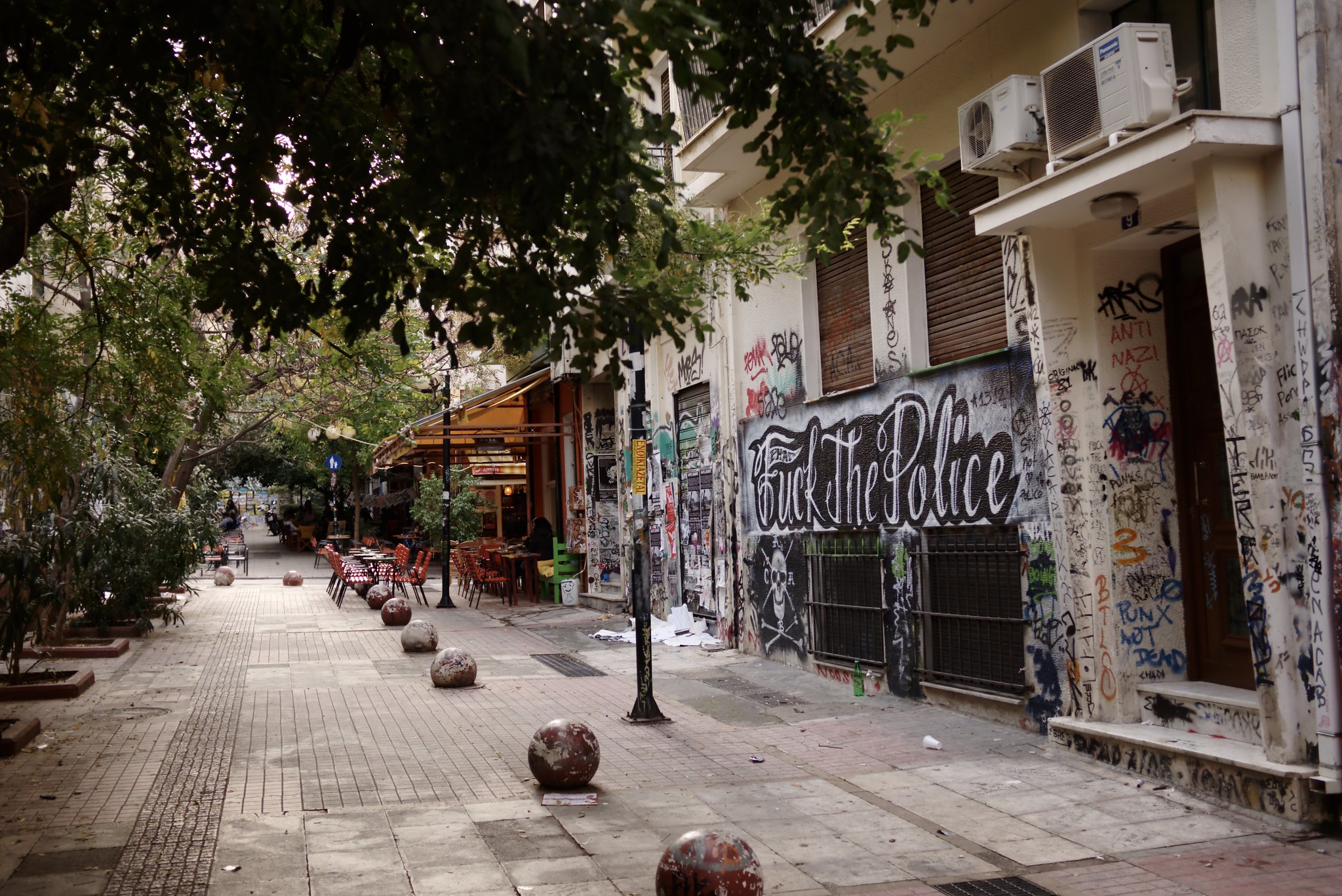
The Exarcheia neighborhood in Athens, Greece. Nicolas Vigier / flickr
In 2004, amid one of France’s many Islam-related controversies, anthropologist Emmanuel Terray published an article discussing the dispute over the headscarf as an instance of political “hysteria,” a concept borrowed from psychoanalysis. Drawing on Hungarian historian István Bibó’s explanation of the blindness and irrationality of interwar Central European politics, Terray discussed how real issues had been sidelined in favor of a “fictional problem” that, once “solved,” would supposedly allow the community to reaffirm its unity and “move on.”
This isn’t the only use of such a “fictional problem.” For to couch this kind of problem in the vocabulary of “crisis” or “danger” legitimizes all manner of excessive “responses.” Dire warnings, harsh “law and order” rhetoric, and the punitive stance adopted by the state’s repressive apparatuses all serve to create a sense of emergency. From this stems the state of exception that allows for the rights of particular individuals or social groups to be ditched.
After years of austerity, Greece is currently experiencing the effects of precisely this kind of political hysteria — one that targets a supposed “enemy within.” Indeed, as soon as a new right-wing government was elected in July 2019, a ferocious ideological rhetoric incessantly zoned in on the supposedly grave danger represented by a particular neighborhood in central Athens, renowned for its far-left and anarchist leanings. The target of this campaign was Exarcheia, a district of the capital associated with political dissent ever since the restoration of the republic in 1974.