When Colombia Caught Fire
Colombian politics have long been dominated by strongmen insisting on the need for “tough security measures.” But right now, with strikes and demonstrations gripping the country, it’s Colombia's hard-right government overseeing atrocities — not the guerrilla insurgents.
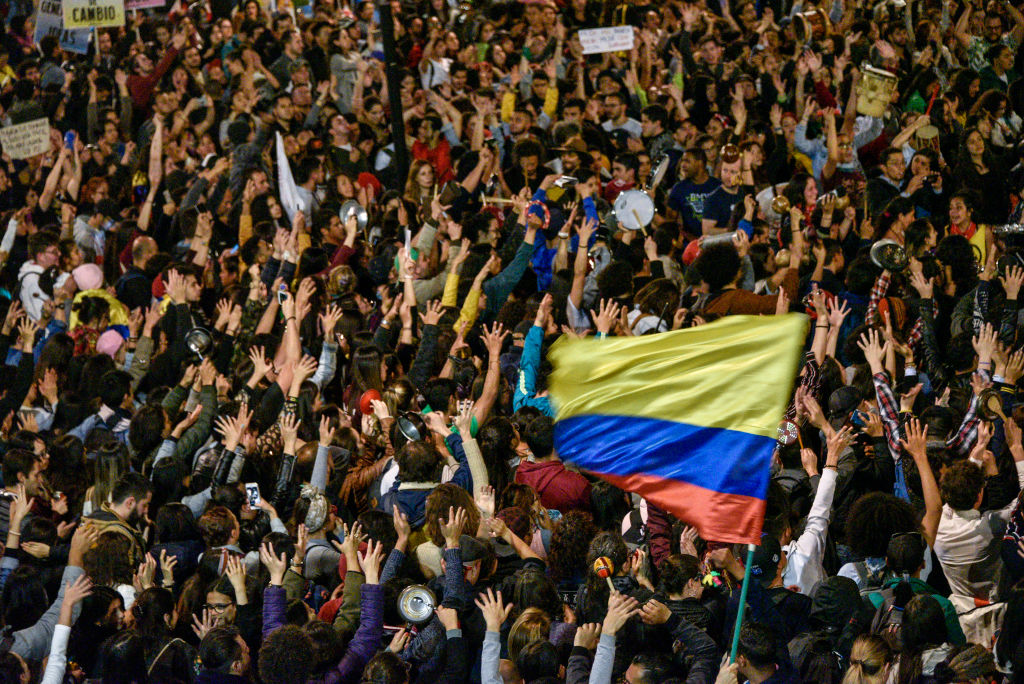
Demonstrators gather and make noise with pots while musicians perform at a square in North Bogotá during a protest against the government of Colombian president Iván Duque on November 28, 2019 in Bogotá, Colombia. Guillermo Legaria / Getty Images
Unlike their neighbors in other Latin American countries, Colombians aren’t used to taking to the streets. As people often say, Colombia isn’t Venezuela or Ecuador — or, indeed, Chile or Argentina. When there are protest marches, they don’t take on mass proportions — those in recent decades that enjoyed broad popular support can be counted on the fingers of one hand.
Yet all this abruptly changed on November 21. What began as a national strike call by the country’s trade union federations rapidly transformed into a generalized cry of protest — one able to rally together a large cross section of Colombians with a wide range of demands. What glued the demonstration together was a common feeling: “We’ve had enough.”
In a day that has already been called historic, marchers filled the streets of Colombia’s main cities. Images of placard-wielding protesters demanding change came from all four corners of the country. The mobilizations were mostly peaceful, though some individuals exploited the situation to attack bus depots and destroy shop fronts. But there was such emphatic support for the demonstrations that president Iván Duque had no option but to come out that same night and acknowledge the need for dialogue.