Tunisia’s “Second Revolution”
The independent law professor Kais Saied’s victory in the Tunisian presidential election saw voters punish the parties who have ruled the country since the Arab Spring. Yet if “anti-corruption” has become a rallying point for Tunisians, the deeper economic woes that drove the 2011 uprising remain unresolved.
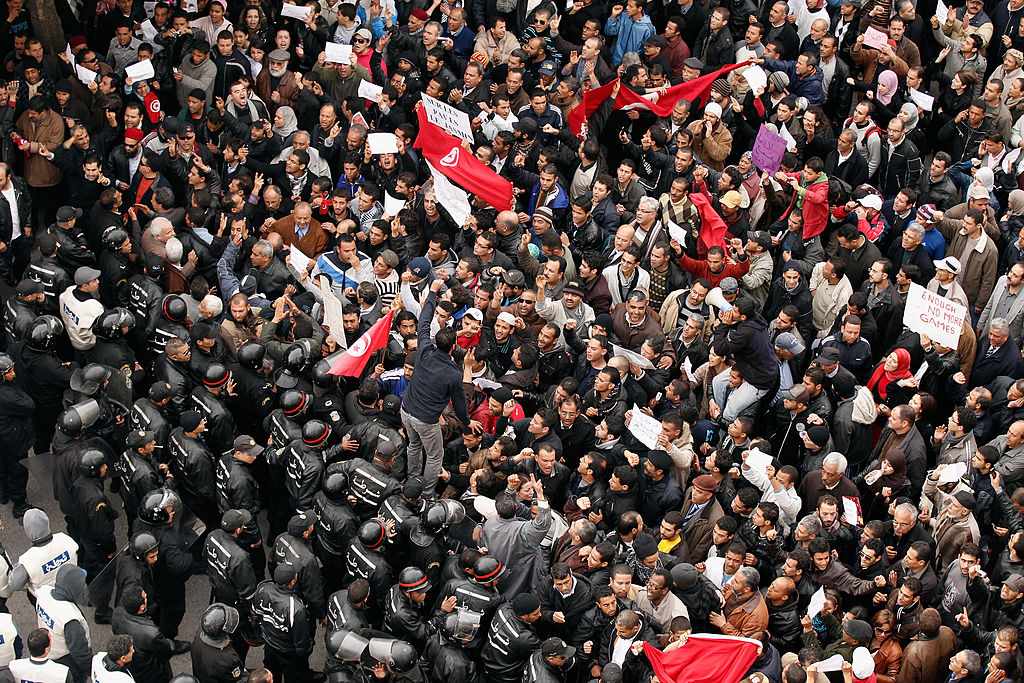
Tunisian police stop protestors along Avenue Bourghiba on January 20, 2011 in Tunis, Tunisia.Christopher Furlong / Getty
On Sunday, October 13, Tunisia held its second free presidential elections since the 2011 uprising that toppled ex-president Ben Ali and sparked the Arab Spring. Exit polls ahead of the official results on Wednesday pointed to a large victory for “anti-establishment” candidate Kais Saied, a constitutional lawyer. He won almost 73 percent of the vote on a 55 percent turnout, guaranteeing him a five-year term as head of state in Tunisia’s semi-presidential system. Remarkably, he built his campaign without the support of an established political party.
The peaceful transition from Ben Ali’s dictatorship after 2011 created space for organized forces in Tunisia, notably the Islamist party Ennahdha, as well as the drafting of a new constitution in 2014. Yet if political pluralism boomed following the uprising, the economic realities for the ordinary Tunisian did not improve. Almost nine years since the street vendor Mohamed Bouazizi set himself on fire in protest at police harassment, unemployment stands at over 15 percent, wages are stagnant, GDP is down, and debt is up. Tens of thousands have fled the country in search of better prospects, many of them illegally.
In response to these woes, in 2017 Prime Minister Youssef Chahed declared a “total war against corruption,” increasingly viewed within Tunisia as the leading threat to the country’s democratization and the main obstacle to its economic prosperity. Soon leading to the arrest of several prominent businessmen, this initiative marked the start of a much broader campaign against nepotism, bribery, and abuse of power.