The Left Can Win in Portugal
Today, Portugal votes on whether to reelect a government influenced by the radical left — or else turn back toward the failed austerity policies of the neoliberal center.
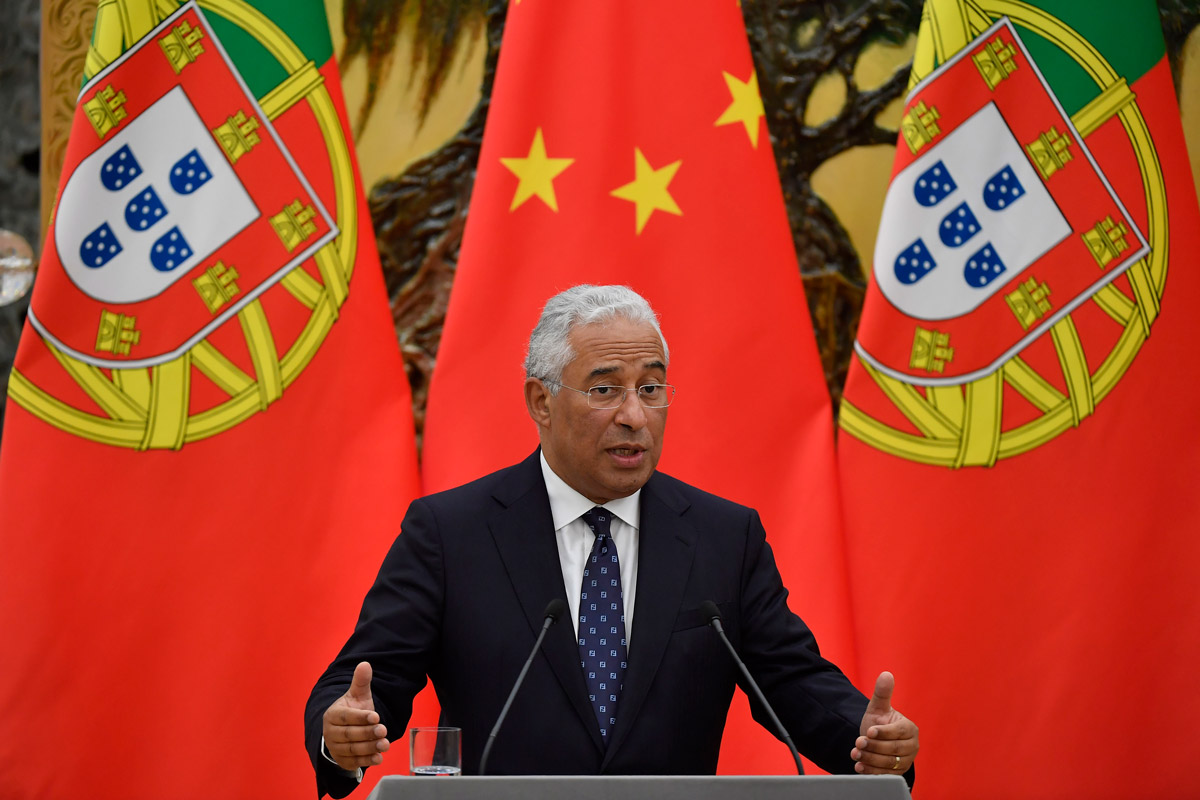
Portuguese prime minister António Costa speaks during a press conference on October 9, 2016 in Beijing, China. (Naohiko Hatta / Getty Images)
On November 6, 1975, Portugal’s public broadcaster RTP hosted an unprecedented debate between the leaders of the two main parties of the Left, the Socialists (PS) and the Communists (PCP). Eighteen months into the revolutionary process that had begun on April 25, 1974, PS general secretary Mário Soares and his Marxist-Leninist counterpart Álvaro Cunhal spent almost four hours debating the nature of socialism and its applicability — and limitations — in Portugal. Their televised discussion is remarkable not only for the dexterity of the two participants’ arguments, but for the relevance of their theme today.
This Sunday’s election is not only a matter of debates within the Left — there is, after all, a variety of center- to far-right parties on offer. After the conservative PSD implemented one of the most brutal austerity programs in Portuguese history from 2011 to 2015, it has undergone a sort of Pasokification, seeing its base wither much like the center-left party that helped impose austerity in Greece in this same period. But for those who don’t think socialism is some sort of goblin lurking around in the hope of eating Portugal’s children, the question is what comes next for the so-called geringonça.
Geringonça — literally, “contraption” — refers to the governmental agreement struck between the PS, the PCP, and the anticapitalist Left Bloc (BE) following the 2015 general election. That vote originally handed victory to a coalition between the PSD and the Christian-Democratic CDS-PP, but their minority government failed at the first hurdle. This prompted the second largest force, the PS, to meet with the leaderships of the PCP and the BE, in the name of cobbling together a program that could guarantee Portugal stable government. In return for these parties’ external support in parliament, the PS would introduce a series of anti-austerity measures long pushed by both the BE and the Communists.