Why Bernie Sanders Matters
The rationale for Bernie Sanders’s brand of politics has always been that it’s better to aim at shifting the basic parameters of American politics — however difficult that may be — than accepting those parameters and trying to maneuver within them.
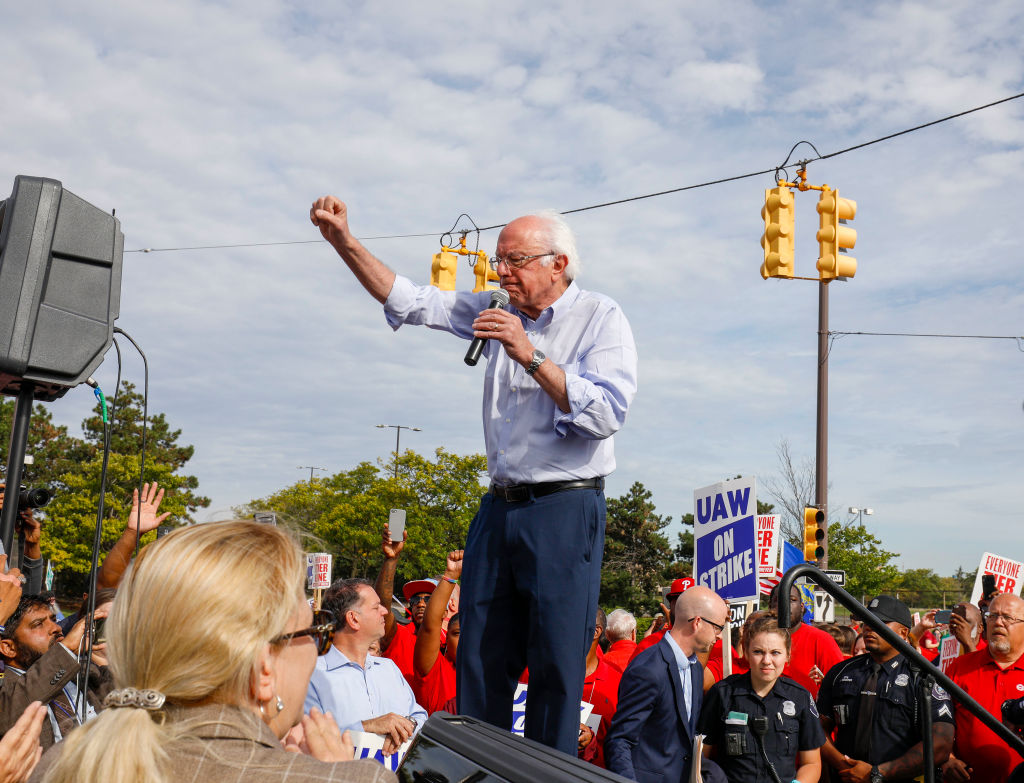
Democratic presidential candidate Bernie Sanders visits striking United Auto Workers union members as they picket at the General Motors Detroit-Hamtramck Assembly Plant on September 25, 2019 in Detroit, Michigan. (Bill Pugliano / Getty Images)
New York magazine’s Eric Levitz — probably the sharpest liberal political commentator writing today — has a few bones to pick with Jacobin writers on the subject of Bernie Sanders versus Elizabeth Warren.
The case for Warren as a force for progressivism, Levitz says, is stronger than we’ve allowed. Whatever differences exist between the two candidates will probably end up moot if their policies ever reach the floor of Congress anyway. Moreover, Levitz questions our conviction that Bernie Sanders has the potential to transform American politics in any real way — at least any more than Warren does. Given the country’s legislative stasis and its conservatizing political institutions, he argues, such optimism about any politician is ill-advised.
None of these points is completely wrong, and yet there’s something perverse about this two-and-a-half-cheers-for-Warren case. Somehow, the very fact that Sanders’s post-2016 ascent triggered a historically unprecedented leftward lurch in Democratic Party discourse — a development for which Elizabeth Warren’s rise is Exhibit A — is used to argue that Bernie Sanders has no particular monopoly on the ability to push American politics leftward.