Manners — Revolutionary and Bourgeois
It's easy to dismiss manners as simply markers of social hierarchy. But manners can perform an egalitarian, progressive function — and they're essential to any democratic organization.
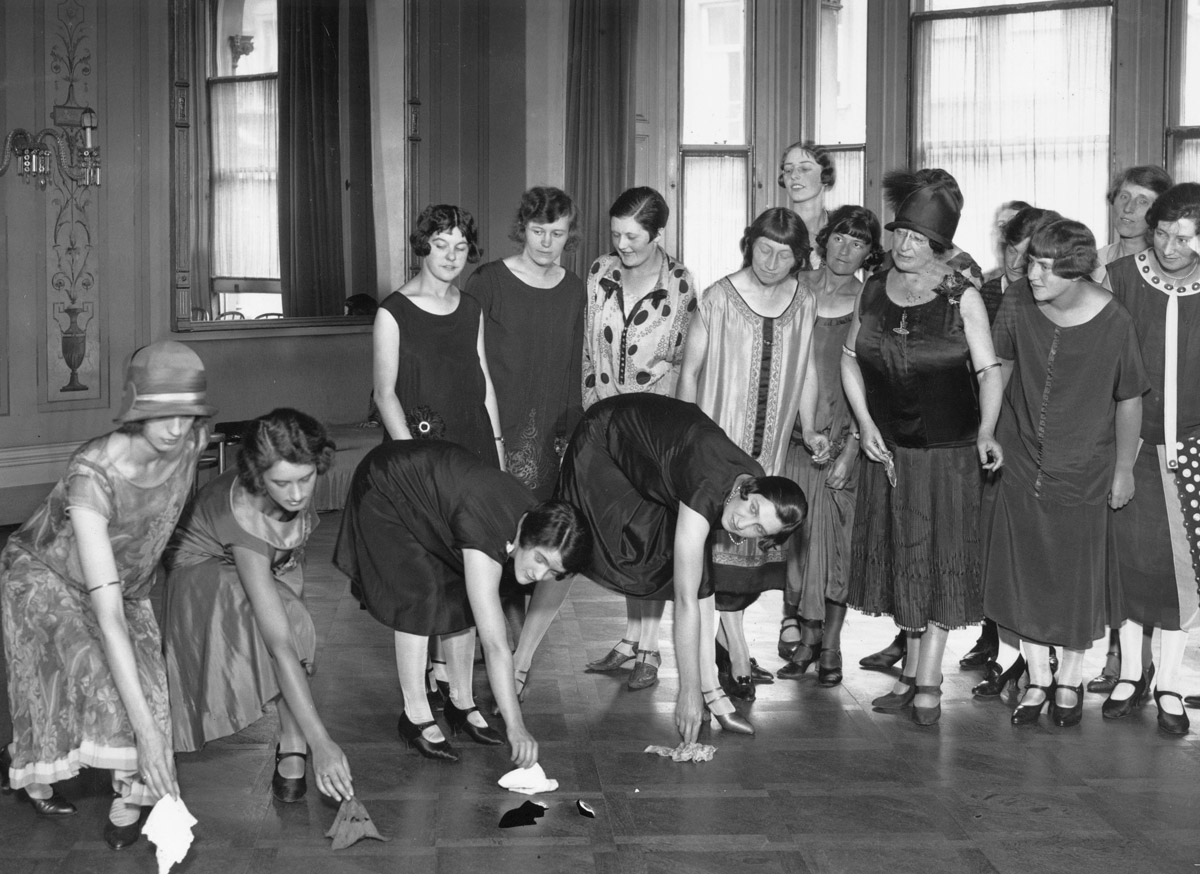
Young debutantes at a deportment school in Kensington, London are shown the correct and incorrect way to retrieve a handkerchief from the floor in this demonstration. (E Bacon / Hulton Archive / Getty Images)
In his discussion on cooperation in Volume 1 of Capital, Marx makes the following analytical distinction: “Just as the social productive power of labor that is developed by cooperation appears to be the productive power of capital, so cooperation itself, contrasted with the process of production carried out by isolated independent laborers, or even small employers, appears to be a specific form of the capitalist process of production.” The same distinction applies in the case of manners: manners involve rules of behavior whose content is shaped by the class nature and culture of specific societies, but like cooperation, they also play an indispensable function in contemporary society.
This was clearly understood by none other than Leon Trotsky, who aptly described manners as a “necessary lubricant in daily relations” in a humane and civil society. Writing at length on the issue in the pages of Pravda, the principal and then widely read Communist Party newspaper, he argued that manners were an essential part of a larger enlightenment project that he, along with Soviet leaders like Vladimir Lenin, Krupskaya (Lenin’s wife), and Anatoly Lunacharsky (People’s Commissar for Education), undertook to transform Russia’s prerevolutionary culture, rooted in peasant servitude and aristocratic privilege, in a rational and humanist direction.
For the US left today, manners should be seen as one element of a broader vision of humane social interaction, as well as an immediate consideration in political organizing. Because manners are the oil that smooth relationships within organizations, they play an important role in the democratic functioning of the Left — fostering the mutual respect and consideration that members owe each other, and that leaders owe the rank and file.