The Student Movement Standing up to the Honduran Regime
It’s been ten years since a US-backed coup installed a repressive neoliberal regime in Honduras. Now, a student movement has emerged to challenge the government’s agenda of privatization and militarization.
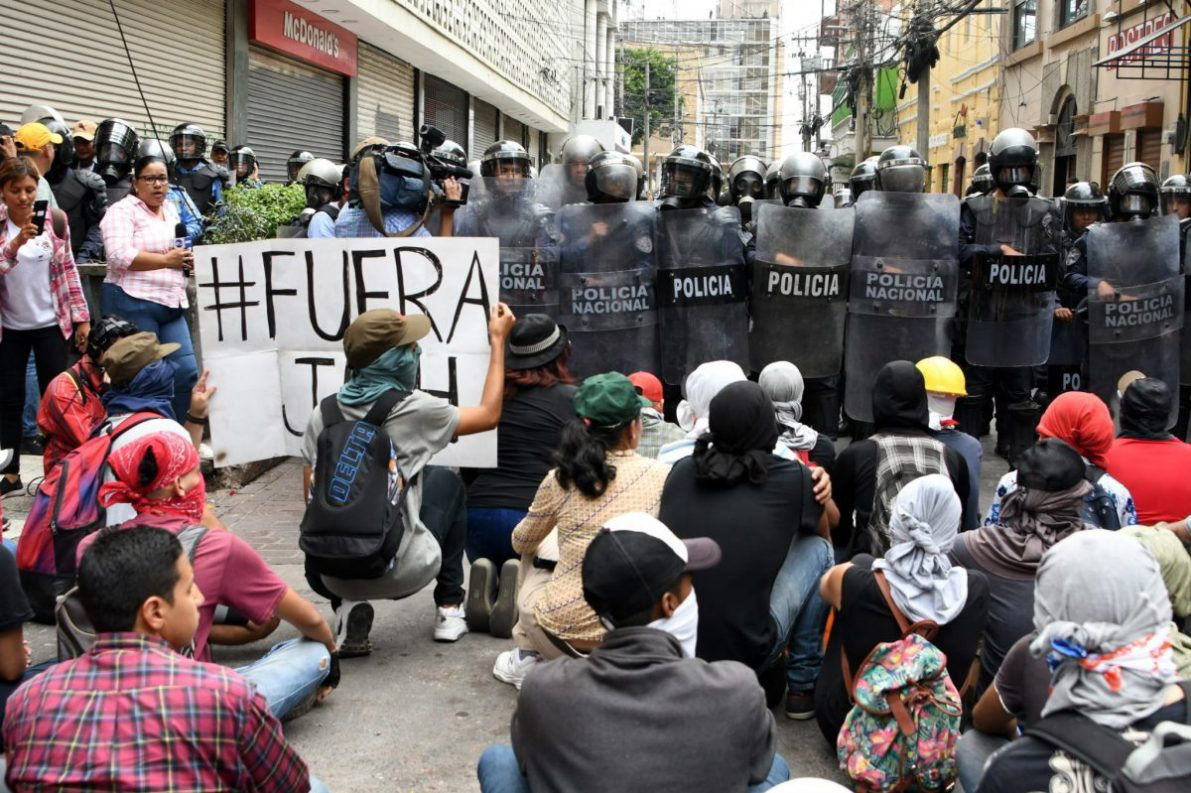
Students protest in front of a line of riot police outside the Congress building in Tegucigalpa on April 30, 2019. (Orlando Sierra / AFP / Getty Images)
Ten years have passed since the democratically elected center-right president of Honduras, Manuel Zelaya, was removed in a military coup. On the same day of a referendum to create a National Constituent Assembly that sought to rewrite the military dictatorship’s 1982 Constitution, Zelaya was whisked away to Costa Rica still in his pajamas. Observers across Latin America, watching nervously to see how President Obama would respond to his first real foreign policy test in the region, quickly had their hopes for a shift in US policy crushed. Obama and Secretary of State Hillary Clinton were quick to legitimize the coup and call for new elections that in Clinton’s words would “render the question of Zelaya moot.”
Clinton has defended the US role in the coup by arguing that to declare it a “coup” would have forced the United States to cut off all aid to the country, ultimately hurting the Honduran people. Yet since then, Washington has found no shortage of alternative ways to hurt the Honduran people, who have watched their country turn into one of the most violent and dangerous in the world.
The current status quo in Honduras is reminiscent of the days of US-backed death squads during the 1970s and ’80s Central American civil wars. Since the coup, a right-wing dictatorship — maintained through an alliance between the military, landowning elites, and the media — has increased ties with the United States while drastically militarizing the country. In July 2013, the regime created the Intelligence Troop and Special Security Group. The next month in August, with a quick amendment to the Constitution to avoid the prohibition on military participation in policing, the Military Police was created. Even the DEA has entered the scene, through its Foreign-deployed Advisory Support Team (FAST) which is now conducting operations in the country.