Democracy Is a Puzzle
Democracy is about the struggle for a more equitable world — but it’s also about grappling with the messy, contingent questions that will always confront humanity.
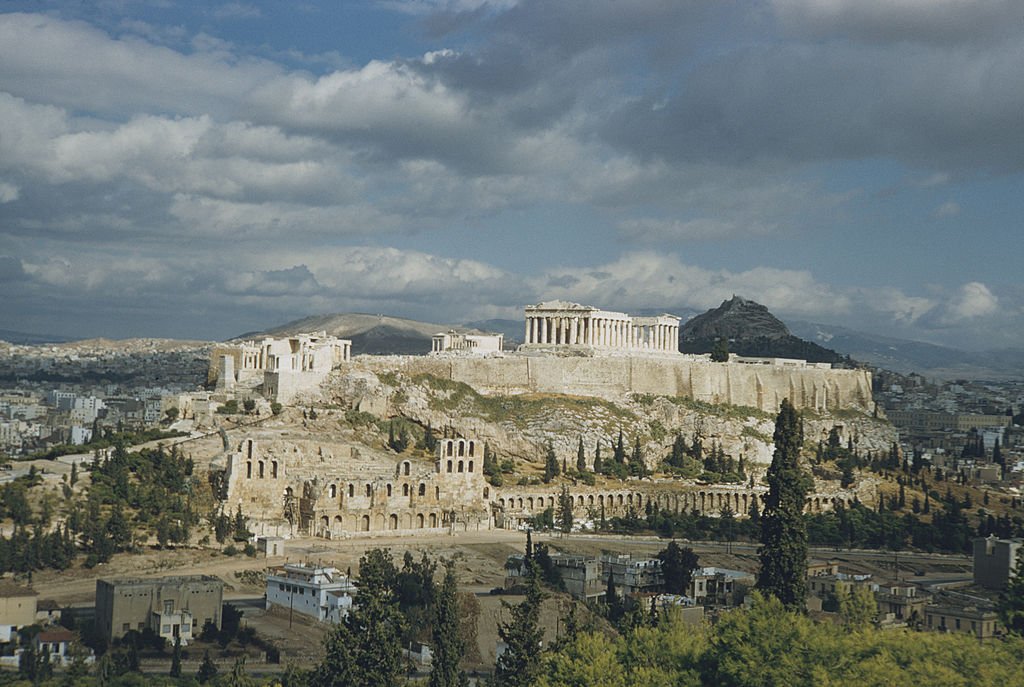
The Acropolis in Athens, Greece, with the Parthenon in the center, and the Odeon of Herodes Atticus at the foot, circa 1960.J. Russell Gilman / Archive Photos / Getty
Imagine if one day soon a wealthy capitalist country chooses to end all immigration, or all immigration except for the rich or for people from particular parts of the world. Imagine the decision is the result of a referendum, and the overwhelming majority of citizens support it. Could we call the outcome “democratic”? If not, why not? If so, what then? What would that mean for a principled commitment to democracy?
We don’t have clear answers to these questions. They pull us in several directions at once: to speak only for myself, I don’t want that to be democracy, but it is hard to say it’s not. And if that is indeed democracy, then am I opposed to it? Sometimes, I suppose I am — but can one be committed to democracy only some of the time? That doesn’t seem right either.
These are the puzzles, the “tension of paradoxes unresolved and arguably irresolvable” that animate Astra Taylor’s fine and valuable Democracy May Not Exist, But We’ll Miss It When It’s Gone. The book is an expansive and generous look at the complexities, contradictions even, that no honest reflection on progressive politics can set aside. It is structured by a series of binaries at the heart of “democracy” — conflict/consensus, inclusion/exclusion, or expertise/mass opinion, for example. Drawing on everything from political theory to stories to interviews, Taylor shows how the struggle for democracy must always engage with both sides of each pair, and that this inevitably means the answers to a lot of important questions are not straightforward. Things get messy, unclear, and they change all the time.