US Workers Are Paying High Taxes. But Without Any of the Benefits.
The United States is commonly thought of as a low-tax country. But workers effectively pay some of the highest taxes in the developed world — without getting a decent welfare state in return.
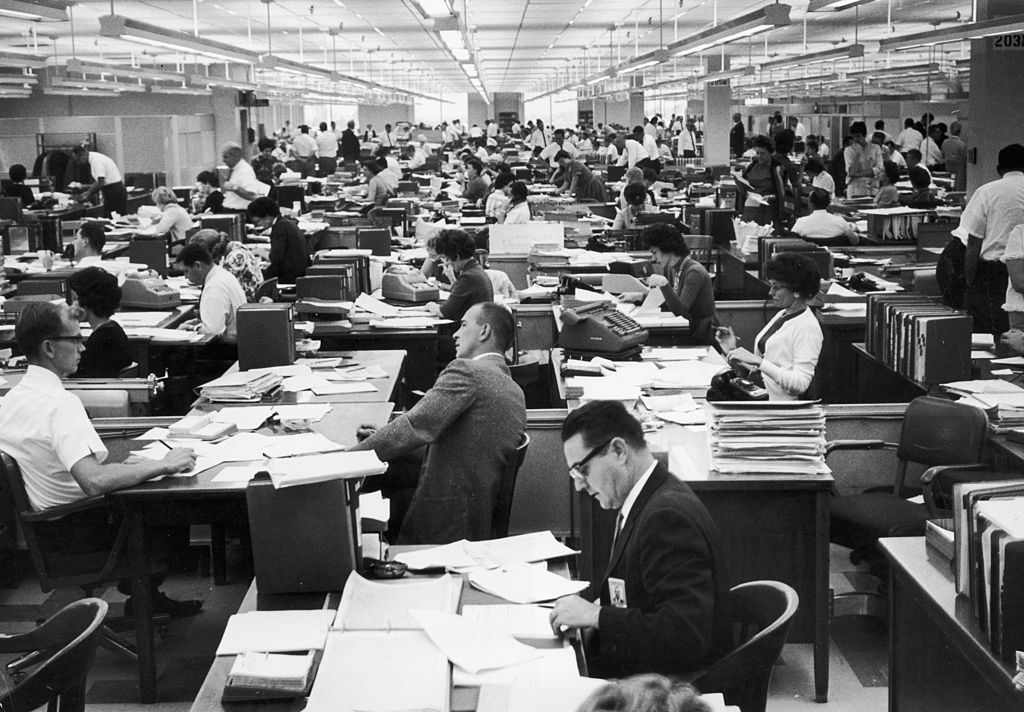
An office with employees sitting at their desks at Rocketdyne, a division of North American Aviation at Canoga Park, California, November 13, 1963.Hulton Archive / Getty
Comparing labor tax rates across countries is a tricky endeavor. Some countries rely mostly on income and payroll taxes charged to workers, others on payroll taxes charged to employers, and still others on compelling workers and employers to pay private parties who provide pension and health insurance products. To get an apples-to-apples comparison, you have to normalize all of these various schemes into a single labor tax concept that actually reflects just how much labor compensation is being put towards compulsory payments of one sort or another.
The OECD produces a number of Taxing Wages publications each year that permit this sort of cross-country comparison. Most of these publications focus on converting formal labor taxes into a standardized format that allows researchers to calculate comparable “labor tax wedges” across the various tax schemes.
But formal labor taxes are limited because they omit “non-tax compulsory payments” (NTCPs). NTCPs are payments workers and employers are legally compelled to pay to private parties. NTCPs are no different from taxes except that NTCPs are made to private corporations like health insurance companies rather than to the government.