1919: The Year the World Was on Fire
One hundred years ago was a time of revolution. Emma Goldman, John Reed, and Bill Haywood were at the center of it all.
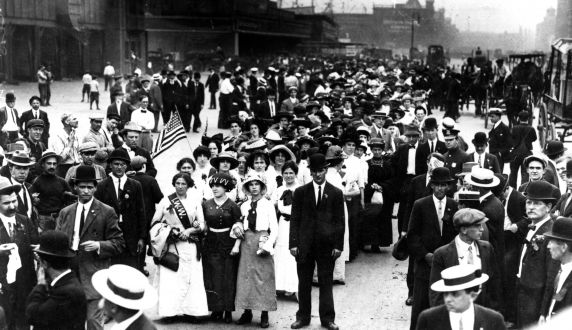
Industrial Workers of the World parading ahead of the “Paterson Pageant” at New York City’s Madison Square Garden. The pageant, a recreation of the events of the Patterson, New Jersey, silk workers strike, was the brainchild of John Reed, Bill Haywood, and Emma Goldman.
“The world is on fire,” Woodrow Wilson told his personal physician attending to him in Versailles as he attempted to negotiate a treaty to end World War I. Across the Irish sea, William Butler Yeats was composing lines that still resonate: “Things fall apart, the center cannot hold;/ Mere anarchy is loosed upon the world,/ The blood-dimmed tide is loosed, and everywhere/ The ceremony of innocence is drowned/ The best lose all conviction, while the worst/Are full of passionate intensity.”
Emma Goldman, the world’s most celebrated anarcho-feminist, was in jail in New York, charged with sedition. Big Bill Haywood, the super-hero of American labor syndicalism, was in and out of jail in Chicago on multiple counts of criminal syndicalism, espionage, and sedition. John Reed, the adventuring radical writer whose Ten Days That Shook the World about the Bolshevik Revolution thrilled millions (Goldman among them) was in transit between Finland and the just-born Soviet Union, certain to be jailed should he return to the United States.
All three would soon find themselves in Petrograd, where the fire that so worried President Wilson had first ignited.