Liberalism in Theory and Practice
Contemporary liberals are temperamentally conservative — and what they want to conserve is a morally bankrupt political order.
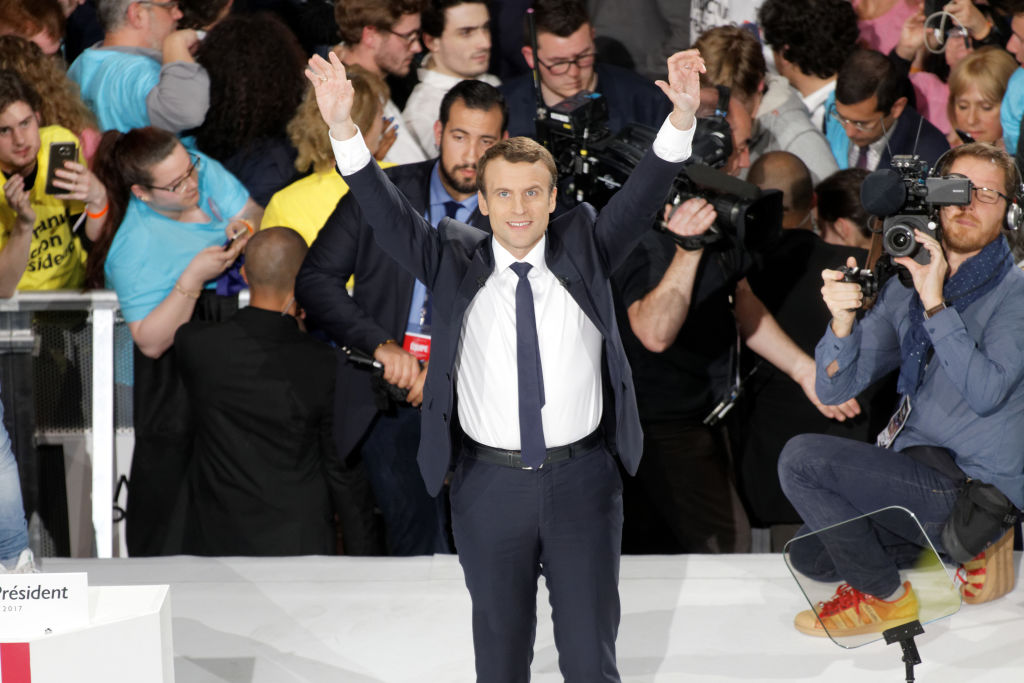
Emmanuel Macron waves as he arrives on stage to delivers a speech during a campaign rally at Bercy Arena on April 17, 2017 in Paris. Sylvain Lefevre / Getty
“In political activity . . . men sail a boundless and bottomless sea; there is neither harbour for shelter nor floor for anchorage, neither starting-place nor appointed destination. The enterprise is to keep afloat on an even keel.”
―Michael Oakeshott
Probably no one of my generation and background will forget where they were on the evening of November 4, 2008. Outside my then-residence at the University of Toronto, people streamed into the quad with tears running down their faces. It was a moment like no other I have experienced. The seemingly impossible had happened: Barack Obama had been elected president of the United States. Within minutes of CNN projecting the result, a collective feeling that was equal parts euphoria and disbelief seemed to burst forth all over. It took weeks, maybe even months, to dissipate.
The election of Barack Obama certainly isn’t my first political memory, but it may well have been my first really formative one. As embarrassing as it is to write more than a decade later, I’ll readily admit to having been swallowed up in the excitement and emotionally sold on the romantic promise of “Change We Can Believe In.” It offered a compelling narrative incorporating everything my political imagination craved at the time: an image of progress as I then understood it; a charismatic leader to take us out of the darkness and into the promised land; the negation of the hated Bush presidency and all it stood for, from the reign of the Christian Right and its dimwitted rubes to the evils of Fallujah and Abu Ghraib. I wasn’t even American, but Obama’s victory still felt like a moment of grand, even historic, affirmation.