Latin America’s Re-Militarization
Even before Jair Bolsonaro's rise, Latin America's militaries had been regaining power through the court system.
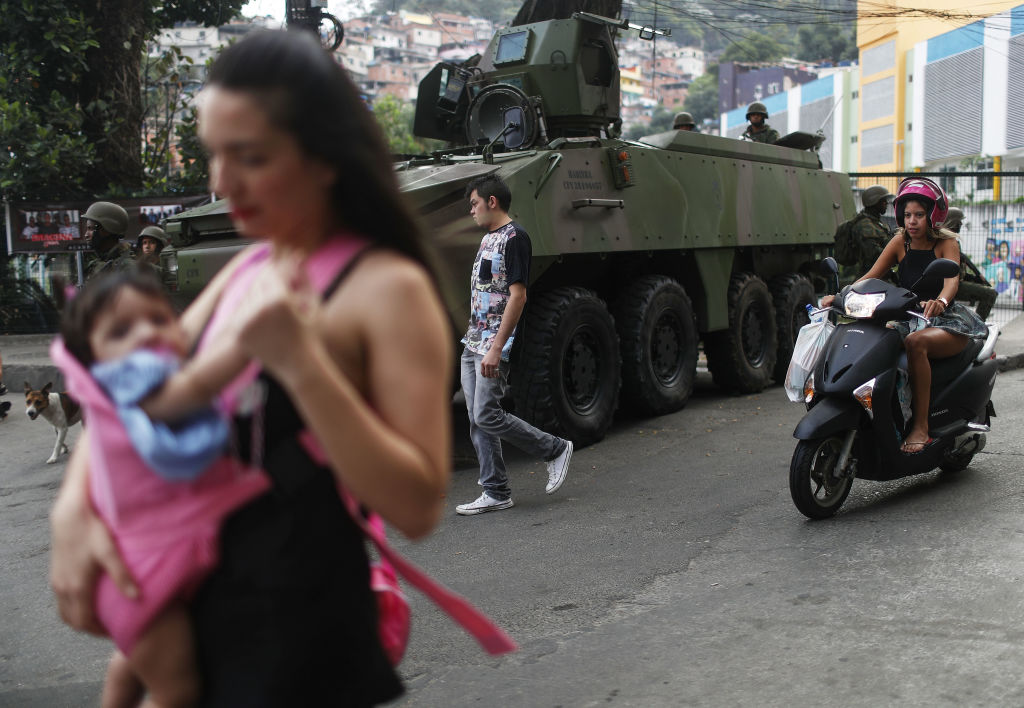
People walk and drive past an armored military vehicle in the Rocinha favela community on September 24, 2017 in Rio de Janeiro, Brazil. Mario Tama / Getty Images
On November 11, 2017, eight civilians were killed in a joint police and army security operation carried out in São Gonçalo, Brazil. Survivors and witnesses reported seeing special forces, dressed in black with laser-scoped rifles, being deployed by helicopter and shooting from a wooded area. The military, however, has refused to investigate the case or cooperate with civilian authorities. Thanks to a new law passed the previous month, it has the legal right to do so.
Law No. 13.491, passed by the Brazilian Congress in October 2017, gives military courts jurisdiction over their personnel accused of human rights violations. Prior to the law’s approval, the Ministry of Defense publicly made the case that allowing civilian courts to handle such cases would hinder policing operations. Michel Temer’s administration increasingly used the armed forces for domestic policing duties, whether in rural areas against land rights activists or in the favelas and peripheries of major cities.