Labour’s Socialist Realism
A new book of essays edited by UK Shadow Chancellor John McDonnell makes the case for economic democracy and charts the increasingly transformative thinking of Corbyn's Labour Party.
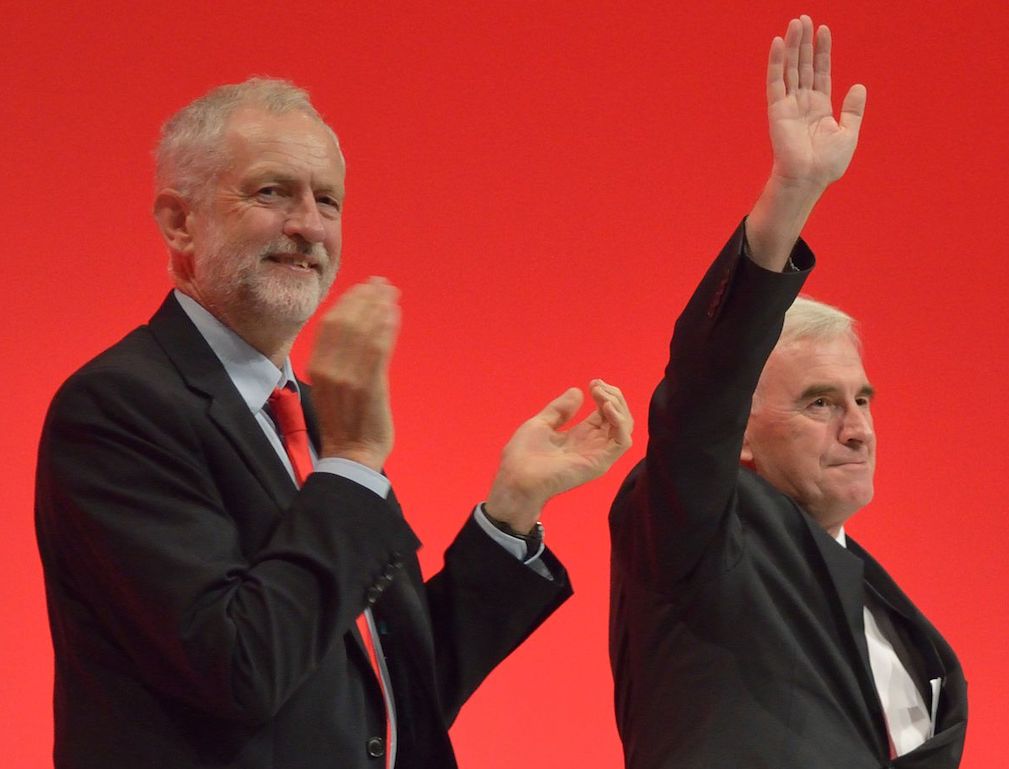
Jeremy Corbyn and John McDonnell, after McDonnell gave his Shadow Chancellor of the Exchequer speech, at the 2016 Labour Party Conference in Liverpool. Rwendland / Wikimedia.
“ . . . A New Britain where the extraordinary talent of the British people is liberated from the forces of conservatism that so long have held them back, to create a model 21st century nation, based not on privilege, class or background, but on the equal worth of all. And New Labour, confident at having modernized itself, now the new progressive force in British politics which can modernize the nation, sweep away those forces of conservatism to set the people free.” – Tony Blair, 1999
“Economics are the method: the object is to change the soul.” – Margaret Thatcher, 1981
Though they didn’t know it at the time, those who observed Britain’s 1979 general election and the Labour Party’s defeat were witnessing far more than a simple change of government. The Thatcherite ascendency that followed would not only reconfigure the institutions of the British state but establish — through a combination of luck, guile, and brute force — an entirely new political consensus that would consciously reshape British society in the process. By the time Labour returned to power nearly two decades later, a wholesale ideological counterrevolution was underway and its own leaders were among its most zealous partisans.
Perhaps no other European country in the postwar era (with the possible exception of Russia) has experienced a comparably drastic ideological shift, and certainly no working class has suffered such bitter repression and defeat in such a short time. After 1990, much of the global left faced a period of retrenchment but Britain’s political sclerosis, and the widespread sense of defeat it engendered, was particularly acute.