France’s Changing Climate
- David Broder
Last year, French president Emmanuel Macron gave liberalism a hip young face. Now the golden boy’s shine has started to come off.
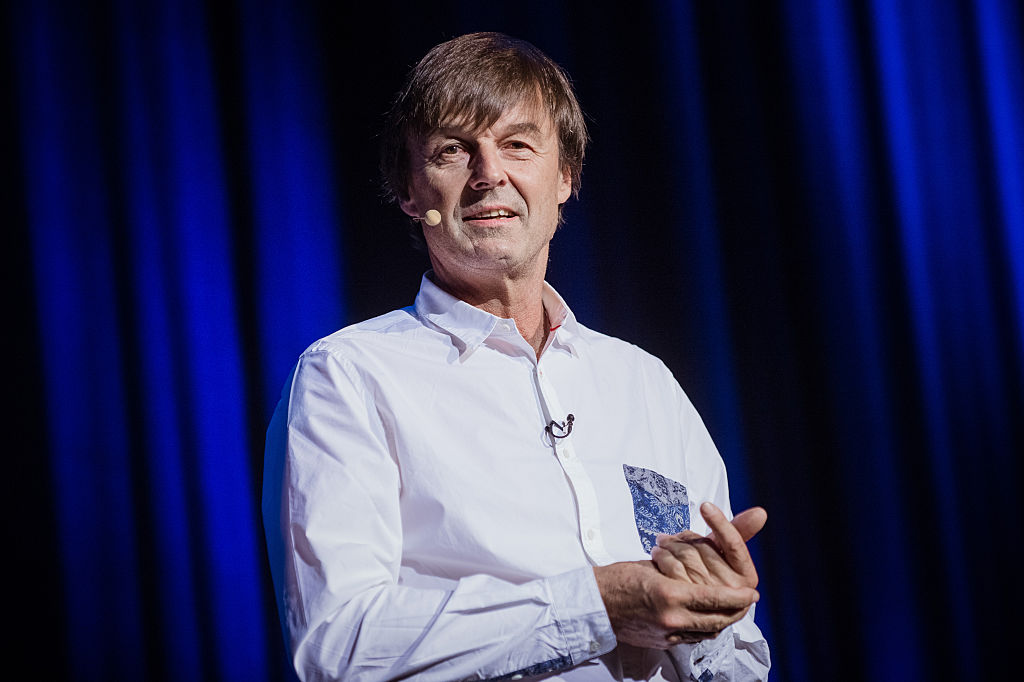
Nicolas Hulot attends the “Act For Climate” event at L’Olympia on December 7, 2015 in Paris, France.Francois Durand /Getty
The news came like a thunderbolt. When the Minister for an Ecological Transition quit the government on Tuesday, it sparked an electric shock in Macronland, where Nicolas Hulot had been the only guarantor of environmentalist concerns. The minister surprised everyone, perhaps even himself, when he announced live to France Inter listeners that he had decided to hand in his notice. He said he had made the decision because he did not want to “become cynical,” because he did not want to “water down what he was demanding.” Because he didn’t believe in this government any more.
The environmentalist leader spelled out the reasons for his failure, the government’s failure, the whole society’s failure. He criticized the government’s inability to break out of an imaginary that belongs to the time before global warming, and decision-making mechanisms, constrained by powerful lobbies, that are dictated by firefighting the latest news stories.
There has, indeed, been a series of retreats. In 2017 Macron promised to uphold the previous government’s plans to cut France’s uniquely high reliance on nuclear power, but after he reached office this goal was pitched a decade into the future. In May, Hulot’s proposals to ban glyphosate weed-killers were voted down by parliament, even though Macron’s party holds a sizable majority of seats. The herbicides, notably used in Monsanto’s product Roundup, have been branded carcinogenic; supporters of the ban blamed chemicals and agricultural lobbies for sinking the reform. Plans to ban certain pesticides dangerous to public health and wildlife have also been significantly watered down — with the minister Hulot forced to defend the government.