Emmanuel Macron Goes to Church
France’s neoliberal golden boy is now flirting with religious identity politics.
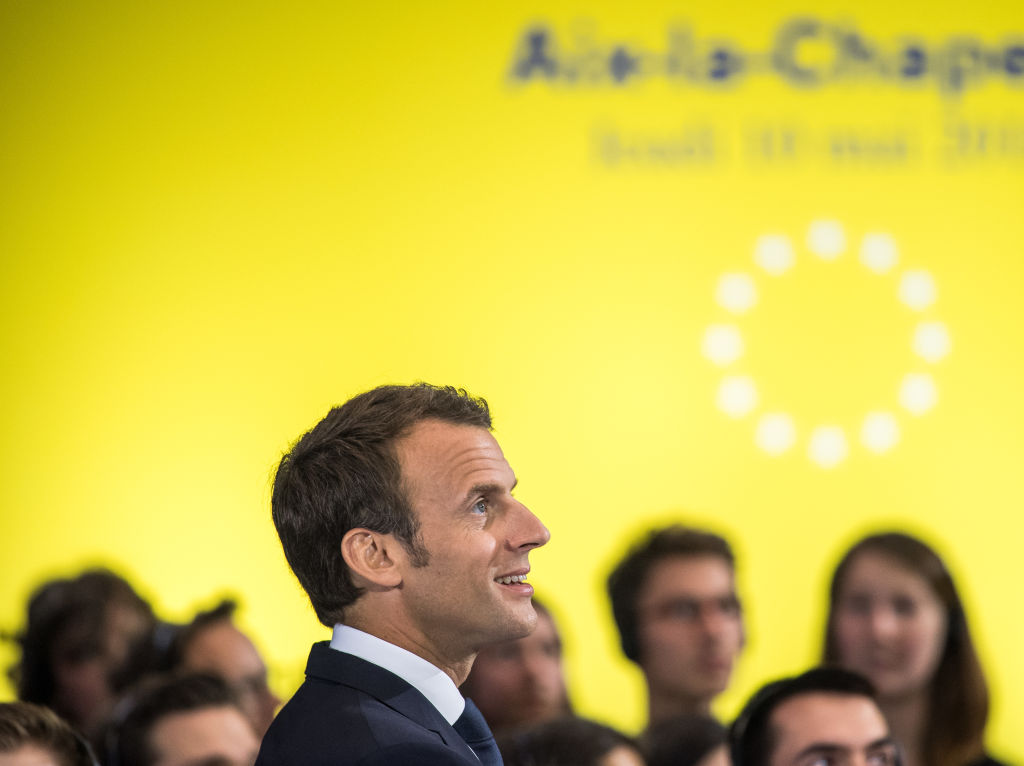
French President Emmanuel Macron at RWTH Aachen University on May 10, 2018 in Aachen, Germany.Lukas Schulze / Getty
Until recently, Emmanuel Macron has had little to say about laïcité, as the legal separation between religion and state as well as the broader culture of secularism and anticlericalism is known in France. Notoriously hard to pin down as a candidate in last year’s presidential election, he likely saw little benefit in stating a position on a subject that has been increasingly polemicized in recent years. Over the course of his presidency, Macron has mostly delegated speaking about laïcité to Marlène Schiappa, the state secretary in charge of issues of gender equality, as well as to his education minister Jean-Michel Blanquer. While these members of his government have more or less supported what some call a “strict” approach to secularism, Macron himself has occasionally hinted at a different approach, in one instance warning against a “radicalization of laïcité.” In his trademark spirit of sending contradictory messages “at the same time,” Macron’s early months in office gave both secularists and their critics something to hate.
This past April, however, Macron made the controversial move of accepting an invitation to speak at the annual conference of the bishops of France. In a country with a long tradition of militant anticlerical struggle, the fact that the president would even get in a room with the Catholic Church’s top clergymen was enough to rouse some secularists’ worries that Macron’s commitment to laïcité was less than solid. Minutes into his speech, the young president seemed to confirm these worries, announcing to the bishops that “the link between the church and the state has become strained, and it is up to us to repair it.”
Macron went on to suggest a role for religion — and the Catholic faith in particular — in his political program. One might have thought that a president so often portrayed as the champion of a progressive liberal center would have little use for the church. But a year into his presidency, as the French public has increasingly come to view him as a right-winger, Macron articulated a surprisingly explicit connection between his neoliberal reform agenda and Catholic religious identity.