The Continuity of Khan
Corruption and military might have long dominated Pakistani politics. And Imran Khan's reform-minded rhetoric is unlikely to change that.
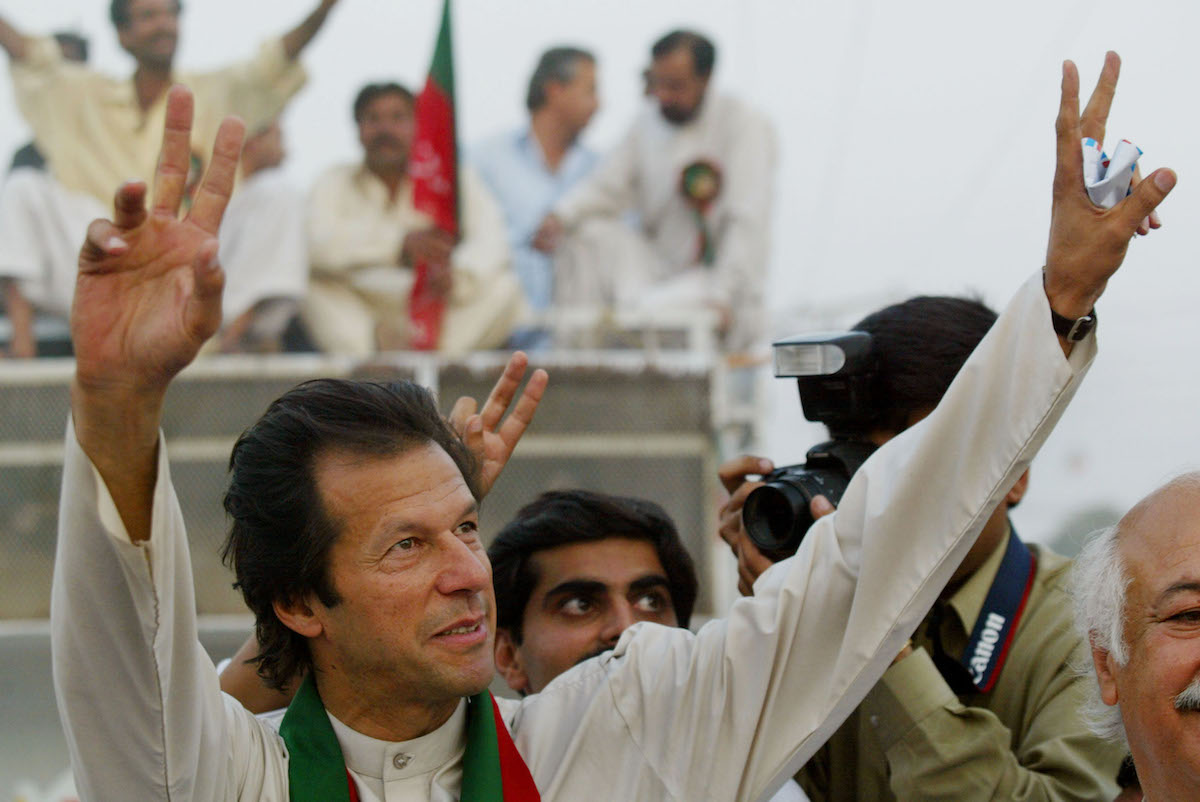
Imran Khan, cricket captain turned politician, waves to supporters during a rally, October 8, 2002 in Shadi Khal, Pakistan. Paula Bronstein / Getty
Some time ago, a Pakistani political party gained at the expense of the Pakistan Army. The year was 1971. The army had suffered a humiliating defeat at the hands of India in East Pakistan (now Bangladesh). With the Army disgraced, the Pakistan Peoples Party (PPP) — a self-proclaimed Islamic socialist party — rose to power. The state news channel telecast the surrender of Pakistani forces, further embarrassing the army.
Six years later, the PPP’s leader, Zulfikar Ali Bhutto, called an early election. It was a contest that the PPP was guaranteed to win — less because of the party itself, which had lost support among the urban middle and business classes (as well as leftists purged from the party), and more because the opposition seemed to pose no threat.
Bhutto was right. The PPP did win an absolute majority in the National Assembly. But he had still miscalculated. The opposition parties — a motley group of Islamist, pro-business, and Baloch nationalist forces — had allied and run under the banner of the Pakistan National Alliance (PNA), calling for an end to anti-Islamic practices and corruption. Soon after the results were announced, the PNA alleged mass rigging, rejected the elections, and called for a new contest under the supervision of the army. Protests swept the country, and the army — after some nudging from the United States — carried out another of its seamless coups.