Counter-Hegemonic Struggles
Socialists believe not only that capitalism is an oppressive, undemocratic system, but that there's a viable, humane alternative.
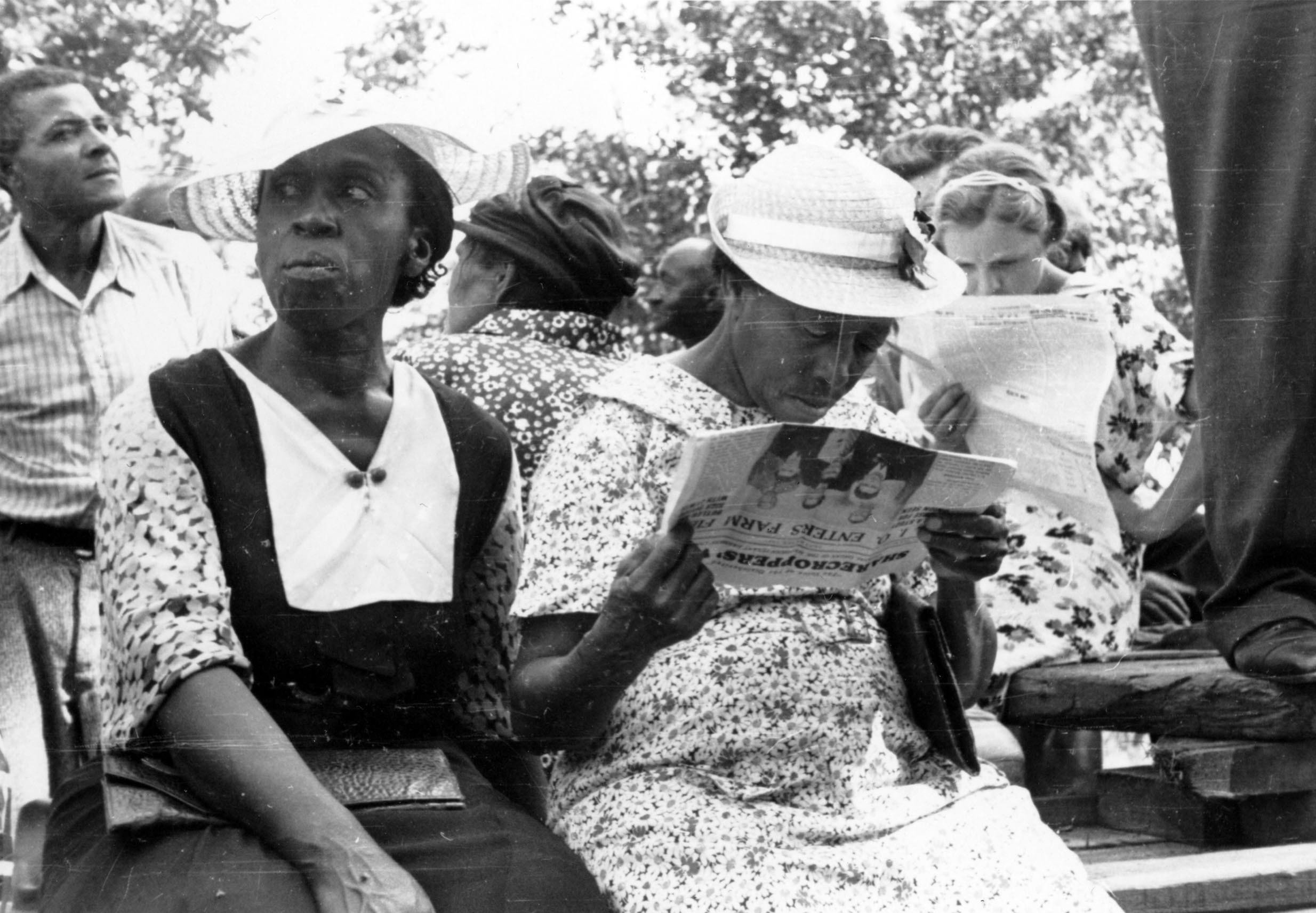
A woman reading the Sharecroppers’ Voice during an outdoor meeting of the Southern Tenant Farmers’ Union in Arkansas in 1937. Kheel Center / Flickr
Hegemony, in Gramsci’s meaning of the term, involves both coercion and consent. As consent, it means the capacity of dominant classes to persuade subordinate ones to accept, adopt, and “interiorize” the values and norms which dominant classes themselves have adopted and believe to be right and proper. This might be described as the strong meaning of hegemony-as-consent. A weaker version is the capacity of dominant classes to persuade subordinate classes that, whatever they might think of the prevailing social order, and however alienated they might be from it, any alternative would be catastrophically worse, and that in any case there was nothing much that they could do to bring about any such alternative. Weaker though this second version might be, it is not much less effective than the first one in consolidating the social order. In either version, however, hegemony is not something that can ever be taken to be finally and irreversibly won: on the contrary, it is something that needs to be constantly nurtured, defended, and reformulated.
The dominant classes of capitalist-democratic regimes understand this very well, and do not take hegemony for granted. The whole history of these regimes, since the achievement of an extended suffrage, the creation of national working-class movements, and serious political competition between bourgeois and labor or socialist parties, has been marked by a determined “engineering of consent” on the part of conservative forces, and by their fierce striving to win the hearts and minds of their subordinate populations. The sources of these struggles have been extremely varied, and their forms have ranged from the most sophisticated and subtle to the most stridently demagogic. The purpose, however, is always the popular ratification of the prevailing social order, and the rejection by the working class (and everybody else) of any notion that there could be a radical and viable alternative to that order. This purpose, it should be added, is also served by real concessions to pressure from below, notably in the realm of welfare services: it would be a great mistake to take hegemony-as-consent to be purely a matter of mystification.
Be that as it may, the main reason why the struggle for hegemony-as-consent can never be taken to be finally won in capitalist-democratic regimes is that there exists a vast discrepancy between the message which hegemonic endeavors seek to disseminate, and the actual reality which daily confronts the vast majority of the population for whom the message is mainly intended. The message speaks of democracy, equality, opportunity, prosperity, security, community, common interests, justice, fairness, etc. The reality, on the other hand, as lived by the majority, is very different, and includes the experience of exploitation, domination, great inequalities in all spheres of life, material constraints of all kinds, and very often great spiritual want. Reality may not be conceived and articulated in these precise terms, but it is nevertheless adversely felt, and produces frustration, alienation, anger, dissent, and pressure from below for the resolution of grievances. A crucial purpose of hegemonic endeavors is to prevent such sentiments from turning into a generalized availability to radical thoughts.