Beyond Social Democracy
It is precisely social democracy's history that shows why we need a more radical socialist politics today.
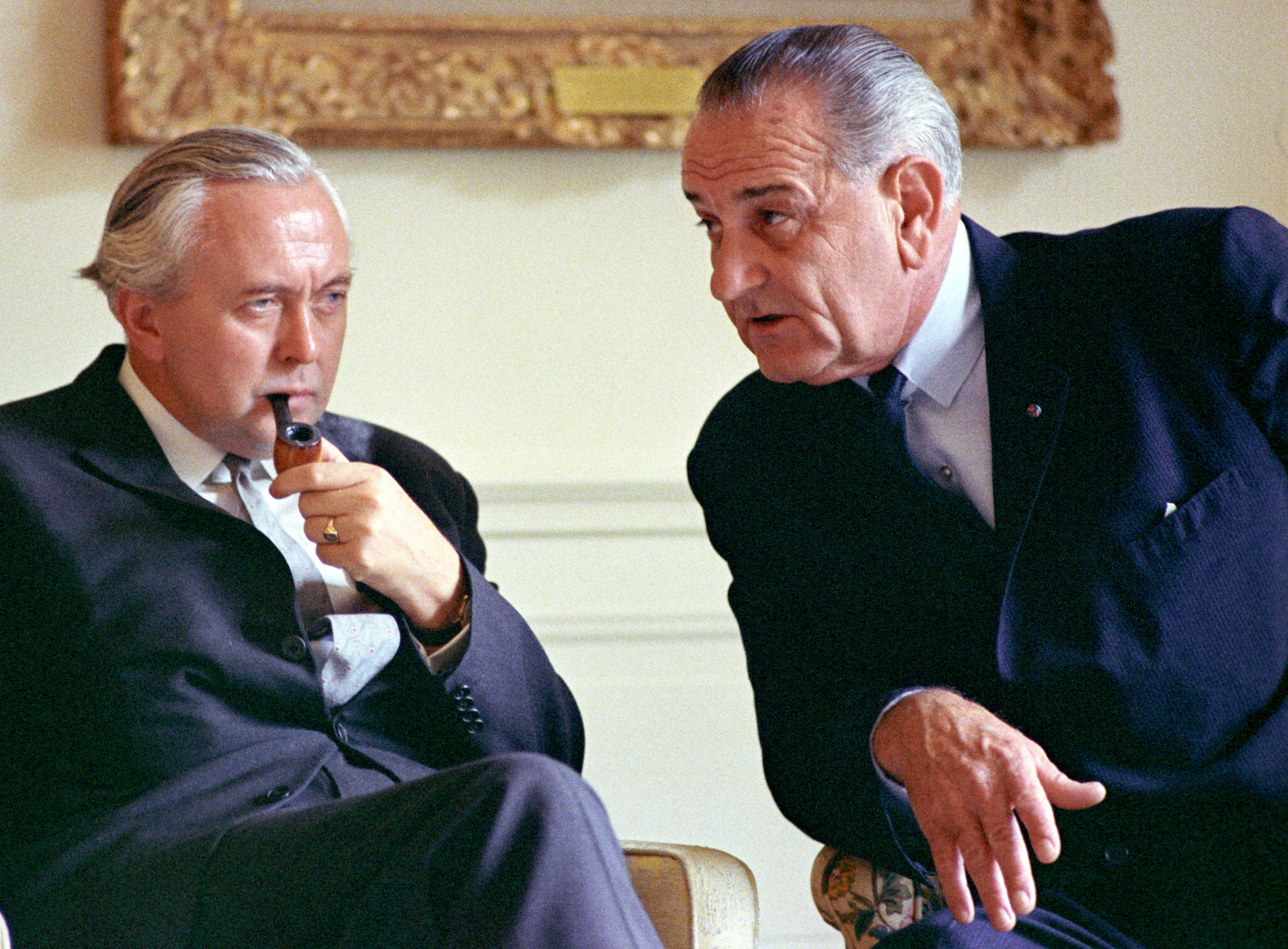
British prime minister Harold Wilson meets with US president Lyndon Johnson at the White House in 1966. Wikimedia Commons
In this essay, we seek to answer two closely related questions: first, why socialists in advanced capitalist countries should want to move beyond social democracy; and secondly, what are the requirements and implications of such a move. Until not so long ago, the first of these questions would have seemed rather indecent: of course all serious socialists wanted to move beyond social democracy. Today, no such intention or desire can be taken for granted. For even where there is sharp criticism of the limitations and derelictions of social democracy, there is also an implicit acceptance of it, based upon a despairing uncertainty about what else is possible. So both questions do need to be probed.
An answer to the first of them — why socialists should want to move beyond social democracy — requires a brief recapitulation of its nature and record. An initial distinction needs to be made for this purpose between social democracy before 1914, and social democracy after World War I and particularly since 1945.
In its earlier formative phase, social democracy unambiguously stood for the wholesale transformation of the social order, from capitalism to socialism, on the basis of the social appropriation of the main means of production, distribution, and exchange, a far-reaching democratization of the political system, and a drastic leveling out of social inequality. This was to be achieved by way of a long series of economic, social, and political reforms, to be brought about by way of a parliamentary majority reflecting a preponderance of electoral and popular support.