The Shocking Truth About Russia’s Troll Campaign
The Russian Facebook ads that destroyed American democracy have now been released. Try not to laugh — it’s serious business.
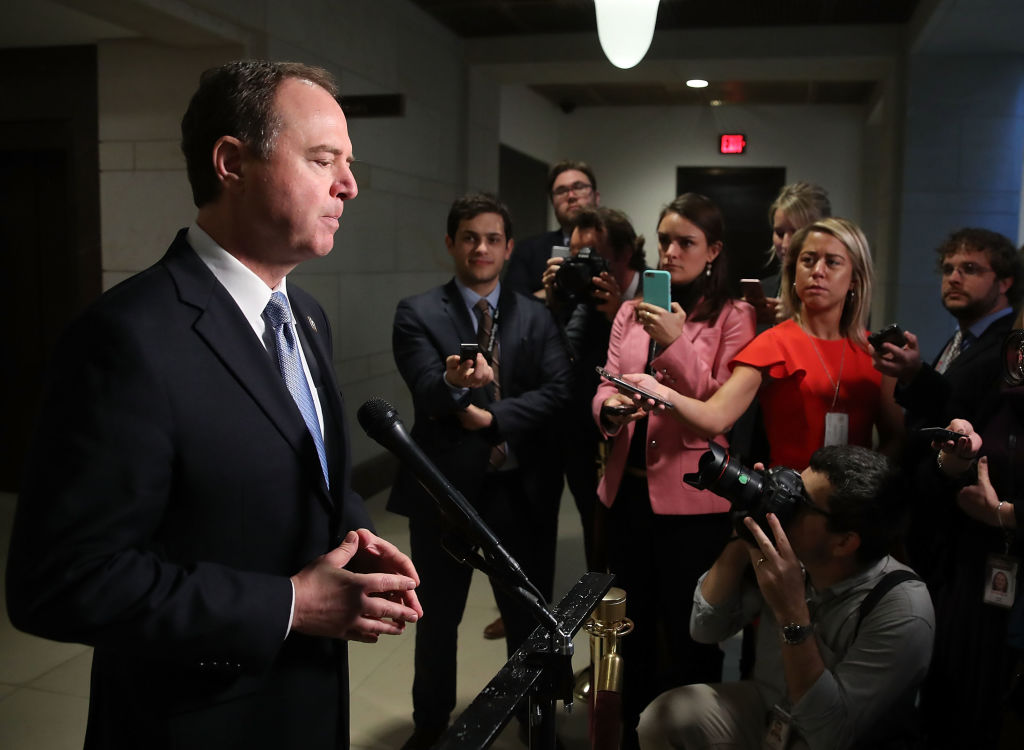
Adam Schiff (D-CA) speaks about today’s testimony on Russian interference in the 2016 election from US Attorney General Jeff Sessions during a session of the House Intelligence Committee on Capitol Hill, November 30, 2017 in Washington, D.C.Mark Wilson / Getty
It’s now well-established that in 2016, the Kremlin hijacked American democracy and tricked the press and public into doing its bidding. In fact, the revelations are so shocking they’ve prompted some liberals to undergo a bout of soul-searching. New York Times journalist Amy Chozick has expressed her regret over having acted as a “de facto instrument of Russian intelligence” during the campaign by reporting on the leaked emails from the Democratic National Committee and Clinton campaign manager John Podesta. Sure, the leaked material was newsworthy and provided unprecedented insight into the behind-the-scenes inner workings of one of the country’s two major parties. But since reporting on them overlapped with the Kremlin’s geopolitical goals, it might have been better to keep the American public in the dark.
Similarly, we now know that Bernie Sanders’s insurgent campaign wasn’t just an attempt to push Hillary Clinton to the left that rapidly took on a life of its own. Nor was Jill Stein’s Green Party campaign merely an effort to offer a left-wing alternative to Trump in the general election. Rather, these, too, were tools of Russian aggression, tacitly supported by the Internet Research Agency (IRA), the Russian troll farm allegedly used by the Kremlin to sow chaos in 2016 and beyond. MSNBC was able to reveal the truth to its audience earlier this year, lest they be tricked into backing either politician in the future.
The good news is that now, with Congress releasing the more than 3,500 Facebook and Instagram ads made by the IRA over the past few years, the voting public finally has the information it needs to protect against future Russian attacks.