The Kinder Scout Mass Trespass
In April 1932, hundreds of workers took to the hills of northern England to challenge the right of landed gentry to enclose the countryside.
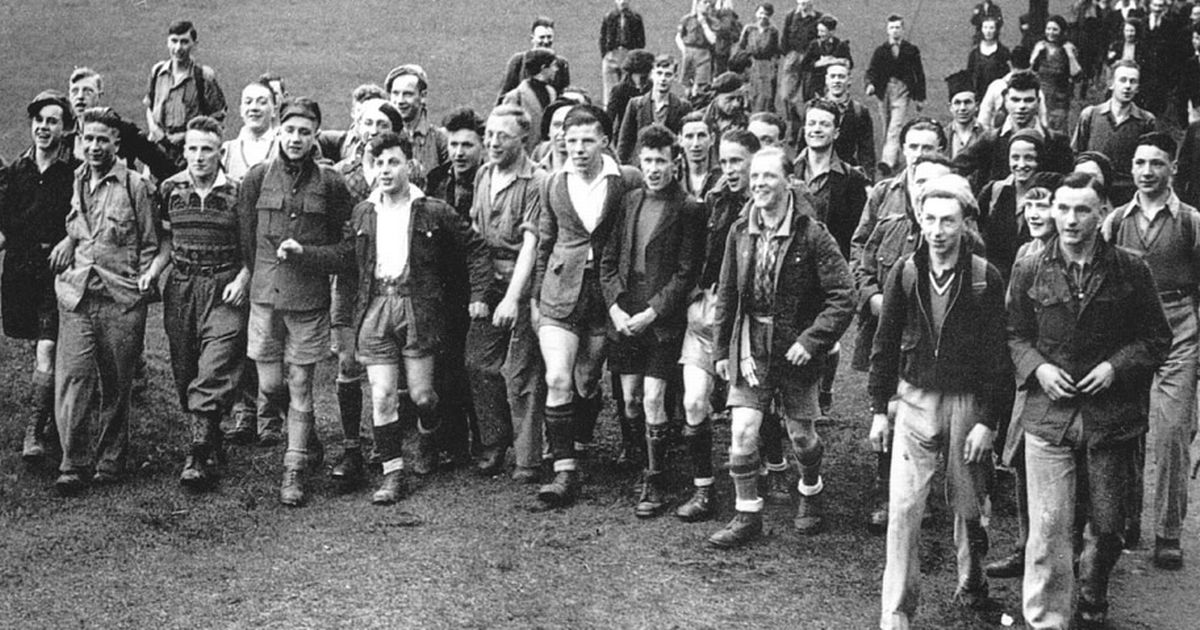
The Kinder Scout Mass Trespass Group, 1932. (Credit: Stewart McLaughlin)
Rambling emerged as a mass recreational activity in the last few decades of the nineteenth century in northern English areas increasingly swallowed by early capitalism’s apocalyptic landscape. It was a time when visitors to the premier industrial city of Manchester were welcomed by belching plumes of black smoke. In a short essay, Charles Dickens would describe its environs as a “plague of smoke” which “obscured the light, made foul the melancholy air,” and covered “all things living or inanimate, shutting out the face of the sky, and closing in on all these horrors with a dense dark cloud.”
Choked by the toxicity of their immediate surroundings, many young workers in Manchester and other nearby industrial cities sought retreat in the heather and furze of the moorlands and mountains of the nearby Peak District. This phenomenon found reflection early on in the northern English labor movement, where rambling clubs were a consistent feature. George “Bert” Ward formed the first northern workers’ rambling club, the Sheffield Clarion Ramblers, in 1900, while Manchester’s socialist Clarion Café soon followed suit.
For socialists such as Ward, rambling was not merely escapism but a potential avenue of human improvement. Northern socialist sports publications were fond of quoting his philosophy on their mastheads: that “a rambler made is a man improved.” Regular land invasions were organized by Britain’s socialist pioneers, who enjoyed the sense of trepidation that came with discovering new paths, conquering the “unconquered,” and scaling the summits that workers were formally denied access to.