Why the Left Should Embrace Brexit
Remainers claim that Brexit will be an economic apocalypse. But it provides the opportunity for a radical break with neoliberalism.
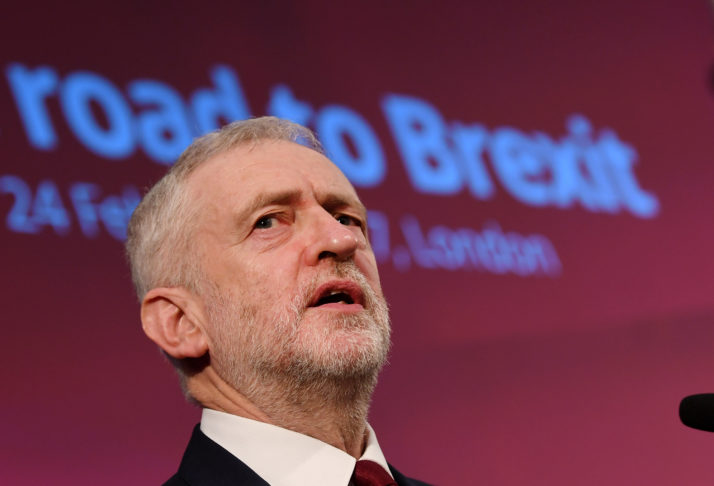
Labour Party leader Jeremy Corbyn delivers speech on Brexit in 2017. (Credit: Getty)
Nothing better reflects the muddled thinking of the mainstream European left than its stance on Brexit. Each week seems to produce a new chapter for the Brexit scare story: withdrawing from the EU will be an economic disaster for the UK; tens of thousands of jobs will be lost; human rights will be eviscerated; the principles of fair trials, free speech, and decent labor standards will all be compromised. In short, Brexit will transform Britain into a dystopia, a failed state — or worse, an international pariah — cut off from the civilized world. Against this backdrop it’s easy to see why Labour Party leader Jeremy Corbyn is often criticized for his unwillingness to adopt a pro-Remain agenda.
The Left’s anti-Brexit hysteria, however, is based on a mixture of bad economics, flawed understanding of the European Union, and lack of political imagination. Not only is there no reason to believe that Brexit would be an economic apocalypse; more importantly, abandoning the EU provides the British left — and the European left more generally — with a once-in-a-lifetime opportunity to show that a radical break with neoliberalism, and with the institutions that support it, is possible.
Modelling Dystopia
To understand why the anti-Brexit stance of most European progressives is unfounded and actually harmful, we should start by looking at the most pervasive Brexit-related myth of all: the idea that it will lead to an economic apocalypse. For many critics this is an open-and-shut case, proven simply by citing a much-publicized leaked report prepared by the British government’s own Department for Exiting the European Union (DExEU). The document concludes that all possible forms of Brexit, from remaining in the Single Market to a free-trade deal or no deal at all, would have a substantially negative impact on the UK’s GDP. Estimates range from a 2 percent lower GDP and 700,000 fewer jobs over the next fifteen years to an 8 percent lower GDP and as much as 2.8 million fewer jobs.