Ireland’s Fight for Choice
Ireland has the most restrictive abortion laws in Europe — but this summer they will be put to a referendum.
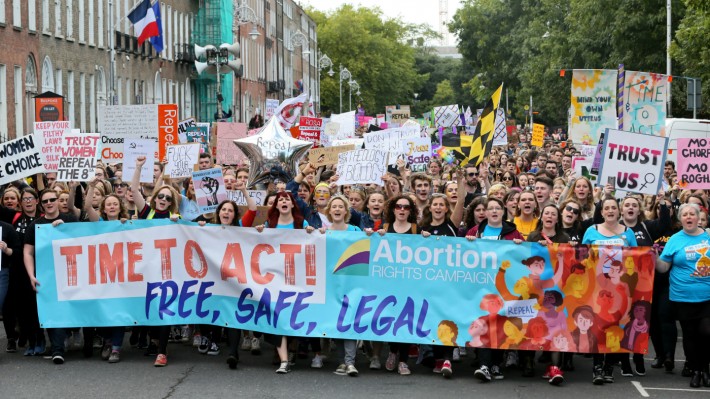
Abortion rights protesters at the March for Choice in Dublin in September 2017.
Every year on the days surrounding St. Patrick’s Day, the Irish political establishment engage in a self-congratulatory global publicity tour, essentially designed to promote Ireland as a scenic tax-haven. Ireland, the official narrative goes, is a business-friendly, low-tax, low wage, modern nation state that is now led by a young, energetic, openly gay and neoliberal Prime Minister. In this context, Ireland’s constitutional ban on abortion, and the highly visible tragedies that it has produced, seems out of step. While the government has committed to holding a referendum to liberalize Ireland’s abortion laws in early summer, the issue remains fraught even for a country that, in the wake of 2015 Marriage Equality Referendum victory, has begun to see itself as progressive. So why has abortion remained such an intransigent political issue in Ireland and now, after decades of campaigning, is change finally in our grasp?
Ireland’s abortion rate is comparable to that of most other European countries; the only difference is that most Irish abortions don’t happen on the island of Ireland. Abortion has been illegal in Ireland, in almost all circumstances, for more than 150 years. It is illegal even in cases of rape or incest; in cases of fatal fetal anomaly; and where a woman’s health is at risk. Despite this legal fact, hundreds of thousands of women living in Ireland, North and South, have had abortions. Every single day, at least 9 women decide to leave Ireland and travel to Britain. For those unable to travel at least 2 women every day will take the abortion pill. Women who take the abortion pill do so under the shadow of criminal law and can face up to 14 years in prison if prosecuted. But for many women who cannot afford to travel, or who do not have the necessary travel papers, this is a risk they must take.
In order to understand how Ireland came to have such tightly regulated abortion laws, it is necessary to look at how the regulation and control of sexuality became so deeply woven into the structures of the Irish state. The Irish Free State emerged from the detritus of a War of Independence with Britain, and a short but vicious civil war. Almost immediately the newly partitioned State, created in 1922, adopted Catholicism as one of its principle regulating ideologies. The Catholic Church conferred on the new State the legitimacy it sought as a new post-colonial state, and secured for it delivery of already established but ideologically driven education and health care systems. For a newly formed state, born out of counter-revolutionary struggle, the regulation and control of sexual behavior created a sense of social stability for a society in flux. This regulatory ideal of sexuality also became a way of extending the hegemony of the newly empowered Catholic middle classes who emerged as the bearers of stability and morality. It also allowed the State, in a post-colonial context, where there was an overwhelming push to define Ireland as ‘not-England’ to reproduce a coherent national identity that defined “Irishness” as Catholic and white. Women’s dedication to reproducing the next generation of Irish people became “elevated to a symbol of Ireland’s moral and cultural distinctiveness over Britain.