The Politics of France Insoumise
In the wake of its impressive performance in last year’s presidential campaign, the movement around Jean-Luc Mélenchon has set about establishing a new kind of political organization.
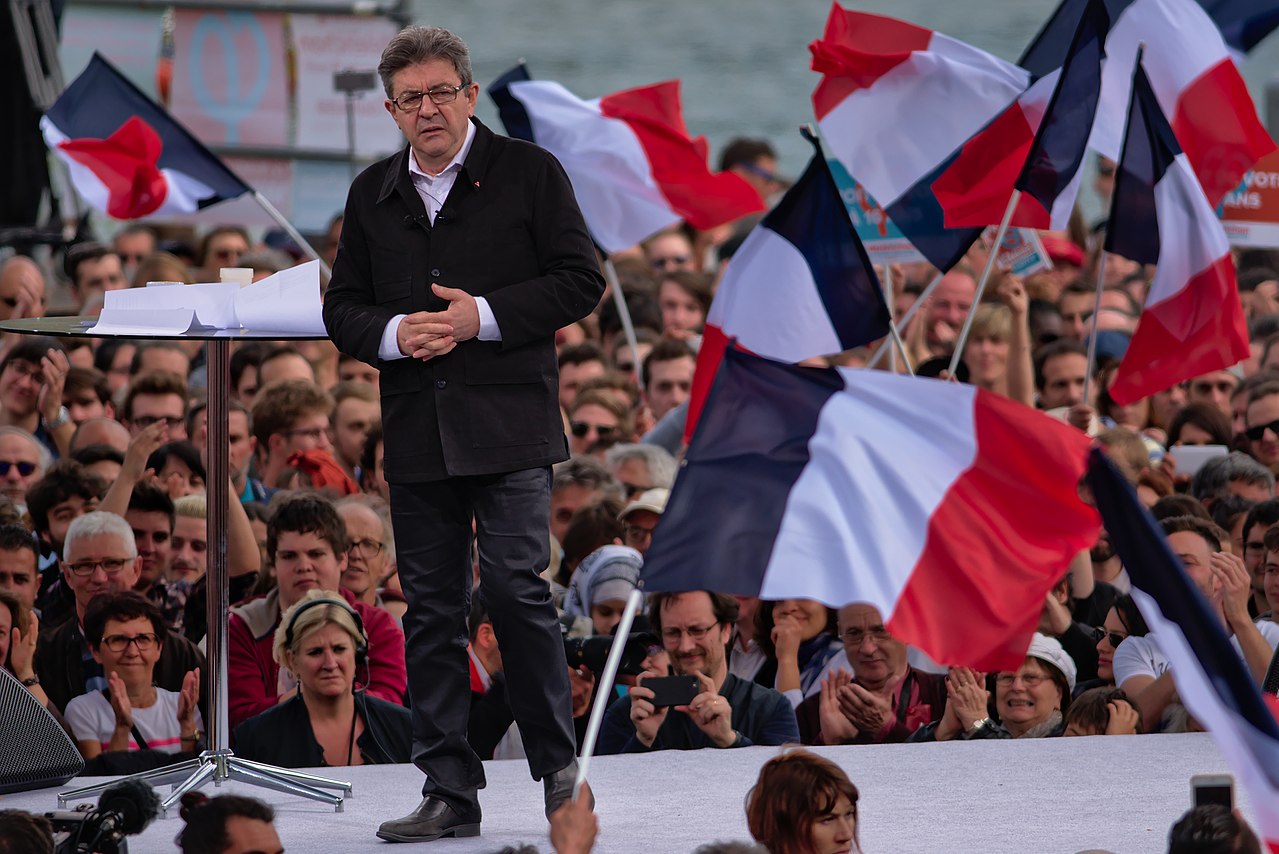
Political meeting of Jean-Luc Mélenchon in Toulouse, France on April 16, 2017.MathieuMD / Wikimedia
During last year’s French presidential election, Jean-Luc Mélenchon impressed Europe’s left as he won almost 20 percent of the vote. Shortly after the election, Mélenchon’s left-populist party France Insoumise became the most visible opposition to Emmanuel Macron’s neoliberal government, a role that it intends to strengthen by encouraging popular mobilization. For this reason, it has been constituted as a new kind of campaigning-focused political organization that aims to overcome the very notion of the political party. But many questions remain about this model. For instance, can it avoid the old problems of traditional parties, such as the top-down concentration of power?
Perry Anderson described France Insoumise’s April 2017 presidential campaign as “an impressive feat.” Jean-Luc Mélenchon’s rallies gathered huge crowds, and he was widely recognized as the winner of the televised debates. In the final weeks of the campaign he achieved a spectacular increase in his support. Despite this major advance, Mélenchon came in fourth place, after Emmanuel Macron, the Front National’s Marine Le Pen, and François Fillon, the candidate of the conservative Les Républicains. In the parliamentary elections that took place in June, France Insoumise (FI) obtained seventeen seats, an insufficient number to have any real influence in parliamentary negotiations. Macron’s party La République En Marche secured a majority in the National Assembly, while Les Républicans came in second place.
If France Insoumise’s institutional power is limited, polls show that it has established itself as the main opposition to President Macron. On the center-left, the Parti Socialiste is going through an existential crisis after obtaining only 6 percent of the vote in the presidential election, and the Parti Communiste Français remains weak (though it did begrudgingly support Jean-Luc Mélenchon’s presidential candidacy). On the Right, both the Front National (FN) and Les Républicains are also facing difficulties. While Les Républicains, long expected to win the election, are still recovering from their defeat, the FN is more divided than ever. Its chief strategist in the run-up to the election, Florian Philippot, was pushed aside and has now created his own organization, Les Patriotes. It was Philippot who authored the FN’s strategic turn to put social issues at the center of the agenda, a move which does much to explain its impressive electoral growth in recent years. Philippot’s resignation may mean that the far-right FN returns to more traditional nationalist positions, focused on immigration and cultural issues, combined with a more liberal approach on economic questions.