Trump the Sovereign
According to Donald Trump, the US should be able to do what it wants, when it wants, and the way it wants.
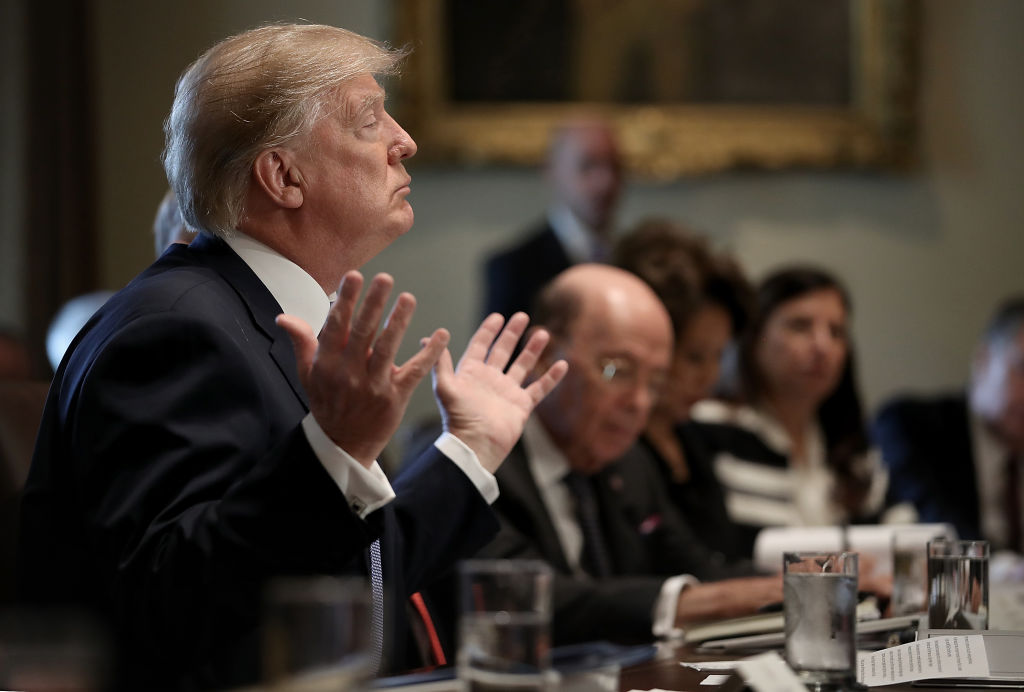
Donald Trump on November 1, 2017. Win McNamee / Getty Images)
On September 18, 2017, President Donald Trump addressed the UN General Assembly for the first time. His speech was intended to promote a new departure in American foreign policy, a “principled realism” which would put “America First,” whose cornerstone was sovereignty. It was probably the first speech by Trump that the media took seriously. They viewed it in a balanced manner and they interrogated the president’s use of sovereignty. The president used the term twenty-one times. He identified sovereignty with the right of nations to privilege their interests and determine their own affairs, pure and simple. This new emphasis was intended to confront the supposedly less “muscular” foreign policy of his predecessor, President Barack Obama. The shift privileges unilateral over multilateral action, coercion over diplomacy, arbitrary determination of the American national interest over international cooperation, and a crude and traditional “power politics” over human rights. To understand Trump’s speech and why it’s so dangerous, we need to look at the history of sovereignty.
Friends and Enemies
Sovereignty and raison d’etat emerged after the Hundred Years War (1337–1453), the Thirty Years War (1455–1487), and a host of other wars in between. Sick of the bloodshed, wary of religious absolutism, the secular sovereign was seen as, above all, seeking stability. This meant countering the hegemonic aspirations of any state by decentralizing international power, forging favorable alliances (even with rivals), and remaining watchful of new states entering (and possibly changing) the existing constellation of political forces. The concept developed in concert with a new appreciation of the “balance of power,” the principles underpinning international law, and the extension of formal reciprocity to other sovereign states in choosing their government and religion.
In this system, policies that call for unqualified isolationism — which could result in an erosion of leverage — are as dangerous as those justifying impulsive intervention in the affairs of other states. There is a sense in which the two play off one another. Feelings that the state is alone, disrespected, and under siege heightens the appeal of paranoia and xenophobia, unpredictable policy choices, and the likelihood of war. Distinctions between “friend” and “enemy” blur and change so rapidly that purely instrumental considerations come into play. Any state can appear as an “enemy” or “friend” at any time not merely in principle but in fact. Strategy dissolves into tactics; the consequence is an inability to formulate any coherent or consistent policy. This is precisely the situation in which the United States now finds itself: sovereignty has been stripped of its connection with the balance of power, reciprocal recognition of other states, respect for international law, and — perhaps above all — stability.