Walt Disney’s Latin American Tour
- Nicolas Allen
Two 1940s Disney features show how the film industry learned to sell American empire.
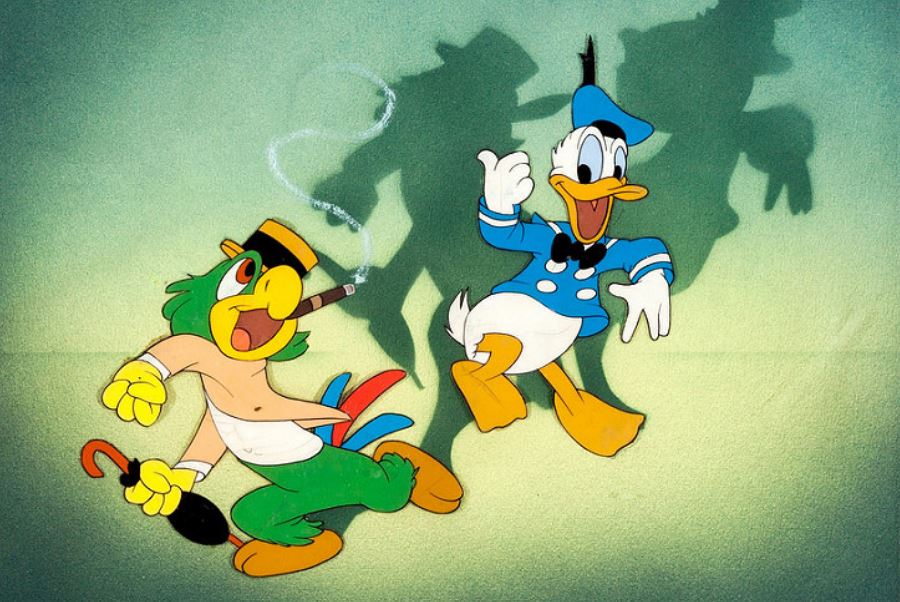
José Carioca and Donald Duck in Los Tres Caballeros, 1945.
Walt Disney announced his arrival in Latin America with two animated films: 1942’s Saludos amigos and 1944’s Los tres caballeros. Their debuts — in Rio de Janeiro and Mexico City, respectively — were milestones in the decade-long Good Neighbor Policy, which had begun in 1933 when the United States wound down its military occupation of Central America. In the 1940s, the Roosevelt administration saw hemispheric collaboration as vital to the American war effort.
With the rise of fascism in the region a real, if exaggerated, threat, the two Disney films and the accompanying diplomatic mission were intended as anti-Nazi propaganda for a South American audience. Riding high on a wave of similar goodwill tours — including Henry Wallace’s Hemispheric New Deal — the resulting animations initially seem like earnest, if naïve, attempts to engage in an authentic dialogue with Latin American culture.
But pan-American rhetoric withered and the dream of a Latin American Marshall Plan evaporated in the postwar period. Good neighborliness gave way to the Cold War nightmare of Guatemala in 1954. Today, it seems clear that the two Disney pictures established a precedent in which the film industry would work to justify American intervention in the region and around the globe.