Why We Loved the Zapatistas
The abandonment of Marxism had more than academic consequences.
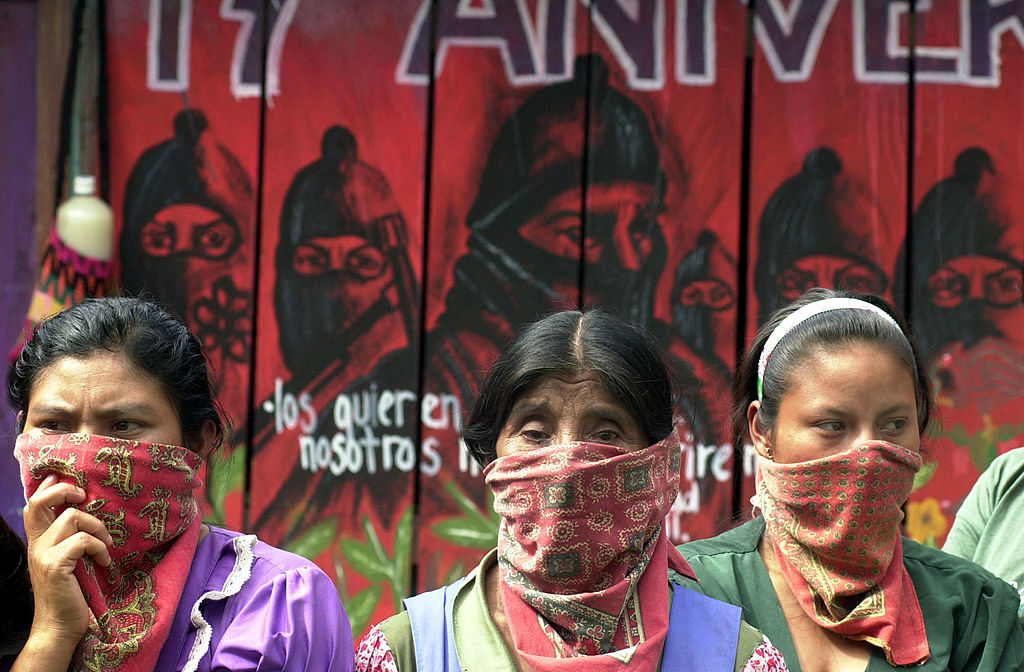
Three Zapatista women stand in front of a painted mural as Zapatista rebellion leader Subcommandante Marcos discusses the details of a fifteen day protest march that he will lead to Mexico City, February 22, 2001. Susana Gonzalez / Newsmakers
At the age of twenty-two, creeping towards a bachelor’s in something practical, Ian Harris looked destined to join the ranks of the smug and overpaid. His plans changed abruptly when he, by chance, attended a Progressive Student Network conference in Washington. The theme of the gathering was the hemisphere’s emerging people’s movements. Ian insists that his activist bona fides didn’t run much deeper than owning a Rage Against the Machine album, but it’s clear he had a sense of history. There were just and noble stirrings of the exploited and he was on their side. The year was 1994; Larry Hunter was drafting a Contract with America, Vanilla Ice was sporting dreadlocks, and Ian Harris was off to Chiapas.
“Zapatourism” saw thousands of activists descend on the southern Mexican state. Merchants in places like Tierra Adentro sold revolutionary knickknacks and handcrafts to international adventurers, while graduate students back home sold MA theses about “mobilizing frames under transitional conditions” and “countermovement synergy” to tenure tracks. The global climate and local conditions couldn’t have been more different, but those who actually made it to Mexico were in the tradition of the Venceremos Brigade and the North Star Network. Far from passive observers, activists delivered aid, performed human rights observations, installed irrigation, and repaired infrastructure, generally conducting themselves like model internationalists. Still, Ian’s stories from the front are mostly about chronic diarrhea and mosquitoes. And today, a partner in a law firm, he is by his own admission smug and overpaid.
Context
During the Cold War era, even for many leftists critical of the Soviet Union, attempts to pull societies in the periphery out of poverty and underdevelopment evoked romantic sentiments. Faith in the historic potential of the universal class, the proletariat, was sidelined. The Maoist exalted the peasantry; the Fanonite praised the lumpenproletariat. Photogenic Latin American guerrillas, Chinese provincials, and mid-level military officers across the rest of the Third World seemed poised to offer a shortcut to modernity and progress. Socialist enclaves were to compete with, and eventually supersede, capitalism from without.