The Violent Far-Right Response to France’s Protests
In recent weeks, French far-right militants have carried out several violent attacks. While media focus on young rioters breaking shop windows, they ignore the reactionaries who use deadly force against minorities and left-wingers.
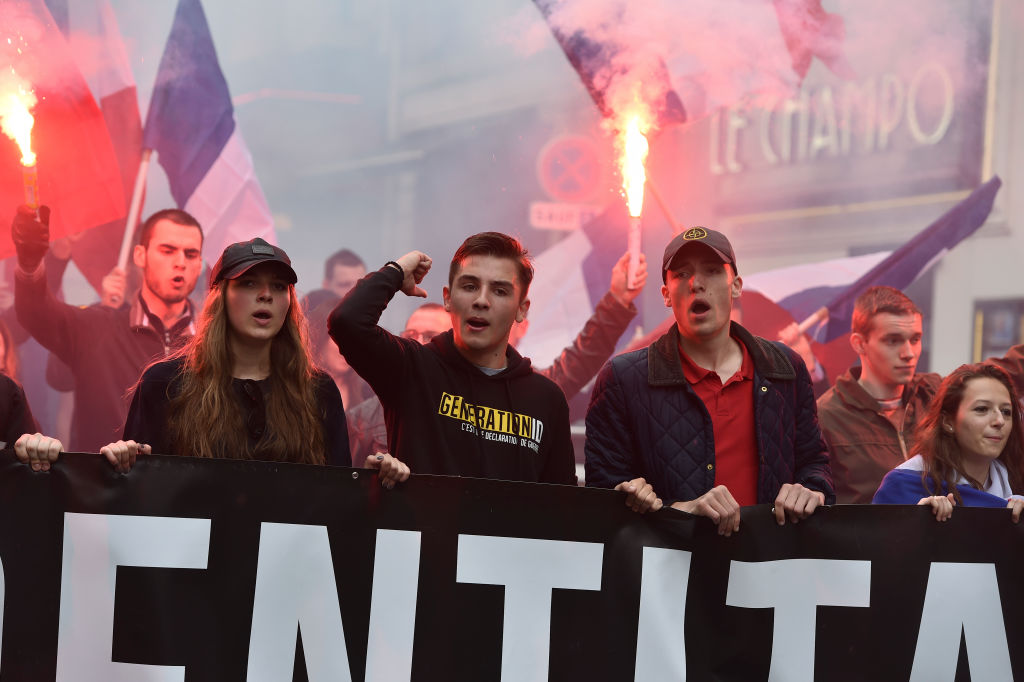
Militants from the now-proscribed white-nationalist group Génération Identitaire march in central Paris. (Eric Beracassat / Gamma-Rapho via Getty Images)
For France’s media-political classes, the recent student movement has prompted a series of searching questions about violence and who has the right to use it. Debates often center on the alleged closeness of protesters to La France Insoumise, implying that Jean-Luc Mélenchon’s left-wing party is somehow responsible for vandalism by protesters and marginal acts of violence by students. Less remarked upon however, is that a wave of violence coming from the far right has also marked the protests and the presidential election campaign. Nor has it been much noted that this violence has killed already, and that Marine Le Pen’s Rassemblement National (RN) is alarmingly close to the violent groupuscules involved.
Already on October 24, far-right militants attacked trade unionists and protesters in Rouen, Nice, and Montpellier. In a video taken by a bystander in Rouen, Normandy, members of local identitarian movement Les Normaux can be seen throwing a man to the pavement before kicking him. None of the men were arrested by the police, although officers were present on the scene. The identitarians attempted to intimidate protesters by yelling far-right slogans such as “Rouen, Rouen is nationalist” and “the street and France belongs to us.”
The group had launched similar attacks on protesters the week before, beating two people to the ground and leaving them bloody. In a video taken before the incident, a man can be seen at the head of their march, a leather belt wrapped around his fist, metal buckle in hand like a makeshift knuckle-duster. Street Press, a news website that closely monitors far-right activity, identified the man as Mathieu Balavoine, who runs a production company that was hired by the Rassemblement National in 2024, and that last year earned over €100,000 for a contract making videos for the party’s group in the European Parliament.
The far right’s propensity for lethal violence has also been demonstrated elsewhere in recent weeks. On October 23, Kevin Tessier, a coked-up fascist armed with an automatic weapon, fired 128 bullets at black and Arab people in the city of Trappes, killing one person and injuring four. Trappes had repeatedly been the subject of a media moral panic about “territories lost to the Republic” because of their large minority populations. Le Pen contributed to this over the years, tweeting in 2018 following a stabbing in the city, that Trappes is “the symbol of those cities and neighborhoods where the French Republic has retreated, making way for communalism and Islamism.” Tessier’s motives were undeniably racist. Whether he was influenced directly by Le Pen’s words is unknown, but stickers found in his house suggest that he was at least a party sympathizer. Among a copy of Adolf Hitler’s Mein Kampf and other items indicative of his far-right ideology, were thirty stickers bearing the words “Long Live France, the RN, proud to be French.”
These were just the most recent instances of a longer story of far-right violence in France. In 2022 Argentine rugby player Federico Martín Aramburú was gunned down in the street by two former members of the Groupe Union Défense (GUD), a fascist youth circle with close ties to the RN. In 2023, a wave of far-right violence was unleashed in reaction to the Nahel Merzouk riots, which followed the police killing of a seventeen-year-old. That year, France became the only European country to see a major increase in the number of violent attacks by far-right groups compared to the 2010–2022 national average, according to a study by the Center for Research on Extremism. Since then, acts of violence by such groups targeting ethnic minorities and political opponents have become increasingly common. According to daily Libération, there was an average of one far-right attack per week in 2025.
The groups perpetrating these attacks — the formations that emerged following the self-dissolution of the GUD and the mandatory dissolution of Génération Identitaire — are alarmingly close to the RN.
According to Thomas Portes, who is president of the National Observatory of the Far Right, and France Insoumise MP for Saint-Denis, “There has been no break between the parliamentary far right and the groupuscules.”
[In France] we have an annual mobilization by the May 9 Committee; it’s a Nazi demonstration in homage to a fascist activist who died. It was banned this year, but two years ago, the paperwork for the demonstration was filed by a parliamentary attaché for the RN, called Maylis de Cibon. There was a parliamentary assistant called Raphaël Ayma, who spoke at a conference of the friends of Léon Degrelle, a Belgian Nazi figure [before Ayma was expelled from the RN]. There is the press secretary of the RN group, Elise Laplace, who has just married a neofascist activist that arranged an attack on a political meeting in Bordeaux that was organized by my fellow [France Insoumise] MPs Louis Boyard and Carlos Martens Bilongo.
“It goes beyond the assistants,” Portes tells Jacobin, pointing to the case of Tiffany Joncour, an RN MP whose husband, a hooligan with a background in the identitarian movement, beat up her parliamentary assistant whom he suspected of having an affair with her.
Portes’s list continues, telling Jacobin about four further examples. Even this list is not exhaustive. While researching another article, in the Eurocom forum that the group organizes through, I found an account of the Save Europe Act, an organization linking identitarian movements across Europe, which includes several groupuscules accused of violence. The account bore the name and location of Philippe Eymery, an RN regional counselor whose party branch was exposed in 2018 for employing Génération Identitaire activists. Eymery recently appeared on a radio show alongside various extreme-right groups that are members of the Eurocom group, promoting remigration. (He did not respond to my message requests on Twitter attempting to confirm if he was the owner of the account with his name.)
At France Insoumise’s own summer university in August, the party’s parliamentary chief Mathilde Panot told journalists that this would be an unusual presidential election campaign because of the level of violence that she and her colleagues expected. Her assessment has already proved prescient, though France Insoumise has in fact long been a target for far-right violence. The Trappes killer had a list suggesting he was intending to target France Insoumise MPs David Guiraud and Aymeric Caron, as well as anti-police-violence campaigner Assa Traoré and Green MP Sandrine Rousseau. France Insoumise canvassers and parliamentary assistants have been beaten up while campaigning for Mélenchon, and even the Quentin Deranque affair, which ended with a neo-Nazi activist dying from injuries sustained in a street fight by antifascist activists, began with fascist activists ambushing the antifascist activists outside a France Insoumise meeting in Lyon.
According to Portes, there is an “operation to reverse society’s moral compass based on falsehoods, which is targeted against us. For example, yesterday the minister of education tried to claim that it was France Insoumise, our activists and officials, who brought fireworks to high school students to allow them to fire them at school buildings. The interior minister was forced to deny it today. . . . As for the far right, we represent everything that they hate. That is to say the imaginary of an anti-racist, anti-colonial, antifascist, egalitarian, New France.”
Part of Marine Le Pen’s strategy of detoxification has been to expel party members associated with openly extreme or violent groups in French politics. However, they only seem to be expelled when the press gets wind of it, and even then those close to the leader can escape unscathed. The Rassemblement National in parliament with the “shirts and ties” is just “decor” and “window dressing” says Portes. “When you look at the list of people who are elected officials for the RN, or their assistants, it’s a nursery of neo-Nazi, nationalist, royalist, and identitarian activists.”
Le Pen may have successfully detoxified the party brand. That doesn’t, however, mean that it has actually changed.