How Cultural Marxism Became a Right-Wing Obsession
The term “cultural Marxism” has become one of the main rallying cries for the international right. This lurid conspiracy theory about the influence of the Frankfurt School has little connection to reality, but that doesn’t make it any less dangerous.
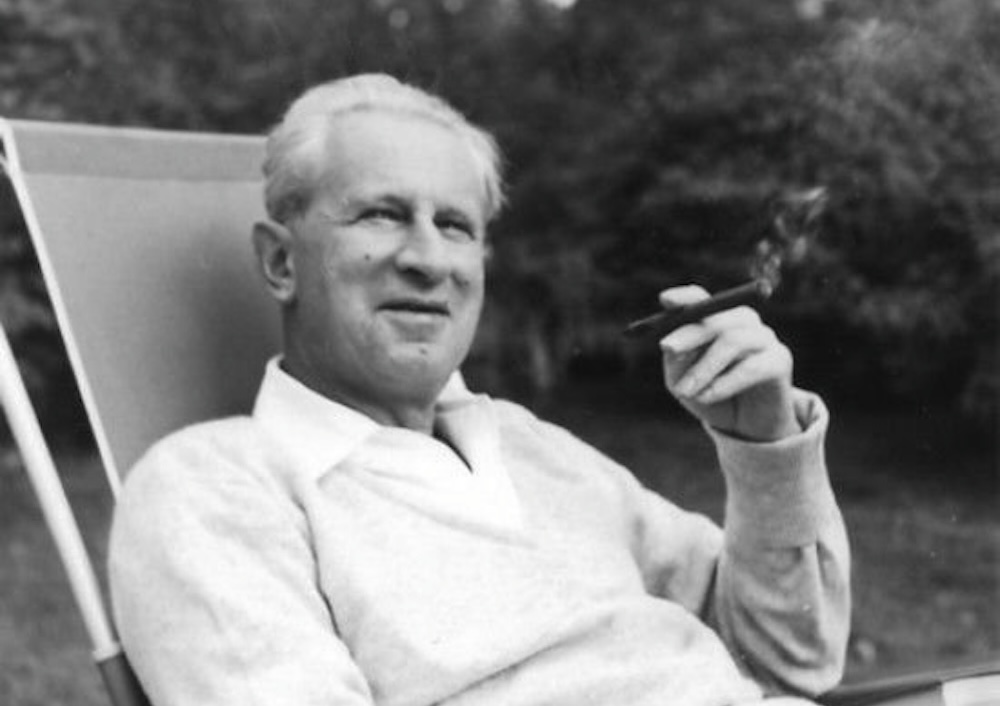
The cultural Marxism conspiracy theory is the political right’s attempt to explain why the culture of Western societies has changed since the 1960s. It blames the Frankfurt School for the rise of multiculturalism, feminism, and environmentalism. (The Marcuse family, represented by Harold Marcuse / CC BY-SA 3.0 [lightly cropped])
In December 2021, the term “cultural Marxism” was added to the Oxford English Dictionary. It was, according to the OED, a phrase with a sinister and controversial past. Its etymology could allegedly be traced to 1930s Nazi propaganda; its first recorded English-language use was in a 1938 issue of a British Union of Fascists magazine.
Despite its dark history, this expression has recently surged in popularity. College campuses and city streets have been plastered with stickers that urge passersby to “smash” cultural Marxism. Prominent US Republicans, such as Texas Senator Ted Cruz and Defense Secretary Pete Hegseth, have written book-length polemics to blame America’s decline on cultural Marxist ideologies.
Leaders in Latin America, like Brazil’s former President Jair Bolsonaro and Argentina’s President Javier Milei, have vowed to rid their governments of this left-wing scourge. In the United Kingdom, Conservative Party MPs have said that cultural Marxists are “destroying” children’s souls and “snuffing out” the right to free speech.
Even the world’s richest man, tech-mogul-turned-Trumpian Elon Musk, has voiced concerns about a Wikipedia article that dismisses cultural Marxism as a “conspiracy theory.” This buzzword has now become a fixture in the lexicon of the contemporary Right — but what does it mean?
The Long March
“Cultural Marxism,” or the “cultural Marxism conspiracy theory,” is the political right’s attempt to explain why the culture of Western societies has changed over the past sixty years. According to this theory, a group of German thinkers known as the Frankfurt School (or the Institute for Social Research) invented the “ideologies” of multiculturalism, feminism, and environmentalism to trigger the demise of Western civilization.
When Theodor Adorno, Herbert Marcuse, and other Frankfurt School theorists fled Nazi Germany, they traveled to the United States and successfully injected their ideas into the 1960s student movement — or so the story goes. In the late twentieth century, their indoctrinated disciples performed a “long march through the institutions” (a phrase coined by German New Left activist Rudi Dutschke) to promote cultural Marxism in education, the media, the government, and the church.
More recently, right-wing activists and conservative pundits have used this theory to understand the rise of the Black Lives Matter movement, the increased visibility of LGBTQ+ communities, and the efforts to tackle the climate emergency. Even in countries outside the United States, conservatives have engaged in a “culture war” to defend their societies from this supposed menace.
What is cultural about this cultural Marxism? What is Marxist about cultural change? Conservative critics speculate that the Frankfurt School developed a fresh strategy of communist subversion in the 1930s. Instead of building a vanguardist party or seizing the factories, the Frankfurt School decided to infiltrate the cultural apparatus of bourgeois society to undermine Western capitalism.
Once ensconced in these positions of power, the critics maintain, cultural Marxists catered to the petulant demands of various minority groups — Black people, LGBTQ+ people, feminists — and dismantled the civilizational inheritance of the (white) majority. The Frankfurt School apparently believed that this strategy would cause a Marxist egalitarian utopia to emerge from the ruins of Western culture.
As the art historian Sven Lütticken observes, this alternative intellectual history relies on a theory of culture that mixes “conservative essentialism” with “schematic superstructuralism.” Culture, according to this right-wing conception, naturally reflects the values of a native populace. These values fuse a nation’s citizens into a harmonious unity that annuls antagonism and difference.
Yet this essentialist notion of culture cannot account for the drastic social changes that have taken place since the 1960s, because it treats the subordination of minorities as “natural” (or even as virtuous). Consequently, conservatives must conclude that an outside agent has seized the organs of cultural production to destroy the West.
In an act of self-defense, the opponents of cultural Marxism propose to eliminate every instance of “political correctness” or “wokeness” in public life through legislative reform, lifestyle changes, or violence. In this version of global events, the Frankfurt School and their devotees are blessed with a magical level of agency that can overcome all contradictions and countervailing forces.
A New Concept
Of course, no one can deny the historical existence and importance of the Frankfurt School. But why does this narrative of cultural degeneration focus so much on a collective of German Marxists? How does it continue to convince and excite the forces of political reaction? What is the genealogy of this idea we call the “cultural Marxism conspiracy theory”?
Some scholars suggest that “cultural Marxism” is simply an updated version of older antisemitic conspiracy theories like “Judeo-Bolshevism” or “cultural Bolshevism.” Of course, there are some eerie parallels between these earlier ideas and “cultural Marxism.” The British Union of Fascists translated Kulturbolschewismus as “cultural Marxism” in 1938, even if their use of the term was long forgotten by the time it was “recoined” in the early 1990s.
Contemporary far-right activists and authors tend to emphasize that several members of the Frankfurt School were Jewish, as if to suggest that these thinkers were genetically predisposed to operate as agents of cultural degeneracy. Even more damningly, the fascist online encyclopedia Metapedia once maintained an entry on cultural Marxism that presented the term as interchangeable with “cultural Bolshevism.”
It is ahistorical, however, to claim that “cultural Marxism” is nothing more than a rebranding of these previous tropes. This argument presupposes that Judeo-Bolshevism, cultural Bolshevism, and cultural Marxism are substantially identical, as though they share a transcendental essence that precedes their historical manifestations. It ignores the distinct trajectories of these ideas and implies that all right-wing politics are fundamentally the same.
The phrase “cultural Marxism,” as well as the conspiratorial narratives about the Frankfurt School that it often denotes, had its own bizarre history long before it ended up in the neo-Nazi thesaurus as a synonym for cultural Bolshevism. Where do we start? While I recognize the parallels between cultural Bolshevism and cultural Marxism, I do not think that the story begins in the 1920s or 1930s. For me, the 1960s is a better starting point for our analysis.
The history of cultural Marxism cannot be understood unless we reflect on the many overlapping shifts and realignments that stemmed from the ’60s. We must remember not to limit our notion of that decade to the spectacular images of May 1968 or Woodstock. As many scholars now agree, the 1960s were long — some claim that the 1960s lasted from 1955 to 1974 — and global.
It was a conjuncture that opened possibilities for revolution, dissent, and counterculture. However, it also involved the exercise of vast political power to defend social and racial hierarchies, control subversive energies, and protect modes of domination and exploitation.
Decades of Struggle
In his groundbreaking essay “Periodizing the 60s,” the cultural critic Fredric Jameson argues that the beginning of what would become known as the 1960s can be traced back to the struggles for national liberation and decolonization that broke out in 1950s Africa. Events in the Global South, such as the independence of Ghana and the Algerian War, ignited nearly two decades of struggle that shook the postwar global order.
Radicals in America and Western Europe drew inspiration from the successes of revolutionary and anti-imperialist movements around the world. They read Frantz Fanon’s The Wretched of the Earth, Mao Zedong’s The Little Red Book, and Che Guevara’s Guerrilla Warfare. Students in the American New Left marched in the streets, held teach-ins, and occupied university buildings to protest their government’s military interventions in Vietnam, Cambodia, and Laos.
The truly global nature of this 1960s revolt, with all its fissures and contradictions, gave rise to the hope that the “marginalized” and “minoritized” of the earth would be at the forefront of an unstoppable worldwide revolution. The days of an all-supreme Western civilization looked like they were coming to an end.
The 1960s saw the flourishing of new social and political categories of race, gender, and sexuality. Traditional modes of class-based struggle had lost their radical edge. The Taft-Hartley Act of 1947, as well as the merger between American Federation of Labor and the Congress of Industrial Organizations, tamed the labor movement in the United States and integrated unions into the anti-communist Cold War consensus. Uprisings against bureaucratic communism in the Soviet Bloc — Hungary, Poland, Czechoslovakia — demonstrated the need for a non-Stalinist and antiauthoritarian left.
New ways of doing politics were tested and elaborated. The slogan “The personal is political,” popularized by second-wave feminism, emphasized the importance of finding the links between individual experiences and wider structures of repression. Movements for Black power, women’s liberation, and gay liberation introduced a vibrant politics of identity that fused potent critiques of the existing order with daring visions of a liberated future.
They exposed the social exclusions, subordinations, and restrictions that underpinned the status quo of postwar capitalist societies. In the United States, these movements fought for the establishment of women’s studies, Black studies, and ethnic studies departments in American universities. Racial, sexual, and gender identities were embraced as epistemological bases for developing new forms of knowledge that could identify the multiple dimensions of power and oppression.
In the decades following the 1960s, many countries experienced something of a social and cultural revolution as women, racial minorities, and LGBTQ+ people acquired civil rights and started to play a more active and visible role in the public sphere. While these forms of equality and inclusion were usually partial and contradictory, they represented a significant liberalization of social life and an unsettling of old hierarchies.
The Cultural Turn
One of the most significant developments of the 1960s was the drastic expansion of “culture.” In the middle of the twentieth century, many “developed” countries transitioned from a predominantly industrial model of production to a largely service-and information-based one. During the rise of the postindustrial economy, culture burst into the foreground of day-to-day life.
The mass media — film, television, music, fashion, advertising, newspapers, and magazines — started to exert tremendous power and influence over the rhythms of everyday existence. The growing demographic of teenagers and young adults became an eager audience for the offerings of a new and exciting “youth culture.” The rise of this youth-oriented popular culture even altered conventional habits of speech, dress, and behavior.
These rapid changes spurred a “cultural turn” in humanities and social sciences scholarship. The thinkers of British cultural studies drew on the resources of Gramscian theory to rethink the nature of cultural production and consumption in postwar capitalist societies. Instead of assuming that mass culture turned people into passive consumers, these cultural theorists suggested that popular culture, especially youth subculture, constituted a site of potentially subversive political struggle.
As the forces of Western Marxism cut ties with Moscow, these intellectuals engaged with other radical causes and movements to promote a broad and populist form of cultural politics. Since the 1960s, cultural questions have become increasingly central to political debate.
It would be a mistake to believe that the 1960s were nothing but an outburst of liberal acceptance and youthful rebellion. From right-wing coups and neocolonial economic policies to police repression and state surveillance, the 1960s featured the use of extraordinary force to preserve arrangements of power and privilege.
Various right-wing and reactionary political movements ventured into this conjunctural terrain to defend the existing hierarchies of a supposedly pristine Western civilization. These forces required intellectuals who could explain away the causes of perceived cultural decline, organize their supporters into a coherent political identity, and offer compelling visions of conservative revival.
All cultural Marxism narratives derive from these efforts to resist and reverse the social changes that started to unfold in the long and global 1960s. It is important to understand how these intellectuals operated within their own political movements. How might we investigate the function and activity of these intellectuals? What kind of theory would illuminate the specific ideological practices that shaped their approaches to this cultural tumult? What this task requires, I suggest, is a return to Antonio Gramsci’s theory of intellectuals.
The Formation of Intellectuals
A central theme of Gramsci’s Prison Notebooks is a sustained and innovative rethinking of the concept of the intellectual. In a letter to his sister-in-law Tatiana Schucht, Gramsci remarked that he wanted to extend this concept beyond the limits of “the current notion that refers only to the preeminent intellectuals.” Instead of sticking to this abstract notion, Gramsci examined how specific types of intellectual were formed historically and how they functioned politically.
The sociologist Jerome Karabel describes this reorientation as a shift from a normative framework, which “treats intellectuals not as they actually are, but as they should be,” to an analytical one that identifies “the conditions and processes that shape the actual political consciousness and actions of different groups of intellectuals.” In the Prison Notebooks, Gramsci started from the “immediate, direct, and vivid impression” — the details of social practice and material circumstance — to reveal larger historical patterns.
His entries on intellectuals included several reminders about the importance of grounding one’s research in material reality. He specified that the formation and elaboration of intellectual strata did not “take place on the terrain of abstract democracy, but in accordance with very concrete traditional historical processes.”
The elements of cultural Marxism have been deconstructed and reconfigured time and time again as reactionary political forces across the world search for new ways to justify their opposition to equality, democracy, and justice. We will never understand these stories if we cling to the language of individual pathology.
Our approach to cultural Marxism must be rooted in the institutional, the conjunctural, and the structural. As Gramsci once put it:
Ideas and opinions are not spontaneously born in each individual brain: They have had a center of formation, of irradiation, of dissemination, of persuasion [that] has developed them and presented them in the political form of current reality.
It would be impossible — and uninteresting — to refute all the claims that every critic of cultural Marxism has made. After all, most cultural Marxism narratives include several factual observations, such as Herbert Marcuse’s endorsement of the “long march through the institutions” as a potential strategy for the post-1960s New Left. Yet these little facts are rarely used to provide us with an accurate account of either the Frankfurt School’s influence or contemporary social realities. Instead, they are mobilized to fuel political campaigns that seek to denigrate and disempower certain groups.
The Right has declared war on cultural Marxism. Only when we understand the practices — and weaknesses — of those reactionaries who have signed up for this war can we hope to resist their attacks and fight for a better future.