Rabid Anti-Communism Still Shapes the Politics of California
Donald Trump likes to brand California’s Democratic establishment as a nest of “far-left communists.” This unhinged rhetoric can still find a ready audience because it resonates with a deep-rooted Californian tradition of lurid, authoritarian red-baiting.
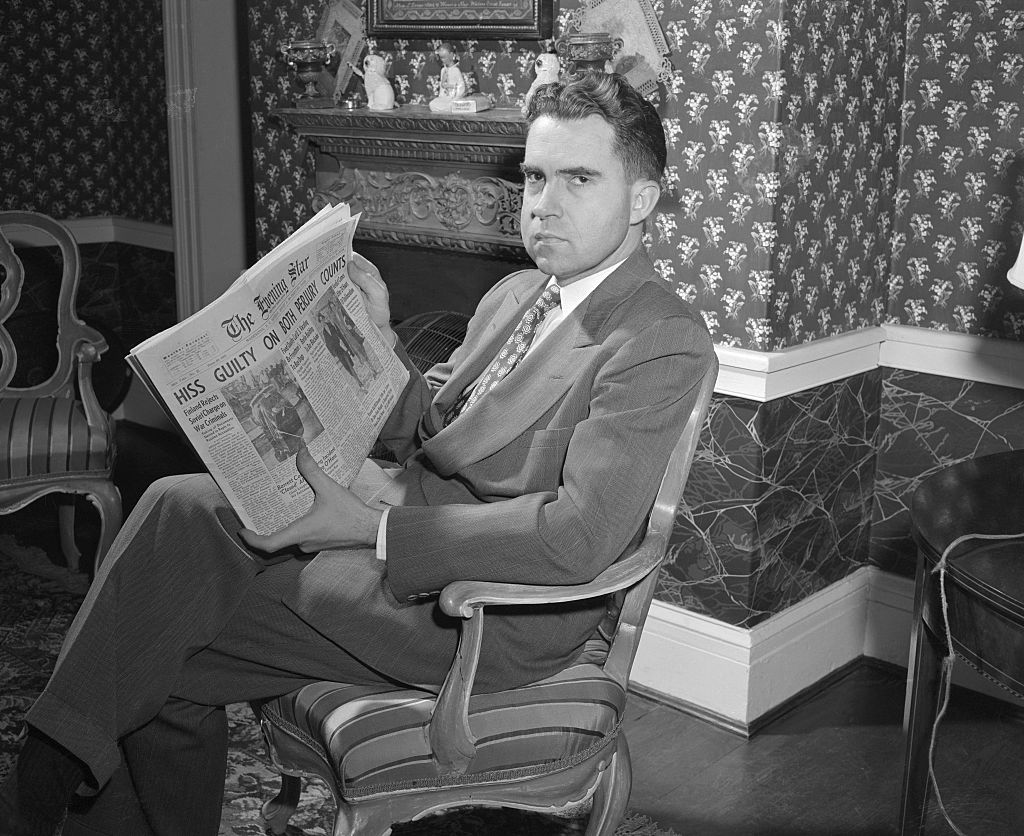
Richard Nixon, then a California Representative and an active participant in the House Un-American Activities Committee, displays a newspaper reporting the guilty verdict of Alger Hiss in January 1950. (Bettmann Archive / Getty Images)
Donald Trump’s political vocabulary is not especially original. When he calls Democrats “radical left,” “Marxists,” or “hardcore godless communists,” he recycles one of the oldest weapons in American political life: the charge that political opponents are not merely wrong but fundamentally un-American because of their alleged leftist ideology.
In his rambling social media posts and ham-fisted rants, Trump uses anti-communism as a blunt political instrument. He labels proposals for expanded health care, rent control, stronger unions, and higher taxes on the wealthy as evidence of some sort of communist conspiracy. Obviously, this is not analytical precision but brutish intimidation.
California, home of coastal elites who pride themselves on leading a progressive bastion of resistance to MAGA, should not dismiss this rhetoric as something imported from the reactionary red states of flyover country. Anti-communism has deep roots in the Golden State’s political history. In California, the legal and cultural architecture of the Cold War survives today.
California’s Cold War
The irony is as beautiful as a Malibu sunset. Trump and other right-wing ideologues routinely describe California as a “communist” state, an absurd insult to direct at one of the most heavily capitalist jurisdictions on Earth.
California is home to Silicon Valley, Hollywood, immense agricultural corporations, vast real estate fortunes, and some of the most concentrated private wealth in the United States if not the world. Calling California “communist” is not political analysis; it is a silly denunciation ritual. But it is a ritual with a history behind it.
In the late 1940s and early 1950s, California was a laboratory for Cold War repression. With the 1950 Levering Act, the state legislature required public employees to take a loyalty oath. The law reflected a climate where politicians claimed Communist Party members were an internal enemy seeking to infiltrate public institutions such as schools and universities.
University of California professors who refused to sign the oath lost their positions. As a graduate student teaching assistant at the University of California, Santa Cruz, in 1990, I was required to sign an iteration of the oath in my onboarding paperwork.
Californian anti-communism produced the Cold War’s most consequential conservative presidents. Richard Nixon began his career as a California congressman by pursuing Alger Hiss through the House Un-American Activities Committee (HUAC). This red-baiting made him a nationally recognized figure.
A middling Hollywood actor who had been elected as president of the Screen Actors Guild in 1947, Ronald Reagan willingly collaborated with HUAC. In the 1950s, he starred on a weekly television show called “General Electric Theater.” As well as introducing each episode, Reagan traveled across the country to tour GE plants and deliver free-market, anti-communist speeches.
He then starred in 1962’s “The Truth About Communism,” a propaganda film whose IMDb page includes a memorable line: “Top Cast: Adolf Hitler — Aleksandr Kerensky — Ronald Reagan.” After he retired from acting, Reagan entered politics by attacking the University of California, especially its Berkeley campus, as a symbol of decadence and decline.
During his 1966 gubernatorial campaign, he conflated student protests, antiwar activism, drugs, and sexual freedom with alleged communist influence. Promising to “clean up the mess at Berkeley,” he converted hostility to campus dissent into a central conservative political issue. Governor Reagan’s contempt for the Berkeley Free Speech Movement is the direct ancestor of Trump’s vilification of Columbia’s student encampment for Gaza. There is a line from Sproul Plaza to Hind Hall.
Legacies of Anti-Communism
Both Reagan and Nixon understood the domestic potential of anti-communism to discredit liberal institutions, discipline the Left, and mobilize conservative voters. Their California roots led to presidencies defined by military escalation, repression, covert intervention, and the assault on New Deal and Great Society liberalism.
With the Cold War now a fading memory, California’s anti-communist laws seemed increasingly anachronistic when State Senator Alan Lowenthal introduced Senate Bill 1322 in 2008. This would have repealed provisions that allowed the dismissal of public employees for Communist Party membership and removed related Cold War language from the state codes. The bill passed both legislative chambers but then ran into a successful countermobilization by the Vietnamese American community.
Vietnamese American lobbyists and politicians campaigned against it. Activists, including lawyer Nguyễn Quốc Lân, urged Republican Governor Arnold Schwarzenegger to veto the bill, for fear that it would permit communists to teach in California schools. Schwarzenegger answered their call, invoking the experience of Californians who had fled communist regimes and arguing that the state should keep the existing laws in place.
The episode demonstrates how anti-communism survives in the Golden State. Senate Bill 1322 would hardly have legalized violent subversion or served as a pathway to revolution. It would merely have removed archaic penalties for political affiliation while preserving the state’s power to punish advocacy of its violent overthrow. But refugees from one of the most successful revolutions in world history transformed a narrow civil liberties reform into a supposed threat to public safety.
The law’s legacy remains embedded in California’s legal bureaucracy. Government Code sections 3100–3109 still require public employees to take an oath before entering state employment. Currently the oath requires employees to support and defend the US and California constitutions, disavowing violent, unlawful revolutionary organizations.
Today California employees are not required to utter the clichéd declaration, “I am not nor have I ever been a member of the Communist Party.” Explicit Cold War anti-communism has given way to a broader prohibition on organizations advocating the overthrow of the government. But the relevant provisions flow directly from laws designed specifically to target Communist affiliation, while other sections of the Government Code still refer explicitly to Communist Party membership in background checks.
Diaspora Politics
Californian anti-communism also lives on in diaspora politics. After the collapse of the US-backed South Vietnamese regime in 1975, hundreds of thousands of Vietnamese refugees arrived in the Golden State. Southern California became the center of the largest Vietnamese community outside Vietnam.
Those who fled the revolution consider April 30, 1975, to have been the date of the “fall of Saigon.” The victorious Hanoi government prefers to speak of the city’s “liberation” (before it was promptly renamed Ho Chi Minh City). These new Californians refused to celebrate April 30 as the achievement of national unification. For them, “Black April” is a moment of catastrophe.
For these refugees and their descendants, the Republic of Vietnam’s yellow flag with three red stripes represents a lost homeland, family sacrifice, and displacement, but above all a mythologized resistance to communist tyranny in the name of freedom. Just as Miami’s Little Havana recalls pre–Fidel Castro Cuba with nostalgia, and West LA’s “Tehrangeles” reimagines the shah’s Iran as an era of progressive modernity, Orange County’s Little Saigon and San Jose’s Vietnamese neighborhoods invoke the alleged heroism of the Army of the Republic of Vietnam.
In these circles, discussion of endemic corruption, rigged elections, and bustling torture rooms under US client dictatorships is not welcome. These exiles silence the memory of Fulgencio Batista’s gangsterism, the brutality of Iran’s Bureau for Intelligence and for Security of the State (SAVAK), and the tiger cages of the Saigon regime.
These newly enfranchised Southeast Asian Californians made common cause with established white anti-communist Californians. In the reactionary Reagan era of the 1980s, firebrand conservative and Vietnam combat veteran Bob Dornan moved from liberal West LA to Orange County.
Behind the Orange Curtain, Dornan exploited the trauma of Westminster’s Vietnamese refugees for his political career. In the House of Representatives, while the Californian Republican was not particularly effective in pursuing a legislative agenda, he proved to be one of the most vocal cheerleaders for Reagan’s global anti-communist crusade.
As these Vietnamese émigrés passed their rabid anti-communism onto their children, the American-born generation continued to fight their lost cause. Despite his white nationalist anti-immigrant rhetoric and policies, Trump found a pool of MAGA loyalists in Little Saigon. In some of the most surreal images from January 6, 2021, Californian Vietnamese Americans marched on the US Capitol waving the South Vietnamese flag.
A Bipartisan Effort
In California, anti-communism is a bipartisan effort. In 2024, Democratic State Assembly member Stephanie Nguyen and her Republican colleague Tri Ta took issue with Los Angeles County’s decision to declare April 30 “Jane Fonda Day” in honor of her decades of progressive activism.
Nguyen and Ta argued that celebrating the woman dubbed “Hanoi Jane” by her detractors on April 30 was deeply hurtful to the Vietnamese community, which claims a monopoly of the date for their anti-communist rituals. Right-wing veterans and their supporters, who had never forgiven the young Fonda’s 1972 peace mission to North Vietnam, supported the protest.
California anti-communism can also take on much cruder forms. At a Trump-inspired anti-communist demonstration on Huntington Beach in 2017, a group of white men chanted, “You can’t run, you can’t hide, you’re going to get a helicopter ride,” while wearing shirts that depicted bodies falling from helicopters, invoking a global history of anti-communist state terror.
While Trump’s anti-communism is opportunistic, vulgar, and intellectually empty, it is effective because it draws upon institutions and memories that long predate him. Of course, California is not and has never been communist, but it has been and remains deeply shaped by anti-communism.