Peter Thomas Was a Marxist Intellectual With a Mission
Peter Thomas, the Marxist theorist best known for his work on Antonio Gramsci, has died. He restored the political edge to Gramsci’s theory of hegemony and saw his own scholarship as part of the Left’s fight for power.
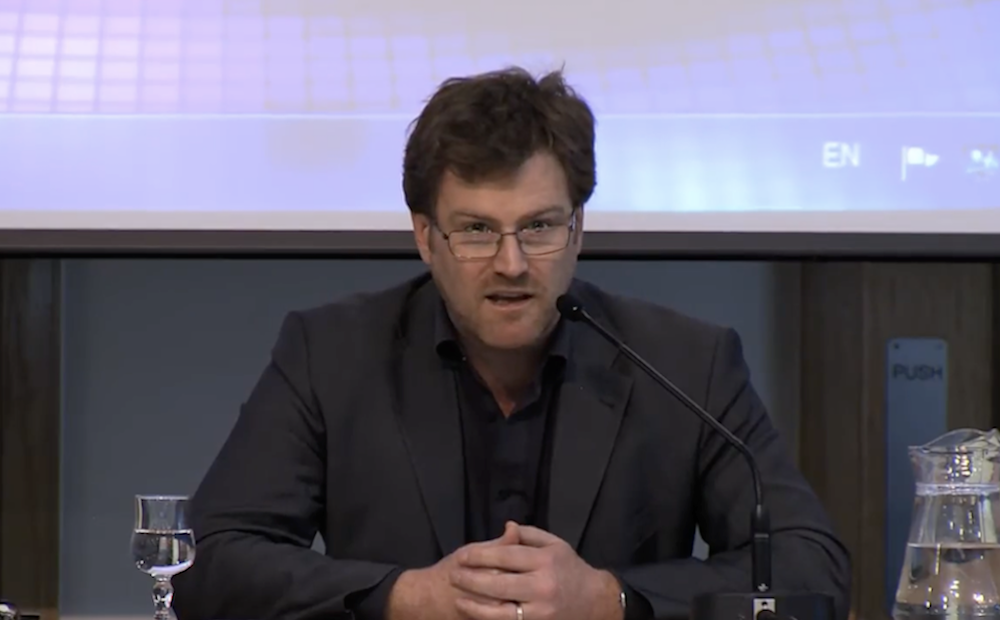
Peter Thomas’s work offered a powerful rethinking of politics beyond the alternatives of technocratic governance and populism. (YouTube)
It is difficult to write in memory of Peter Thomas. Not for lack of memories, but because there are too many. So many discussions come to mind, shared projects, collective volumes to which we both contributed. One obvious one is In Marx’s Laboratory: Critical Interpretations of the Grundrisse (2013), which Peter coedited with Riccardo Bellofiore and Guido Starosta. But my thoughts turn even more insistently to The Government of Time: Theories of Plural Temporality in the Marxist Tradition (2017), coedited by Peter and Vittorio Morfino. The preparation of that volume was accompanied by countless discussions and meetings. I remember one in Milan, intellectually lively, friendly, and full of good humor. In those discussions, Peter had a remarkable ability to defuse tensions and soften the occasional sharp edges of disagreement without compromising the intellectual or political rigor of the exchange. He did so naturally, with a joke and a smile.
But now other memories come flooding back. Peter, his family, his wife Sara, and their little girls. After I moved to California, it became more difficult for us to see each other and keep in touch. Yet only recently we had been in contact again, exchanging ideas and making plans for new projects. I had invited Peter to participate in a panel on my latest book, next month, at the Historical Materialism conference in London. He had gladly accepted and had already begun making plans for a dinner at his home. I still find it difficult to believe that I will not see him in London. I canceled the panel. It makes no sense to sit around discussing my book without Peter.
A few months ago, I had also asked Peter to write a review essay for Political Theory, surveying the major publications and interpretive currents in Marx scholarship over the past twenty years. Peter had agreed, asking only for a little more time because he was overwhelmed with academic commitments. For five years, if I remember correctly, he had been serving as head of department in Brunel’s Department of Social and Political Sciences.