China Miéville’s The Rouse Is a Haunting Magnum Opus
The Rouse follows a secret British effort to weaponize ghosts amid the Cold War and decolonization. A supernatural spy thriller, a Marxist meditation on history, and a stylistic triumph, China Miéville’s novel is a masterwork two decades in the making.
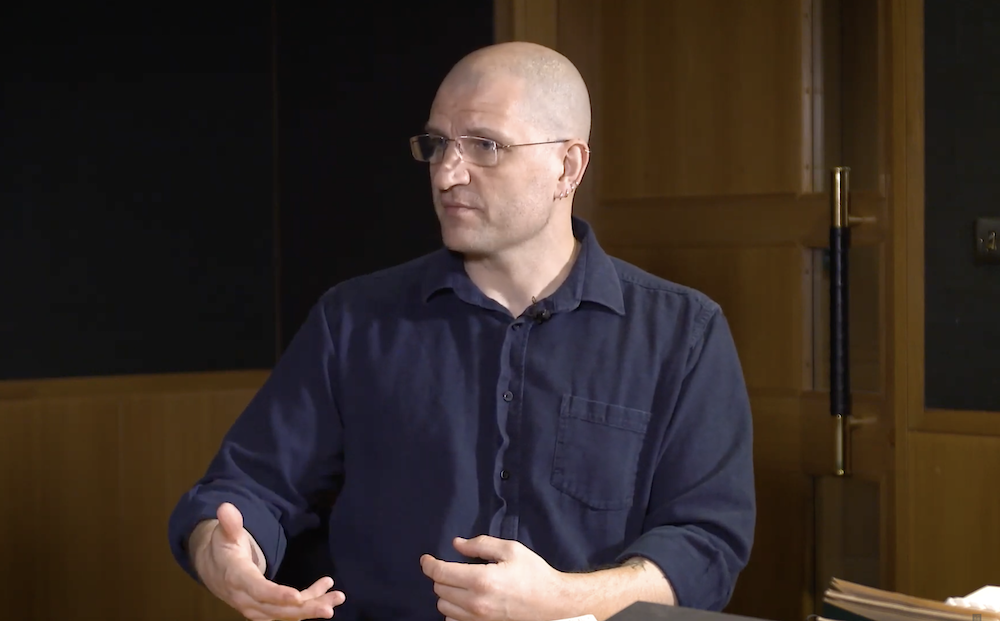
In his stunning new novel about occult espionage during the Cold War, China Miéville suggests that every ghost story is also a story about politics, economics, and history. (YouTube)
China Miéville’s The Rouse is a book that should not exist, and yet here it is. It should be read cover to cover, and then immediately read a second time. For twenty-one years, Miéville wrote and rewrote it while publishing shorter works at an impressive pace: four novels; two novellas; a history of the Russian Revolution; a book-length essay on The Communist Manifesto; an out-of-left-field collaboration with Keanu Reeves; a children’s book with Zak Smith; countless articles and reviews. Each of these now seems like a stepping stone on Miéville’s path toward his great project.
Into The Rouse’s 1,200-plus pages have gone a lifetime of writing as well as a lifetime of reading — Miéville’s influences range from pulp horror to high modernism, from Marxist theory to esoterica. From the bones of this personal canon, he has developed the most ambitious and successful synthesis of genre fiction, formal experimentation, leftist political commitment, and metaphysical inquiry produced in English since Thomas Pynchon’s Gravity’s Rainbow.
The novel weaves together two main threads, both written in an extraordinarily close third person. One begins in 1970s London and concerns Maureen Towns, a downwardly mobile single mother to a reserved, awkward, and increasingly violent son named Ewan. Through Maur’s eyes, we see Ewan grow fascinated with guns in his adolescence, join the military when barely out of his teens, report “see[ing] stuff” during a deployment to Sarajevo, become involved with shadowy acronymous divisions, and then finally turn up dead in the woods outside his barracks. When his death is ruled a suicide despite the two bullet holes in his temple, Maur begins to investigate and soon joins forces with other parents of soldiers who perished under mysterious circumstances.