Trump Family Prediction Market Conflicts Are a Good Bet

Donald Trump Jr is raising money for Polymarket and lobbying to shield prediction markets from regulation. There should be a thick wall between Trump family business and the presidency. An event contract on whether one exists might be a good investment.
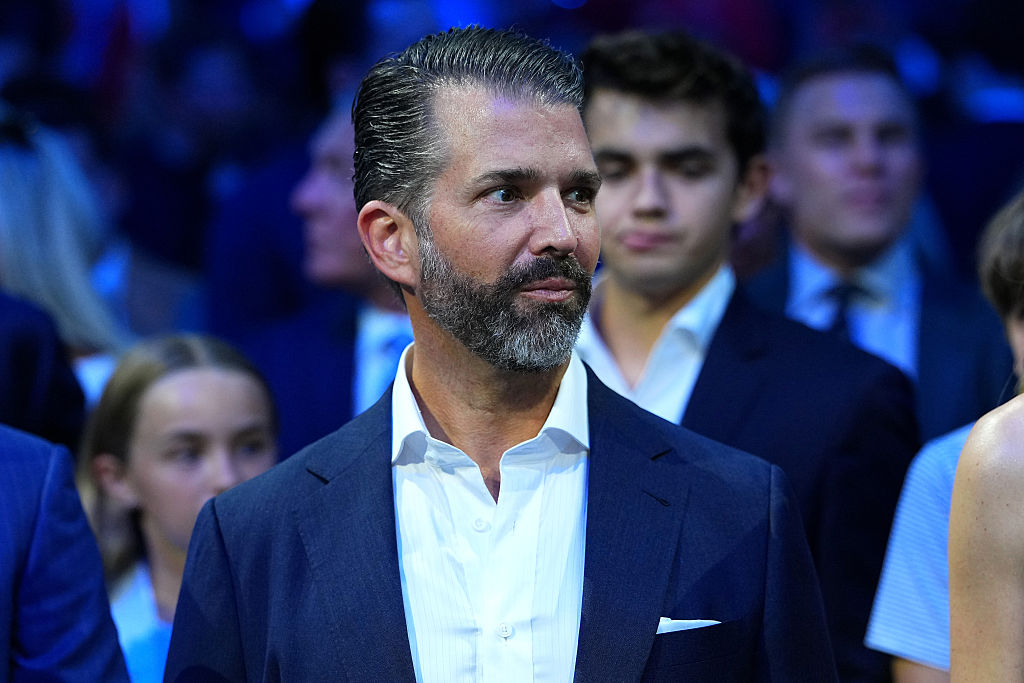
Donald Trump Jr is seen during the UFC Freedom 250 event on the South Lawn at the White House on June 14, 2026.

As the Trump family invests in prediction markets and Trump Jr lobbies to keep them lightly regulated, their harms are are increasingly clear. From distorting public expectations to fostering addiction, they are hard to defend except on mercenary grounds. (Jeff Bottari / Zuffa LLC via Getty Images)


There’s nothing to see here, folks. Don’t believe your lying eyes. The eldest son of the president of the United States and his investment firm, 1789 Capital, are raising money in a funding round for Polymarket, the gambling website that styles itself a “prediction market” and which DonaldTrump Jr’s firm values at $21 billion. But it’s a nothingburger. Really.

Except, if the relationship seems suspect on its face, that’s because it is. Trump Jr and his company stress that there’s a thick, heavy wall between his political connections — for instance, his father, the president — and his business activities. Never mind that, as the New York Times reports, the Trump family is invested in the “prediction market” business, and Trump Jr is an adviser for Polymarket and competitor Kalshi. Never mind that Trump Jr lobbied Republican state attorneys general to leave these companies alone as they sought regulatory capacity to rein in these gambling giants. So much for the wall between business and politics.

The New Threat on the Block

You can bet on just about anything on definitely-not-gambling sites like Polymarket and Kalshi. On an overcast Saturday morning, September 5, at 10:21 a.m. Eastern Standard Time, the “politics” tab on Polymarket’s site is offering odds on whether the Digital Asset Market Clarity (or CLARITY) Act will be signed into law (15 percent chance), the Federal Reserve rate decision in September (50 percent chance of a 25 basis points increase), and a Russia-Ukraine ceasefire by June 30, 2027 (57 percent).

The CLARITY Act, introduced in Congress by a Republican lawmaker, and backed by Donald Trump, would regulate the cryptocurrency market. Last week, President Trump threatened to stop trading with some US partners unless the Fed cut interest rates. On the weekend, Trump’s son-in-law Jared Kushner and US special envoy Steve Witkoff arrived in Moscow ahead of talks with Russia and Ukraine in an effort to end the war. A thick, heavy wall indeed.

Scroll down any politics or economic market page on Polymarket, Kalshi, or any of the newfangled gambling platforms, and you’ll find no shortage of wagers that could be affected by the activities of someone in or close to the Trump family. The connection between the Trumps and the gambling markets is a prima facie conflict of interest — one that should matter in a sane, stable, democracy, but doesn’t seem to in the United States today. It’s a risk that won’t abate.

In April, an American soldier was charged with using classified information to gamble on Polymarket, allegedly making more than $400,000 by misusing privileged information. The Anti-Corruption Data Collective has found evidence of more than 150 wallets on the platform that might be up to similar activities. In 2024, in the final hours of the Biden administration, someone made $300,000 betting on the outgoing president’s last-minute pardons. The profits were then sent to a crypto wallet. These stories are, predictably, a dime a dozen.

Las Vegas 2.0 in the Palm of Your Hand

Platforms like Kalshi and Polymarket stylize themselves as prediction markets, but they’re not. They’re gambling sites that you can hold in the palm of your hand and on which you can bet beyond sports to just about anything — emphasis on the bet.

Don’t buy into the industry propaganda that suggests these are prediction markets in which traders exchange contracts and forecast the future. Bettors on these sites place bets on events that may or may not unfold in one way or another, and those people will win or lose money based on the outcome of said events. That’s gambling, plain and simple. Labeling these platforms and actions as anything else is marketing at best.

In August, a federal appeals court ruled that these sites were indeed gambling platforms. The Trump-appointed judges decided the states could regulate such “exchanges” as gaming, rejecting the claim that participants were traders exchanging contracts and arguing that “the substance of the sports event contracts offered on Kalshi’s (exchange) is sports gambling, regardless of whether Kalshi calls them swaps.” Kalshi is, of course, appealing, and the fight is far from over, especially given that the Trump administration favors a light regulatory touch combined with political boosterism of the industry.

A Simple Solution to a Serious Problem

Neither the president nor anyone in his immediate family should be involved in gambling platforms as an investor, adviser, or gambler. To be involved in these sites is to invite corruption or the appearance of corruption, which for the purposes of public trust — or distrust — in government and democratic institutions is the same thing. Moreover, no one in the administration, the executive or legislature, organs of state, or anyone in the immediate family of someone in such a position should be involved in these platforms in any way, and for the same reasons. This would rule a lot of people out of the market, but why shouldn’t it?

There’s a better solution still. Ban these monstrosities altogether. The risks that accompany real-world-events gambling platforms are serious and go well beyond sowing institutional distrust and enabling corruption. Nizan Geslevich Packin and Sharon Rabinovitz argue that so-called prediction markets are a public health threat that foster addiction. With the risk of addiction comes all the usual deleterious outcomes, from financial ruin to crime. And it gets worse.

The risk extends beyond individuals, though, to shaping the very events that bettors are gambling on in the short, medium, and long term, alongside attitudes toward their underlying issues. As these platforms style themselves as aggregators of public opinion and expectation — even as forecasters — there is a serious threat of deliberate or accidental manipulation of reality and producing bad outcomes.

In the Guardian, economic historian Jamie Pietruska references this risk for climate change and bets on the future of global temperatures: “If I go online and see the perception that the world will pass 2°C (3.6°F) warming by 2050, it creates a sense of a predetermined future, even though this is an aggregation of public opinion. It’s not a truth machine.”

Platforms like Polymarket and Kalshi provide no tangible good for society, but plenty of tangible bad. They have no reason to exist beyond further enriching a handful of powerful, wealthy people and leaving everyone else rolling the dice to make mortgage or rent payments in a market where, like casinos, the house always wins. In such a world, the second-best option is not to play; the best is to make sure no one can.