The Dog Stars Is a Western in Postapocalyptic Drag
Ridley Scott’s The Dog Stars is a postapocalyptic thriller without thrills, resting on the shoulders of a mopey Jacob Elordi, who’s far from up to the task. What the film does have is a frontier fantasy it can’t stop indulging.
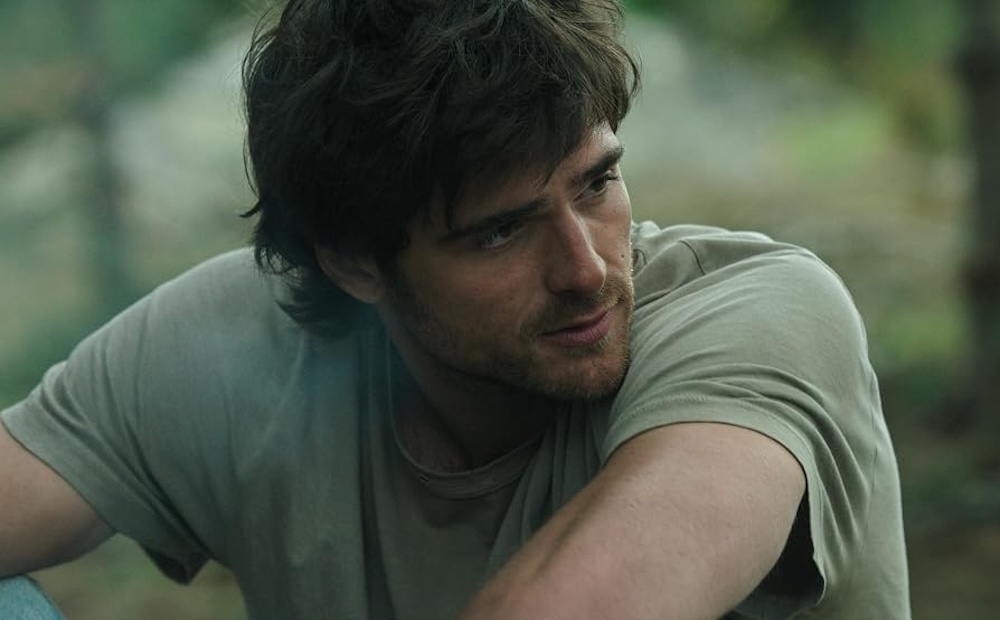
Jacob Elordi should never again play a depressed man wandering around lost in his own inner turmoil. Ridley Scott’s The Dog Stars is all the proof you need. (20th Century Studios / Scott Free Productions)
The dullest yet most enraging film of the year may very well be The Dog Stars, a draggy postapocalyptic thriller with no thrills, even of the grim dystopian kind.
This latest effort by director Ridley Scott, from a screenplay by Mark L. Smith (Twisters, The Revenant) based on the 2012 novel of the same name by Peter Heller, is about the survivors of a flu pandemic who live in isolated enclaves defending their turf from marauding bands of desperate nomads.
Jacob Elordi plays Hig, an ex-mechanic turned prop pilot whose last remaining relationship from the old days is with his dog, Jasper. Jasper is a cool dog, a Belgian Malinois, who keeps whining nervously as if he knows he’s not safe with Hig. They fly around Colorado in Hig’s little putt-putting plane, fetching supplies for Hig’s enclave and the nearby hilltop group of Mennonites led by the fatherly Aaron (Benedict Wong). Then it’s back home to the fort-like settlement with tough ex-Marine survivalist Bangley (Josh Brolin) as Hig’s only human company.
A Man Well-Suited to the Apocalypse
They’re not really friends though. “You like this,” as Hig puts it. “You were living like this ten years before it happened.”
And it’s true, Bangley is well-suited to the postapocalyptic life. He looks most at ease up in the rudimentary watchtower, ready to gun down anybody who comes into their area. Mostly the trespassers are “just kids,” though they might be flu-ridden kids, and they’re certainly looking for food in an age of scarcity, so Bangley shoots them dead regardless. Though he’s really waiting for worthier opponents — a fifty-man gang of tattooed, knife-wielding skinheads howling for blood, say — who inevitably arrive. When they do, he’s armed and ready for them, and mutters, “’Bout time.”
Bangley’s attitude toward Hig is no more complimentary, though he’s adamant they should stick together in their two-man camp for the sake of their own survival. Hig is a brooding hunk who’s always distracted by the idea that civilization must be back up and fully functioning somewhere out there. After picking up repeated radio signals, he’s convinced that place is Grand Junction, Colorado. He’s fixated on flying his plane there, a precarious journey into the savage unknown based on what might be decoy signals to lure in fresh supply-bearing prey.
Bangley calls Hig a “consistently stupid bastard,” and he’s not wrong. It’s hard not to feel massively impatient with Hig, who’s lost in nostalgia for his late wife and old ways and can’t seem to stop risking the lives of the few who are left. If Hig takes off, that leaves Bangley entirely on his own, plus the Mennonites don’t have any access to outside-world supplies either. As for Jasper, well. . . . don’t ask. That dog knew he was in big trouble with Hig.
We’re seeing the limits of Jacob Elordi’s acting ability and star quality here. He should never again play a depressed person wandering around lost in his own inner turmoil, because he really doesn’t do it well. He just looks handsome and mopey.
Of course, Hig flies off regardless of anybody else and winds up crashing his plane almost immediately. He finds an enclave in the woods featuring another crusty stand-your-ground, shoot-first old guy named Jack (Guy Pearce), an ex–Navy SEAL. Jack’s getting along by subsistence farming with his daughter Cima (Margaret Qualley), a widow and former medical student, and one lone donkey, another doomed animal you have to feel bad about. Cima persuades Jack, aka “Pops,” not to kill Hig, presumably because he’s the only hot young male left alive.
So instead they help Hig fix his plane as well as clear a runway for it through the trees. This requires cutting down pines and pulling up their stumps. It was while Jack and Hig were working together to uproot one stump that I suddenly remembered the epic stump-clearing scene from the old 1953 Western Shane. And that’s around when the movie turns into a retro-Western, the one featuring lone gunslingers and tough ranchers laying down their weapons and working together to clear the land and make the wilderness into a garden. And of course, they’ll have to clear the land of heathens too, so very soon their little homestead is threatened by a shrieking band of face-painted warriors on horseback.
Once you know what kind of fantasy you’re in, the rest decodes itself. This is the one that pretends to be dismally postapocalyptic but doesn’t actually mourn the loss of civilization at all, as you see when you meet its chief representative, Allison Janney as Darlene, a sadistic sicko in a stewardess uniform acting as the dictator of an airport enclave. Who wants to go back to that when you can return to the restored wilderness as a heroic white settler in the world where men are men again, fulfilling their Manifest Destiny, and women appreciate them properly? When you can start all over again with tons of land to spread out on and all the resources that the deceased population of the world won’t be needing anymore?
A Western Neverland
You know that famous scene in the John Ford Western My Darling Clementine (1946), when Wyatt Earp, all duded up, goes to an open-air dance on the newly constructed floor of the unfinished church and dances awkwardly but charmingly with the idealized young lady of refinement? And the whole town of Tombstone is there to participate in the refounding of a Western Neverland version of the United States, freed of the more corrupting influences of Europe and the urbanized multiracial East Coast? Yep, it’s redone here. There’s an open-air dance at the Mennonite enclave — which motivates the proper Western iconography of nineteenth-century work clothing, with wide-brimmed hats and all — that unites all the survivors of the former enclaves, Hig and Bangley, Jack and Cima.
John Ford at his corniest wouldn’t go as far as this scene does in celebrating the lovable neo-pioneers. Even Bangley, the avid killer, is revealed to be a delightful scamp in the end, picking up a guitar to play with the little band of local musicians that sprang up out of nowhere to play an old-timey dance tune for the stomping, grinning locals.
The Dog Stars is bombing at the box office, as the public quite rightly avoids it like the plague. At this point in our history, this kind of revanchist shit is just unforgivable.