The Union Deal That’s Undermining Gig Workers
Drivers for companies like Uber and Lyft are wildly exploited, largely because they’re misclassified as independent contractors. Recent union deals to protect those drivers leave them as independent contractors — just the way the rideshare bosses want it.
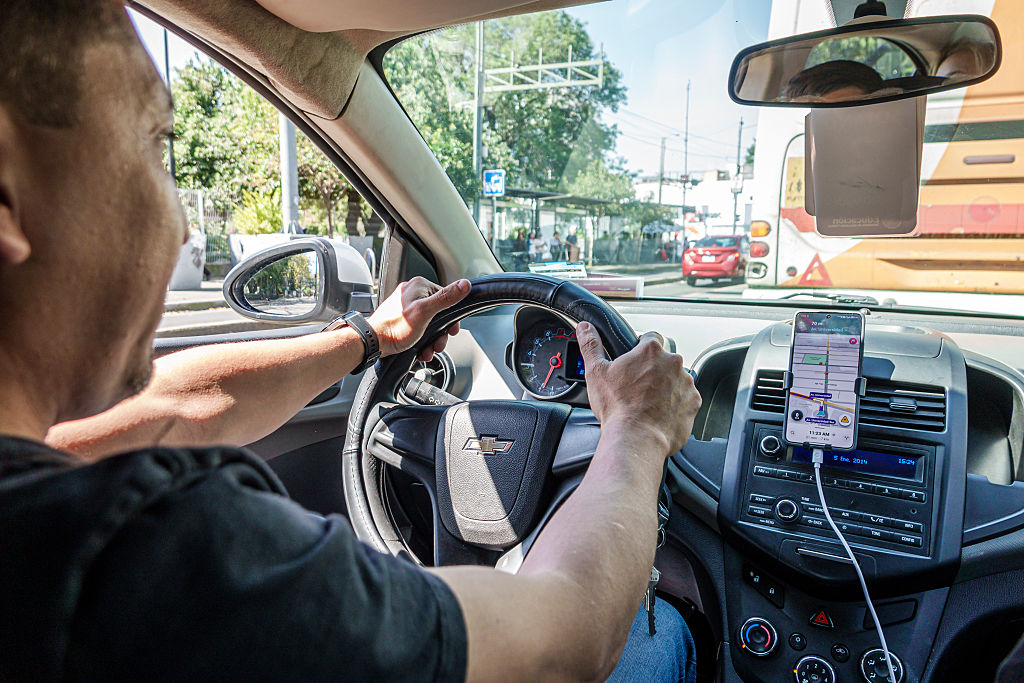
Legislation extending collective bargaining rights to gig workers has positioned some union locals to represent hundreds of thousands of rideshare drivers — with little input from those workers themselves. (Jeffrey Greenberg / Universal Images Group via Getty Images)
In recent months, unions in the United States and Canada have been claiming victory in gig worker organizing. In May 2026, Uber settled its first collective bargaining agreement with drivers in Victoria, British Columbia. Massachusetts has recognized a union representing seventy thousand Uber drivers, constituting what labor leaders describe as “the largest private-sector organizing win” since the United Auto Workers unionized the Ford Motor Company in 1941. This long-standing record has since been outdone again as the Service Employees International Union (SEIU)–affiliated California Gig Workers Union was named the “union of record” to represent potentially two hundred thousand app-based drivers in the state, establishing “the largest union of gig rideshare drivers in the world.” Legislation allowing drivers collective bargaining rights has also passed in Illinois. All of this, on the surface, enables the possibility for record numbers of workers to be brought into the labor movement.
That companies like Uber and Lyft would allow workers to have a say in their own pay and conditions — when their entire business model has been predicated on flouting labor law through misclassification — would be remarkable, and undoubtedly signal that we have reached a turning point within the struggles for gig worker justice and, more broadly, within platform capitalism.
If only it were true.
For years, worker-to-worker organizing efforts have raised the alarm on platform capitalism’s hyperexploitation. App-based workers demand fair pay, transparency, due process in deactivations, and the protections that come with employee status. Rideshare Drivers United (RDU) in California, for example, emerged out of efforts to challenge low pay and unfair deactivations by drivers who first met each other at the Los Angeles International Airport lot. Using social media and a purpose-built app called Solidarity Tech, drivers scaled up their organizing capacity, ultimately leading a global strike in May 2019 on the eve of Uber’s initial public offering (IPO). The App Drivers and Couriers Union in the United Kingdom organized similarly without the institutional support of Trades Union Council affiliates. In New York, Los Deliveristas Unidos has built solidarity among the largely immigrant delivery workforce along the lines of the worker center model, while the New York Taxi Workers Alliance — an affiliate of the AFL-CIO without any collective bargaining rights — has fought tirelessly and successfully for regulation of the rideshare industry.
Scaled up and in alliance with unions that prioritize building bottom-up driver power, self-organized platform worker organizations could significantly improve hundreds of thousands of lives. Such an approach would help ground the struggle against Silicon Valley and AI within immigrant working-class communities. It could be a central strategy in the larger struggle against authoritarianism.
But the window of opportunity for labor to facilitate rank-and-file organizing among the most precarious workers in today’s volatile political economy seems to be closing. Legislation extending collective bargaining rights to gig workers has positioned SEIU locals to represent hundreds of thousands of gig workers. Signaling a settlement between labor and industry on the gig work question, this deserves critical attention.
From Neutrality Agreements to Partnerships
Since the 1990s, unions have sought neutrality agreements with private employers, allowing staff organizers to sign up members and avoid the extreme retaliation workers face in the National Labor Relations Board process. The late labor organizer and strategist Jane McAlevey critiqued this approach for relying on top-down campaigns as “shortcuts” around the deep organizing needed to win strong contracts and sustain a worker-driven movement. The gig economy has magnified this challenge as platforms circumvented labor law through worker misclassification. Uber came to a $100 million class action settlement in Massachusetts and California, agreeing to help form “driver associations.” While the attorney representing the drivers said that these organizations “can play a role similar to a union,” one key difference is that — exempt from the National Labor Relations Act of 1935 (NLRA) and the Fair Labor Standards Act — Uber could play a role in funding these groups.
Uber formed the Independent Drivers Guild (IDG) in partnership with the International Association of Machinists (IAM) in New York and ultimately also brought this approach to both Massachusetts and Illinois. While drivers organized independently in these states for years, IAM and SEIU have sought to make deals with Uber behind closed doors while advocating for state-level legislative reforms. Forming the Massachusetts App Drivers Union, the Machinists joined forces with SEIU and its building service Local 32BJ and supported extending collective bargaining rights. Together they won the right to bargain with Uber not through the mass organization of seventy thousand drivers across the state but through a ballot measure in 2024.
California rideshare drivers won collective bargaining rights through legislation, but drivers had little say in what this legislation would look like. It came through a deal brokered between Gov. Gavin Newsom, Uber and Lyft, and SEIU California. In exchange for the company’s support, SEIU sponsored SB 371, which reduces the companies’ mandate to provide coverage for accidents — from up to $1 million in damages to $60,000 per person — where the app-based driver is not at fault.
The Misclassification Consensus
Uber’s willingness to work with major unions has been predicated on conceding that app-based workers would not be classified as employees. While this may be seen as a labor victory, app-based drivers will be negotiating from a far worse position than classified employees do. As misclassified workers, drivers have no effective minimum wage. Laws like California’s Prop 22 mandate that drivers be paid 1.5 times the local minimum wage, but it is only based on “engaged time” — the time from when a driver accepts a ride to when they drop the passenger off at arrival. The time between rides, determined by algorithmic management, is unpaid. AB 1340 names earnings as an optional — not required — topic of sectoral bargaining.
Drivers’ low wages are further eaten up by the high expenses on their own vehicles, gas, upkeep, and insurance. As employees, US workers are reimbursed at the Internal Revenue Service rate, currently at ¢72.5 per mile, for driving as part of their job. This all amounts to a significant amount of money that workers must take out of their own paychecks to cover ever increasing gas prices and auto repair costs.
A 2022 collaborative study between Rideshare Drivers United and PolicyLink found that the median net income was $6.20 per hour, and the lowest amount any driver in the study earned was $4.10 per hour, after all expenses and all on-app time were considered. Drivers would earn roughly $11 more per hour if they were classified as employees. As independent contractors, drivers will have to negotiate themselves out of this massive deficit just to attain what should be the bare legal minimum. Large unions are trading away these rights in exchange for sectoral agreements that minimize the voices of workers themselves.
Sectoral Bargaining or Company Union 2.0?
Rather than requiring majority support from a bargaining unit, the legislation and agreements between Uber and large unions all set low thresholds necessary to certify a bargaining agent — 25 percent in Massachusetts and Minnesota, and 30 percent in California. In California, a union will be given the information for all “active drivers” — those who have completed twenty rides in the prior six months — after attaining signatures from 10 percent of the proposed unit. AB 1340 mandates that the unit in California comprise the entire state, an estimated two hundred thousand drivers. With such low thresholds, critics emphasize that workers will not be able “to meaningfully decide, as a group, whether to accept or reject the bargain” to ensure “procedural fairness . . . and that any bargain is substantively good for the workers affected.”
Although democratic worker-led organizing could help push for stronger sectoral agreements, this approach to sectoral bargaining seems poised to require little rank-and-file commitment or risk. Legal scholar Veena Dubal notes that unions and platform companies have been discussing sectoral agreements behind closed doors since 2019 to the exclusion of drivers. As such, language in AB 1340 ensures that SEIU Locals 721 and 1021 — the major public employee unions in southern and northern California, respectively with a combined membership of 160,000 workers — are effectively the only unions eligible for recognition. Workers didn’t have much of a choice.
IAM has long taken money from Uber to support the work of IDG in New York. Uber has also partnered with existing powerful unions in Australia and the UK to create similar arrangements. The new wave of laws and agreements suggests the expansion of this strategy, allowing for companies to funnel money to unions through deactivation clinic partnerships. Such agreements’ legality are based on gig workers being exempt from the NLRA but being governed under the state-level legislation and enforced by public employee relations boards. Perhaps most devastatingly, the legislation is unclear as to whether drivers have the right to strike as independent contractors. Without the ability to collectively withhold labor, what leverage would they have in negotiations?
At best, the proposed model constitutes a shortcut around deep organizing to gain representation of hundreds of thousands of workers. At worst, it may become a site of corruption where companies and unions work together to manage the political impulses of low-paid precarious workers, a zombie revival of the company union of the 1920s. Company unions weren’t just anti-worker; they were anti-democracy. The corporatism — the integration of the state, big business, and the working class — that they embodied was part of an American fascist movement, similar to formations that took root in Benito Mussolini’s Italy at the same time.
In the United States, company unions were made illegal by the NLRA. As the gig economy carves out exemptions for itself, it undoes the New Deal. Against a backdrop of increasing authoritarianism — with Silicon Valley a visible willing partner — labor’s consent to such terms is disappointing, if not chilling.
Toward International Platform Worker Solidarity
In our book Notes Toward a Digital Workers’ Inquiry, my collaborators and I highlight the struggles of self-organizing digital worker campaigns, many of whom are misclassified and denied full labor rights. Rather than approach this understanding from the perspective of the organizations cutting deals, we examine them from the perspective of workers themselves, in solidarity with their own organizing efforts. As a collaborative effort, digital workers’ inquiry can feed into labor organizing efforts within and against digital capitalism and help develop strategies for a more democratic labor movement.
Independent worker organizing must continue globally. The International Association of App-Based Transport Workers, which was founded after RDU led the global strike against Uber’s IPO in 2019, has played a major role in pushing forward new standards for “decent work in the platform economy” adopted by the International Labor Organization (ILO). The convention calls for member states to “take measures to respect, promote and realize, in the platform economy, the fundamental principles and rights at work” including “freedom of association and the effective recognition of the right to collective bargaining.” In addition, states are “to ensure the correct classification of digital platform workers in respect of the existence or non-existence of an employment relationship.” While the United States opposed this, the convention was passed in a vote of 406–8.
Gig workers have, over the course of the last decade, built their own organizations and through their collective activity changed the discourse about platform labor. By fighting their bosses, they have garnered media attention and won the ears of policymakers, making it clear that this is not a “sharing economy” or a way to “get your side hustle on” but a new model of exploitation that uses technology to target the most vulnerable workers. They have done this with minimal institutional backing, funding, and political support. The fight for gig workers to have their labor rights recognized has always been uphill.
Guided by the principles outlined by the ILO, workers in the United States can play a role in supporting their siblings abroad, even as they face legal challenges and, potentially, hostility from bosses and some unions alike. We must make sense of the range of experiences that platform workers have from country to country, and to develop strategies that unite them across disparate experiences to demand justice. Platform labor’s fight has not been won, but neither is it over.