Tony Is a Terrific Coming-of-Age Story
Matt Johnson’s Tony takes a few pages from Anthony Bourdain’s best-selling memoir and turns them into a warm, character-driven film about a spoiled kid learning how to work. It’s fantastic.
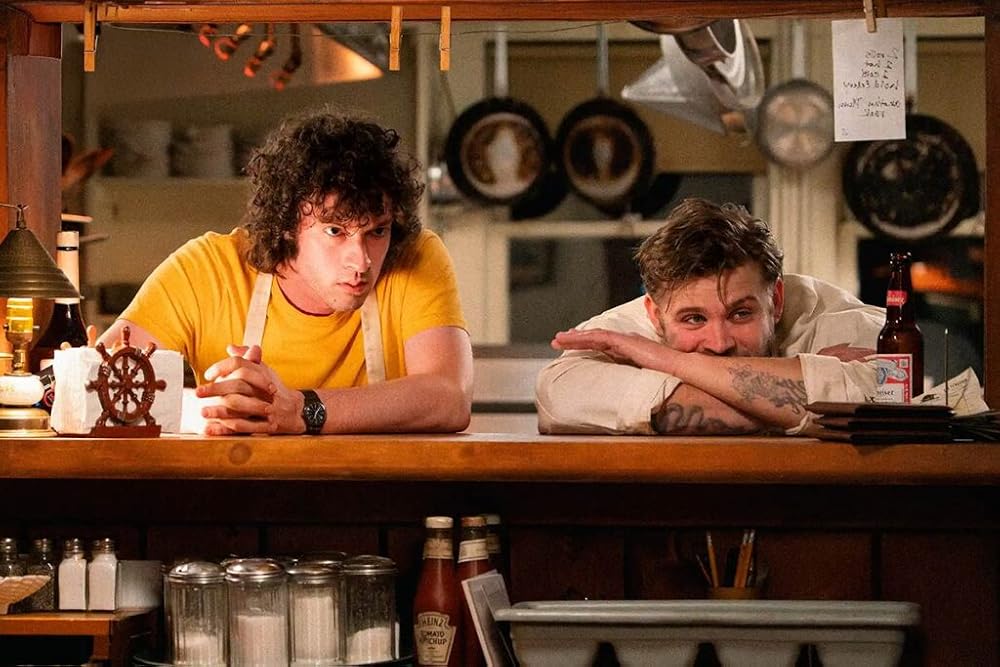
The macho posturing of restaurant kitchens is all over Tony, the same way it’s all over Anthony Bourdain’s memoir. The film is about growing out of it. (Star Thrower Entertainment / Zapruder Films)
A loose adaptation of just a few pages from the memoir that made Anthony Bourdain famous, Tony is a triumph of warm, earthy, character-centered filmmaking on a modest scale. Writer-director Matt Johnson (BlackBerry, Nirvanna the Band the Show the Movie) focuses the film on one fateful summer in 1975, when glowering, disaffected nineteen-year-old Tony Bourdain (Dominic Sessa) gets his start in restaurant work as a lowly dishwasher in a Cape Cod seafood joint.
This film will make a great double feature with Alexander Payne’s delightful Christmas movie The Holdovers (2023). Both star the highly talented Dominic Sessa as a troubled teen acting out furiously while coming of age in the 1970s, and both center on brief but intense vacation interludes when a small cluster of characters, pushed together by circumstances, forge unexpectedly important and memorable relationships.
The Holdovers is about a group of boarding school kids whose rich parents don’t bring them home for the holidays, leaving them in the charge of a crusty, isolated, misanthropic middle-aged teacher (Paul Giamatti) who gradually becomes an unexpectedly valued mentor. In Tony, the mentor figure is the self-contained middle-aged “Chef” Jose Vatel (Antonio Banderas), who’s the owner of the seafood joint called the Flagship and the representative of the local Portuguese fishing community in Provincetown, whose traditions have waned over time. He employs a motley crew of cooks: charismatic young hard case Sal (Leo Woodall), garrulous shit-stirrer Stavros (Stavros Halkias), and silent, middle-aged, ultracompetent Tyrone (Michael Jibrin).
Chef has Tony thrown out of his place for drunken offensiveness — he’s rude to bartender and counter server Mary (Monica Raymund) and actually puts his hand on her arm, which will not be tolerated at the Flagship. Tony gets efficiently bounced out of the place by Sal, who pauses curbside over the unconscious Tony to help himself to all the money in his wallet. Upon seeing Tony passed out in the gutter, Chef relents and allows him to sleep on the hammock strung up on the porch of his beachside home. He also lets Tony earn his keep by washing dishes at the Flagship, which is always frantically busy serving up fishy fast food to summer tourists.
Chef’s reasons for helping Tony are initially mysterious, as are many things about him that he doesn’t discuss — his serious religious beliefs, his personal life, his illustrious culinary past, and his habit of rousing Tony from deep sleep every morning by dumping a bucket of seawater over his head as a kind of ultimate wake-up call. But eventually it becomes clear that he does all this for one reason only, the same reason he gives for hiring Sal and presumably all the other kitchen staff members — he likes them. He sees potential in them.
And Tony is hard to like. The film opens with a title-card quote from Bourdain’s memoir: “I was — to be frank — a spoiled, miserable, narcissistic, self-destructive and thoughtless young lout, and badly in need of a good ass-kicking.”
Tony is also an insecure liar of such fantastical proportions that he winds up juggling various false accounts of what he’s doing over the summer to his parents, Pierre and Gladys Bourdain (Rich Sommer and Dagmara Domińczyk), his boss Chef, his new workplace friend Sal, and his big high school crush, Nancy (Emilia Jones). We see the development of the lies from the start of the film as Vassar College student Tony presents himself as a bildungsroman-writing wunderkind to a triumvirate of professors in charge of awarding a prestigious writing fellowship. Tony then brags that the fellowship is essentially in the bag to his friend in a local Poughkeepsie bar, and to Nancy, whom he’s trying to impress, and to his parents — most painfully, his observant, judgmental, and undermining mother, who isn’t buying his latest tall tale.
All of which makes it awkward when he gets turned down for the fellowship.
Refusing to admit the humiliating truth to anyone, he heads off to Cape Cod in pursuit of Nancy, because she said she’d be working there over the summer. When he sees her again on a Provincetown dock, he lies, of course, claiming to have no memory of her mentioning her destination — it’s a mere coincidence that he happens to be there on fellowship, writing his bildungsroman. But Nancy’s already got a boyfriend at the pizza joint where she works, so Tony gets drunk in teenage despair at the Flagship that night, and the rest is history.
Tony is impressed by the raucous, profane, high-living, drug-and-liquor-fueled ways of the Flagship’s cooks, Sal and Stavros, and their tough camaraderie in a demanding profession. There are immediate tests of strength and know-how that Tony fails. He’s too weak to pull down the heavy lever of the wall-mounted potato cutter, and when he lies about having cooking experience, he’s immediately exposed as a fake by Sal and Stavros, who tell him to pick up a cast-iron skillet with a handle they know is red-hot. He drops it howling and calling for anti-burn ointment, while Tyrone, with silent contempt, picks up the dropped skillet with his bare, scarred, kitchen-toughened hand.
The film is chockablock with great performances. Sessa fulfills his Holdovers promise while raising concerns that he’s already typecast as a miserable, vulnerable, angst-ridden, self-obsessed, overly privileged young bastard who learns to be a decent human being. Antonio Banderas is so good as Chef: so full of quiet, eccentric humor and intense unspoken feeling, he’s almost sure to be nominated for a Best Supporting Actor Oscar, and he’ll have been robbed if he doesn’t get it.
But the scene-stealing breakout performance is by British actor Leo Woodall as Sal, a callous, swaggering young American thug so effortlessly magnetic that he’s a real danger to impressionable punks like Tony, who immediately takes him as a role model. He’s also a lure and a menace to every young woman of just-barely-legal age that he meets. Stavros sneers that Sal has the age of consent memorized in every state of the union.
For all the macho hijinks and strutting tough-guy attitudes that are central to Tony — as they are to Kitchen Confidential as well — the whole poignancy of the film is about overcoming them in order to grow up and develop sufficient perception, compassion, and ability to appreciate other people that you’re not doing damage to yourself and others absolutely everywhere you go. Anthony Bourdain became an inspirational figure on the political left especially because, for all his early privilege and arrogance, he learned through cooking and eating all sorts of foods made by all sorts of people all over the world, and documenting it, to be a real mensch, respectful and appreciative and discerning.
Tony might seem minor as a biopic, concerned as it is with only a sliver of Bourdain’s lifetime experience. But it’s presented as the crucial sliver when he finds an infinitely better way forward. Ironically, it turns out to be quite a wise and touching bildungsroman.