The Fight for Abortion Rights Was Won in the Streets
Half a century ago, feminists won Roe v. Wade with mass demonstrations and a sweeping national vision. A veteran of that movement argues that today’s fight requires the same strategy.
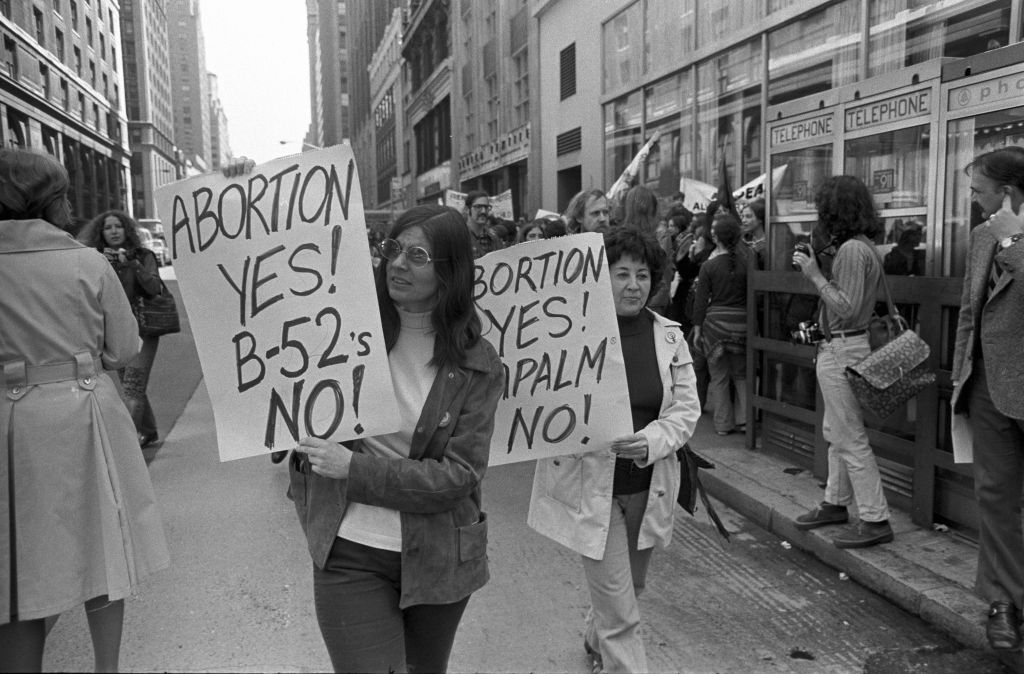
Roe v. Wade wasn’t won quietly behind the scenes — it was won by a mass movement with national demands. (Bob Parent / Getty Images)
Four years after the Supreme Court’s decision overturning Roe v. Wade and the federal right to abortion, the rate of abortion has actually increased.
According to the Society of Family Planning, in 2022 there were 80,000 abortions per month in the United States; in the first half of 2025, that figure had risen to 99,000. This increase, despite bans and other restrictions, is telling. Alongside it are advances in reproductive care, most notably the widespread use of medication abortion, often obtained through telemedicine. In the first half of 2025, for example, 27 percent of all abortions were provided through telehealth.
Nevertheless, thirteen states have imposed total bans on abortion, and seven others have partial bans. These have resulted in hardship and sometimes death. Despite these outcomes, the attacks on abortion access continue. In response, organizations that support women seeking abortions have proliferated, employing a range of methods, from legislative campaigns to abortion funds that raise money, organize transportation, and otherwise ease the burden on those trying to end their pregnancies.
In this light, it’s useful to step back and look at how we won legal abortion nationally the first time: what groups existed and what strategies and tactics they employed. Not all of it remains applicable today, but the history contains lessons for those fighting to regain abortion rights. This article will focus on one group in particular: the Women’s National Abortion Action Coalition, known as WONAAC, of which I was an active member.
The World Before Roe
Understanding the landscape women faced in the years before 1973 helps explain what drove abortion rights activists. Those of us in Boston Female Liberation, for example, confronted a particularly reactionary situation. Massachusetts had a 124-year-old statute on the books, the Crimes Against Chastity, Morality, Decency and Good Order law, which not only banned nearly all abortions but prohibited unmarried women from getting birth control information — much less actual contraceptives — even from licensed physicians. The only way to obtain a legal abortion in the state was to secure the approval of at least two doctors, including a psychiatrist, attesting that carrying the pregnancy to term would cause serious physical or mental harm.
The facts show a stark reality. According to the Guttmacher Institute, by 1965 the number of deaths from illegal abortions had fallen to just under two hundred — but illegal abortions still accounted for 17 percent of all deaths attributed to pregnancy and childbirth that year. In New York City in the early 1960s, one in four childbirth-related deaths among white women was due to abortion; among black and Puerto Rican women, it was one in two.
The abortion issue was central to the new wave of feminism that exploded in the late 1960s. In August 1970, fifty thousand women marched in New York City, with actions in ninety other cities, marking the public emergence of the women’s liberation movement. The Women’s Strike for Equality had three demands: free abortion on demand and no forced sterilization; free community-controlled twenty-four-hour childcare centers; and equal opportunity in jobs and education.
Feminists like us in Boston Female Liberation saw abortion as central. We knew that without control of our bodies, we would never be able to control our lives. “Abortion: A Feminist Perspective” appeared in Female Liberation’s magazine, The Second Wave, in 1971. In it, Nancy Williamson wrote:
We can go on dying from illegal abortions, bearing unwanted children, and suffering the guilt and pain and social stigma that is imposed upon us by this government. Or we can make a concentrated effort right now to change the laws in every state in the country. We didn’t choose the abortion issue. It chose us.
One Thousand Women vs. Connecticut
WONAAC grew out of the campaign around Women vs. Connecticut. The plaintiffs in the case — more than one thousand women — aimed to overturn the state’s oppressive law, which at the time allowed abortion only when necessary to preserve the life of the mother. Women who had abortions, as well as anyone who performed them or helped women arrange them, could be imprisoned or fined.
A Women vs. Connecticut organizing pamphlet from 1970 described the goal of the lawsuit:
Women vs. Connecticut has not chosen to try and change the law because we believe in the power of the law to bring about the liberation of women, or even because we are convinced that once the law is declared unconstitutional all women who need them will be able to get abortions in Connecticut. We see changing the law only as a necessary first step toward making those things possible.
The women involved saw the need for a national focus to the many statewide fights underway at the time.
Repeal, Not Reform
WONAAC held its first national conference in New York City in 1971. The call for the conference declared: “Repeal all Abortion Laws; No Forced Sterilization; No Contraception Laws; Abortion: A Woman’s Right to Choose.” Elaborating on the centrality of the abortion issue, it stated:
We believe all laws that restrict a woman’s right to abortion deny us one of our most basic rights — the right to control our own bodies, the right to control our lives. Restrictive abortion laws provide the basis for legalized murder of thousands of women every year. We defend the right of every woman to decide for herself whether or not she wishes to bear children. We call upon all women to join us for a woman’s national abortion conference that will launch a powerful national action campaign for the repeal of all abortion laws.
With a thousand women attending from twenty-three states and 253 organizations, the conference adopted a national campaign for the repeal of all abortion laws, encompassing legislation, legal action, women’s speak-outs, and demonstrations.
The conference agenda included an opening rally, a closing plenary session, and numerous workshops. A Third World women’s proposal — one of many adopted by the conference — stated:
Part of this struggle to control our own bodies is the fight against forced sterilization and population control schemes. The campaign to get rid of abortion laws is one of the best ways to fight forced sterilization because the lack of legal abortion has been used for years to force women to undergo sterilization. As part of this campaign, we will also fight the racist laws which have been proposed in some states, which stipulate that welfare mothers must be sterilized after they have had a certain number of children. WE ARE AGAINST FORCED STERILIZATION AND FORCED MOTHERHOOD. IT IS A WOMAN’S RIGHT TO CHOOSE.
Coming out of the conference, demonstrations took place in Washington, DC, and San Francisco on November 20, 1971, with three thousand attending in each city. Dr Barbara Roberts, a national project director of WONAAC, opened the DC rally with a speech. “November 20 will go down in history,” she said, “because for the first time, masses of women have gathered together to tell this government in no uncertain terms that we will no longer tolerate laws that degrade, mutilate and murder women.”
Another WONAAC campaign was the defense of Shirley Wheeler. In 1971, Wheeler, a twenty-three-year-old Florida woman, was convicted of manslaughter for having an abortion — the first woman in the United States to be convicted on such a charge. The court denied her motion for a retrial and sentenced her to two years’ probation. On the day of her sentencing, Wheeler asserted, “I’m not the criminal; the state is.” WONAAC initiated a petition in her support, and demonstrations were held in multiple cities in her defense. Nancy Stearns, a lawyer with the Center for Constitutional Rights, took on Wheeler’s case and spoke about its importance at WONAAC’s first national conference. The case became a stark example of the consequences of criminalized abortion and a rallying cry to repeal the unjust laws that denied us the right to control our own bodies.
WONAAC’s second national conference, held in February 1972 in Boston, drew 1,300 women. The call for the conference noted the stepped-up attacks from antiabortion forces:
The response of all women to these attacks on a woman’s right to control her own body must be to unite in even greater strength and determination, to work out a program for action through the courts, the legislatures and through our continued mobilizations in the streets of every country of the world to win the total repeal of all anti-abortion and restrictive contraception laws, to end forced sterilization and to win abortion as every woman’s right to choose.
To involve as many women as possible ahead of the gathering, WONAAC opened its newsletter to preconference discussion and debate over strategies for winning abortion law repeal.
The conference voted to build an Abortion Action Week in May 1972. The resolution adopted stated in part:
We think that this proposal allows for maximum flexibility, creativity and initiative at the local level while retaining the national focus which is so important if we are all to win the right to abortion. As long as any restrictive abortion laws remain on the books, we know that partial victories in isolated states will be vulnerable to attack and that at least some of our sisters will continue to be subjected to dangerous, humiliating and illegal abortions. We want to build so powerful and compelling a campaign that women in every community and state will have the option of safe, legal abortion, will have access to reliable contraceptives, and will never fear forced sterilization.
May 6, 1972, was the culmination of Abortion Action Week. Twelve demonstrations took place across the country, from New York City, where 1,500 marched, to Sacramento, where 250 rallied.
In July 1972, WONAAC held its third national conference in New York City. Attended by eight hundred women, the conference decided to build an International Tribunal on Abortion, Contraception and Forced Sterilization. Promoting the tribunal, the WONAAC newsletter stated:
The Tribunal will tell the truth. We will say: No more suffering in silence! No more fear of demanding those rights which are ours! The Tribunal will dispel the myths surrounding abortion, contraception, and forced sterilization and give voice to the millions of women who daily suffer from the laws which legislate our reproductive systems.
Some six hundred attended the event held at the prestigious Town Hall in New York City on March 10, 1973. The tribunal had a panel of judges that included Florynce Kennedy, the renowned radical feminist, lawyer, and civil rights activist.
The tribunal’s international character was underscored by the attendance of women from France, including a leader of the French abortion rights organization Choisir. The proceedings themselves were striking — testimony from individual women about their experiences with abortion, alongside testimony from doctors, lawyers, elected officials, and religious figures. Barbara Mutnick helped organize the tribunal. When I interviewed her in 2025, she recalled, “It was such a moving experience; it was like theater, very effective.”
Why did all three WONAAC conferences held before the 1973 Supreme Court decision call for “repeal” rather than “reform” of abortion laws? In an article in the August 9, 1972, issue of the Guardian, the American radical newsweekly, Cindy Cisler of New Yorkers for Abortion Law Repeal explained: “In no case has reform led to repeal: on the contrary, it has bought off so much of the citizenry that efforts to achieve repeal have been set back in those states.”
How Roe Was Won
In January 1973, abortion became legal nationwide with the Supreme Court’s decision in Roe v. Wade — a huge victory spurred by feminists. WONAAC held a rally and forum on February 2, 1973, in New York City to “learn the meaning of the Supreme Court decision and to celebrate this tremendous victory for women.” Speaking at the forum, Dr Barbara Roberts pointed to the shift in consciousness that had helped produce the decision:
No political body makes decisions in a vacuum. Public opinion on abortion was changed only when feminist women stood up in public and said abortion is our right. This victory was not won working quietly behind the scenes. It wasn’t won by refusing to confront our enemies. It wasn’t won because a few influential people agreed with us, but because we convinced millions of people that we were right.
The Supreme Court’s decision affirmed abortion as a basic constitutional right, on the premise that the right to privacy includes the right to terminate an unwanted pregnancy. During the first trimester — up to the twelfth week of pregnancy — no restrictions could be placed on abortion. During the second, women were required to obtain abortions in a hospital. During the last, states could prohibit abortion except when the life or health of the woman was endangered.
Noting that the decision did not declare abortion an absolute right, WONAAC wrote in its February–March 1973 newsletter that “this is the major aspect of the decision with which the abortion rights movement disagrees.” Summing up the victory, the newsletter continued:
With the Supreme Court decision on abortion, women in the United States have taken a major step toward gaining control of our bodies and lives. We have much work that remains to be done, but our victory this winter of 1973 should give us the confidence and prove to all that we have the power to go much further.
Today, fifty-three years after Roe v. Wade, debate over the decision has become a feature of the fight for abortion access. Some activists say that Roe did not go far enough, that it was a compromise; others that Roe legalized abortion but that legalization without access is not enough. In my opinion, this view is ahistorical. No reform ever goes far enough; all are compromises to some extent. But in 1973, Roe v. Wade was a major step forward in a continuing struggle. Those of us involved in WONAAC never said the fight was over in 1973. We saw it as ongoing.
The Fight Is Still National
One key to the fight that legalized abortion — a fight in which WONAAC played an important part — was its national focus. One result of the Dobbs decision is that the battle lines are now drawn state by state, something abortion rights activists have had to grapple with. This terrain has been forced on us, and it puts the movement in a weaker position.
The challenges ahead are great, and we need to remain vigilant. Attempts to restrict medication abortion continue. Mifepristone remains available through telehealth following a May 14, 2026, Supreme Court ruling — but that ruling is only a pause in the litigation.
There are many fronts in this fight: removing state bans, securing full access to medication abortion, lifting restrictions on telemedicine, resisting attempts to criminalize abortion, exposing “fake clinics,” and more. But we shouldn’t lose the national focus. We know that without the right to control our own bodies — to decide if and when we will have children — we will never be able to control our own lives.