Postliberal Conservatism Can’t Build a Real Community

Patrick Deneen’s new book American Odyssey offers a compelling diagnosis of American dislocation. But its prescription mistakes nostalgia for the shared material commitments that make real community possible.
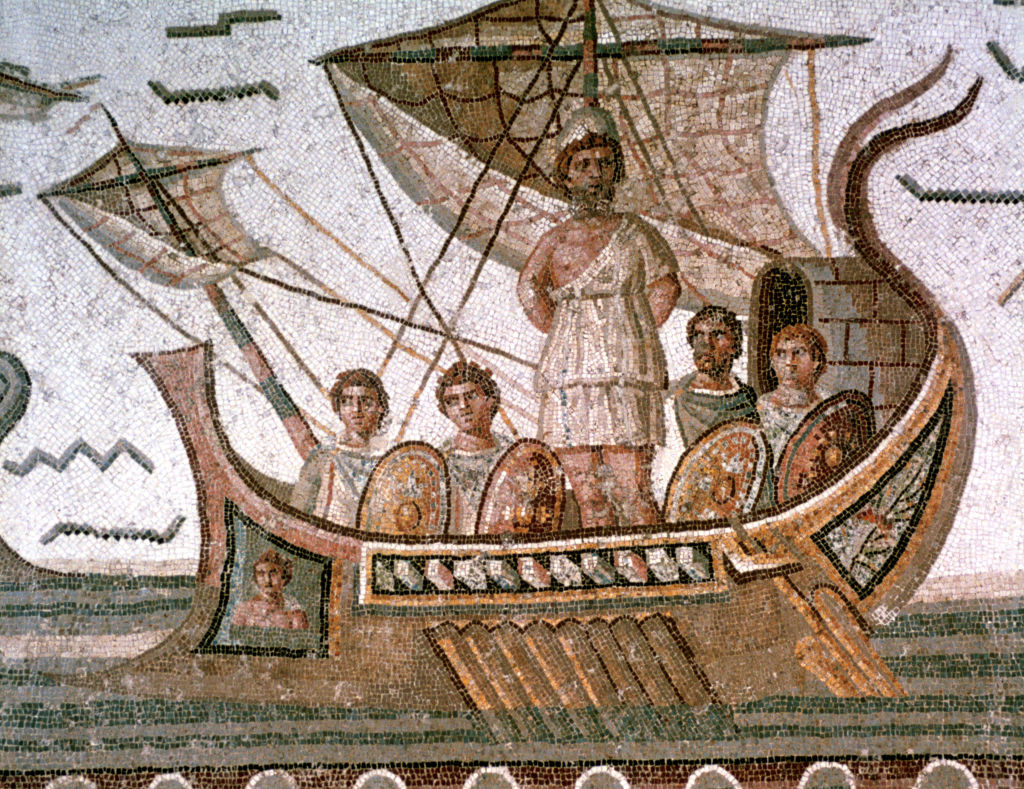
Ulysses and the Sirens, Roman mosaic, third century AD. From "The Odyssey" by Homer.

Postliberal conservative Patrick Deneen’s American Odyssey romanticizes belonging. But community isn’t mythic — it’s material, and it’s shared. (Art Media / Print Collector / Getty Images)


The odyssey of The Odyssey is itself quite the tale. Throughout the centuries, creative reinterpretations of Homer’s epic have been offered by everyone from Dante Alighieri, who placed Odysseus in the eighth circle of his Inferno, to James Joyce, who reconceived the titular hero as an ethnic Jew wandering the streets of early twentieth-century Dublin. Ever since Virgil’s The Aeneid retconned the ending of major parts of the story, significant writers like Nikos Kazantzakis have even written sequels to Odysseus’s adventures. And of course, recently Christopher Nolan’s own adaptation was the center of a various online controversies over both casting as well as perceived thematic departures from the original poem.

All this is to say there is no definitive version of the now archetypal story. Far from being a problem, this demonstrates the enormous depths of a myth that can sustain enormously different readings. One recent take on Odysseus’s suffering has been offered by conservative philosopher Patrick Deneen in his new book, American Odyssey: What an Ancient Story Reveals about Our Divided Souls. Deneen is best known for defending “postliberalism,” an ideology that blames liberalism for spreading a kind of libertine nihilism that has corroded our sense of community and weakened our commitment to the common good. American Odyssey shows Deneen at his best as a thoughtful conservative analyst, with a cooler tone than in some of his more overheated recent work. But it also reveals the limits of his understanding of human nature and what people need to thrive.

Of Gods, Beasts, and the Beastly

D eneen’s book is a surprisingly brisk work from an author known for taking big swings at bigger targets. Deneen describes its origins as dating back to his years as a graduate student at the University of Chicago. He nostalgically recounts “slowly read[ing] The Odyssey with about ten other graduate students” and expresses gratitude for his teacher’s “love of the original Greek and for Homer’s tales, and his charming confusion over whether he was teaching The Odyssey or Ulysses on that particular day.” These formative experiences already inspired one earlier book from Deneen on The Odyssey, so it’s clear the subject is a passion project for him.

For Deneen, Odysseus fascinates on many levels. One is the anthropological. In early parts of the book, he describes how classical heroes and creatures often vacillated between yearning for godhood and descending into a bestial state. While these two poles might appear contrasting, Deneen insightfully notes that the connection between godhood and bestial is tighter than might appear. The “gods and beasts are similar in two respects: they are apolitical, and they share a distinctive kind of acumen.” Gods and beasts are apolitical because they share the capacity to be indifferent to others. The gods don’t need anyone; to the extent they connect with others it is out of a fickle and transient desire to relive the weary boredom of their eternal existence. Beasts lack the reason needed to form deep connections, and so can only relate to others by instinct to gratify unchosen needs.

Gods and beasts are also alike in that they are peculiarly free of curiosity and doubt. Their senses give them “instantaneous knowledge of a thing’s nature, but both gods and beasts are essentially unaware of the broader truth of things that their more narrow, specific knowledge misses.” They have little understanding of the inward experiences of others, which makes them “blind to the suffering and harm their actions cause.”

This means that, in some respects, humanity is a category of being unto itself; less like either gods or beasts than they are like one another. Deneen reads Odysseus as a very human character in this respect. His journey is defined by a yearning for others, longing for “the sight of the very smoke / uprising from his home country.” He rejects immortal life with the beautiful and ageless goddess Calypso to return to his wife, Penelope, in full awareness that both he and she will age and die. Deneen poignantly notes that Odysseus makes this choice in full awareness of the bleakness of the afterlife, which is so devoid of meaning Achilles claims he’d rather be alive and a slave than ruler of the dead.

More tempting for Odysseus, “who is so notable for his ability to hold himself back from temptations,” is the “devastatingly tempting offer of ‘expanded vision.” His yearning to wander and hear the dangerous song of the sirens all stems from Odysseus’s rather philosophical desire to experience and know. This has a tight connection to the yearning for control by acquiring the power of knowledge. Perhaps tellingly, Odysseus is only able to return to Ithaca when he gives up control by casting himself from Calypso’s island on a tiny raft in the hope of reaching anyone who knows the direction home.

Like many other conservative thinkers, Deneen sees great danger in the Promethean longing to escape the limitations of our condition. We can “decide to cease being what our nature intends for us to be” through becoming like gods and beasts living above or below other human beings. But “things will go badly for us if we do, for the city — political community — is our natural home.” Our proper yearning is to transcend, but not escape, our finitude through others.

Sing, Goddess of Postliberal Melancholy

Deneen’s interpretation of his favorite ancient story is moving and deep — and a welcome contrast to his recent broadsides against progressive liberalism and its rainbow flags. But as the subtitle about our “divided souls” suggests, much of Deneen’s attention is directed to the present rather than the Mycenaean past. Like many before him, Deneen finds parallels between the soul of Odysseus and that of the American people. From the communitarianism of the Puritans to the warm folksiness of Ted Lasso, there has always been a pronounced strain of American culture that has celebrated rootedness, belonging, and the great impact of seemingly small kindnesses.

This is the side of Odysseus that wants nothing more than to return to backwater Ithaca and its problems because, however much a battle against greedy suitors pales in comparison to a world-historical event like the siege of Troy, they are his family’s struggles. On the other hand, Deneen notes how Americans are “creatures prone to discontent, creatures who discover the object of our longing was more attractive in the desiring than in its attainment. The American Dream, at least in part, subsists on this discontent, this drive always to abandon settled comfort for anticipation of the undiscovered.” It is the dialectic between the twin poles of the American spirit that generates both its greatness and its vulgarity.

Deneen thinks that the country is at its best when achieving an Aristotelian “golden mean” between its two poles, while stressing that his instincts lead him to “urge against worsening the disfiguring effects of our widespread national and civilizational homelessness.” There is a melancholic nostalgia to Deneen’s book that is more earned and deeply felt than what one sees in most postliberal philosophy, including his own. This treads very close to reactionary sentimentality when Deneen puts The Odyssey into dialogue with American classics like The Wizard of Oz, Huckleberry Finn, and Field of Dreams.

At times, American Odyssey flirts with “good ol’ days”–style reminiscence of the sort that leads very online advocates of RETVRN to transform their Nintendo 64 childhoods into the embodiment of a lost golden age of virtue and simplicity. The seemingly endless ruminations on Field of Dreams, replete with Deneen’s longing descriptions of “rolling cornfields surrounding a classic American farmhouse, and recalling the sport of baseball as it was played in simpler times” are the worst culprits here. But Deneen usually pulls back before things get too syrupy.

A Wonderful Socialist Life

Nonetheless, Deneen’s efforts to enact a dialogue between ancient and modern reveal the limitations of his own analysis. This comes into starkest relief in his half-chapter-long interpretation of the holiday classic It’s a Wonderful Life.

For those who manage to avoid turning their TV on in December, the plot is fairly straightforward. Bright everyman George Bailey longs to leave pretty but dull Bedford Falls to see and remake the world. Circumstances continuously intervene to thwart this ambition — not least preventing a takeover of the town by greedy capitalist Mr Potter. This means George is stuck settling into town life with a pretty wife and cute kids. A sudden crisis leads George to contemplate suicide before an angel intervenes and shows him how ruined Bedford Falls would be without his generosity and civic spirit. He decides to live and reconciles with his family, and all of George’s friends and well-wishers end up coming to his rescue right in time for Christmas. George realizes that he is, in fact, the richest man in town.

Deneen describes George as a “consummately Odyssean character to the extent that he longs, with profound, existential urgency, to get away.” On the surface, it might appear that the lesson of the film is very much to Deneen’s taste; George comes to accept his beautiful life in the homeliest town in America. But Deneen reads it much more critically. He notes how, while Bailey’s dream of leaving Bedford Falls may have been frustrated, he “does not cease to be ambitious.” Instead, Bailey transforms his town; not least by building very modern affordable housing so the town’s poor can have a decent place where they don’t have to pay up to slumlord Mr Potter. Deneen admits that he “instinctively and appropriately sides with [Bailey] against the vicious and heartless Potter.” But these sympathies obscure the “ambiguous nature of George’s efforts — and their ultimate consequences.” In constructing affordable housing while treating his tenants like equals, Bailey has transformed his idyllic town into something more modern — and ugly.

“If we consider ‘Bailey Park’ not just in comparison to ‘Pottersville” — to which it is clearly superior — but in contrast to downtown Bedford Falls, Bailey Park is clearly inferior,” as Deneen puts it. “The film itself implicitly calls attention to this fact.” As Deneen sees it, “Bedford Falls has an intimate town center. It has blocks of houses with front porches where people sit leisurely and greet the passerby who constantly amble along the sidewalks. Bedford Falls is a town with a deep sense of place and history.”

To a degree, one can sympathize with Deneen’s take. When I see people decry the ugliness of public or affordable housing, I often think, “Why don’t we do better?” There is no law baked into the universe that says giving the poor a place to live requires that it be as artificial-looking and cheap as possible. A socialist YIMBYism should create spaces where there is both a geography of community in the present and a sense of continuity fostered with the past. We ought to be more sensible than Bailey, who builds his affordable housing project atop a cemetery. This reads like a bit of a metaphor for superficial neoliberals trying to do good for the needy — but on the cheap and without giving a sh-t about those who’ve lived and died on that very spot.

But Deneen’s nostalgia for the Bedford Falls of yore misses that the only thing worse than living in alienating modern housing is living in a slum with an exploitative landlord like Mr Potter. We’re given a clear insight into that early in the film when Mr Potter berates George’s late father for not evicting his tenants and their families when they can’t pay the rent. In Potter’s words, without the harsh discipline of the market, Bedford Falls will wind up with “a discontented, lazy rabble instead of a thrifty working class.”

Bailey Jr may have disrupted traditional practices a bit too much for Deneen’s taste by building affordable housing for the working class. But that shows how Deneen cares far too much about the antique plumage of the town, with its picturesque middle-class boroughs, and far too little about the material needs of the many poor people who live day-to-day in Bedford Falls.

This belies a deeper point about Deneen’s interpretation of wandering souls like Odysseus and George Bailey. Bedford Falls doesn’t feel like a home for George Bailey for most of the movie. But a core lesson of the film is that the solution to George’s anomie wasn’t just a spiritual change in attitude, let alone nostalgia for dreams long past. Bailey built a spiritual home and community for himself by literally building homes for other needy people, who in turn demonstrated solidarity with him when he was in need. The lesson is that real home and community is about much more than simply sharing values, let alone 1930s aesthetics. It’s about sharing what we have with each other and looking after the needs of everyone. Especially the least off among us.

The failure to internalize this in sufficient depth is one of the reasons conservative conceptions of community tend to be more superficial than their socialist counterparts. In Why Not Socialism?, the great philosopher G. A. Cohen describes the ideal community as like a camping trip where everyone does their bit and shares goods based on a principle of reciprocity rather than self-interested exchange. Cohen understood that community must have a material dimension to it; otherwise, it’s not much more than an abstract profession of unity. It’s one thing for my family and the family next door to attend the same cute little church together on Sunday. He is not my neighbor if his response to learning my wife is sick and our insurance won’t cover it is to sigh and offer his “thoughts and prayers.” That most American conservatives imagine everyone sharing the same “thoughts and prayers” will a community make shows why they can never build the homes they seek.

Postliberalism’s Fatal Flaw

In a world where so many at the moment are trying to flatten Homer’s epic into a banal trope in America’s never-ending culture war, Deneen’s obvious love for the source material is refreshing. Much like Leo Strauss’s Natural Right and History or Roger Scruton’s guide to the sacred, there is insight and even wisdom leftists can glean from it.

But the book also demonstrates the fatal flaw in postliberal conservatism’s yearning for community. That is its all-too-idealist emphasis on the forms of justice rather than its substance; on values symbolized rather than lived. Deneen describes Odysseus as an admirable human being because he resisted the siren’s call of isolating power and perfection for the warmth of hearth and home. And so he was. But it’s the yearning to build a shared home for everyone that constitutes the fuller reconciliation of the American spirit Deneen searches for but fails to find.