HBO’s Burning Man Documentary Omits the Festival’s Workers
A new HBO documentary about Burning Man, produced with the explicit approval of the festival’s brass, elides the underpaid, overexploited workers who toil each year to make the party happen.
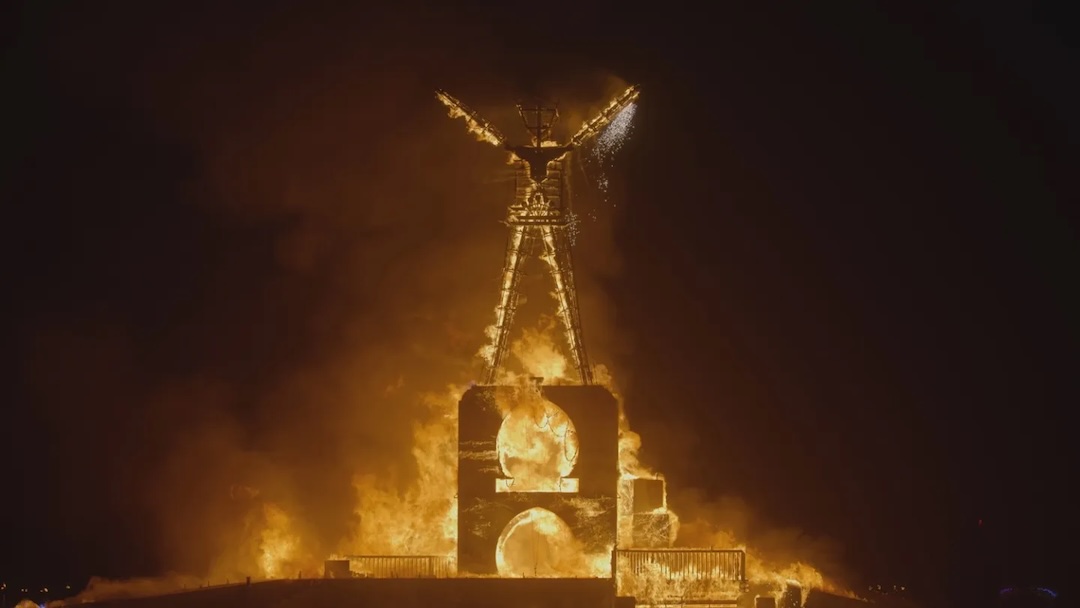
Watching HBO’s new documentary about Burning Man, you’d have no idea the toll the festival takes on the workers who make it possible. (HBO)
It’s been a precarious decade for Burning Man. The legendary counterculture gathering was canceled two years in a row due to COVID-19 and has yet to recover its record pre-pandemic attendance numbers. In 2023, the indulgent spectacle was marred by sensational headlines about attendees being trapped by torrential downpours that snared vehicles in mud. Moreover, the past decade has seen a parade of negative headlines about Burning Man — including stories of horrific volunteer injuries and a pattern of worker suicides.
It’s a weighty moment to release a new documentary series about Burning Man. Directed by Jehane Noujaim and Vikram Gandhi and shot over five years, the four-part docuseries The Man Will Burn dropped its final episode on HBO on July 30. The four-plus-hour series weaves together boardroom drama and spectacular event footage with narrative biographies of multifarious attendees, ranging from army vets to artists to tea house proprietors.
Burning Man is notorious for the production of spectacle, most transparently in the party’s culmination in the burning of the titular effigy. So it might seem surprising that there hasn’t been a similar mass-market, mainstream documentary about the festival that capitalizes on its stunning scale and visuals. That is by design: getting permission to commercially film Burning Man ranges from difficult to impossible, due to the parent organization’s own rules.
Filmmakers are required to apply directly to Burning Man Project, the nonprofit that oversees the event, in order to get permission to film for “non-personal use.” Likewise, Burning Man’s media rights page states that professional filmmakers must obtain “written permission” from Burning Man, subject to restrictions and granting a license to Burning Man’s org to use any recorded footage for their own use.
Because of these stipulations, The Man Will Burn doesn’t have the patina of evenhanded, independent journalism. And while it’s not entirely an advertisement, the Burning Man Project has been happy to promote it on their own website.
The filmmakers’ green light from Burning Man Project is not the only unusual thing about The Man Will Burn. For a documentary that bills itself as providing a “unique behind-the-scenes look” that “chronicles the preparation of staff and volunteers,” the staff featured in the documentary are largely nonprofit leadership. Indeed, there’s no mention of all the crewed labor — underpaid, overworked, and sunburned — that goes into making it possible for a temporary city to blossom in a hostile, lifeless lake bed. To get their take on Burning Man, I interviewed some of that crew.\

“The Workforce Is Sort of Invisible”
Like many crew workers, Jacob started working for Burning Man as a volunteer before getting promoted to being paid an hourly wage. It took a thousand hours of unpaid labor to get there.
Working for Burning Man’s Department of Public Works (DPW), Jacob is responsible for helping to build the base infrastructure on the dry lake bed, or playa, of northwestern Nevada’s Black Rock Desert, where the event takes place. DPW’s role encompasses electrical labor, city planning, construction, logistics, and waste management and constitutes just one of several divisions of laborers who arrive to set up long before Burning Man starts and leave long after the party ends.
Though Jacob is not sure the exact number, he — along with four other workers I interviewed — all estimate there are about eight hundred workers on crew.
“I think most participants think that Burning Man is made by the people, by the participants,” Jacob told me, adding: “They don’t realize [the] logistics it takes to have heavy equipment out here, to place 20,000 flags on all the roads and for all the team camps, to put up the fence. There is an event operations crew that does all this stuff so that there is an appropriate blank canvas of Black Rock City.”
The Burning Man organization’s own promotional materials obscure the existence of workers like Jacob. Their website frames the event as participant-led and -constructed.
“Every person who inhabits this city helps build it; there are no spectators,” the org’s “Survival Guide” reads. This year’s event page explains that Black Rock City “rises for just eight days, then disappears without a trace.”
But that disappearing act, through which the desert returns to its untrammeled state, takes a while. Jacob notes that his “playa restoration contract” extends through mid-October.
Jacob laments that in real life, as in the documentary, the “workforce is sort of invisible,” as he says. “In theory, the people in the city, the participants build the city — and of course they do the absolute vast majority of the work,” he told Jacobin. “But there is still a lot of paid and volunteer labor that is making that possible. And a lot of participants don’t know that there’s a seasonal workforce. That always feels really sad to me. In so many ways, in so many places in our society, labor is invisible.”
Jacob, along with other workers with whom I spoke, said their contracts are typically ten weeks long, consisting of forty hours a week or more of wage labor under the Nevada sun. Indeed, the conditions are positively martian: the Black Rock Desert, the desert lake bed that temporarily transforms into Black Rock City, has average highs above 90 degrees Fahrenheit in July and August. The playa’s dust is alkaline and has a deleterious effect on the skin and mucous membranes. Crew must brace for these conditions for much longer than the ten days that the event lasts.
“People just cannot imagine how much it adds up,” Zoe, a six-year veteran crew laborer, says of the environment. “What a toll that takes on your body, on your sleep, on your skin, on your hair. It’s grueling.” (Zoe, along with workers Martha and Jacob, are pseudonyms; citing Burning Man Project’s alleged history of retaliation, all three asked that I not use their real names.)
Zoe said that she typically experiences hair follicle destruction and cuticle infections — health problems she characterized as “less serious” compared to what she’s seen in her peers.
Beyond exposure, crew jobs have an array of on-the-job hazards, including working with heavy machinery and high-voltage electric lines. Workers say the Burning Man org’s leadership — who are most prominently profiled in The Man Will Burn — are not typically on the playa at the same time as crew. As for board members like Kimbal Musk, brother to Elon, depicted as a main character in The Man Will Burn?
“I never interacted with them,” two-season veteran laborer Maeve O’Donnell, an electrician, says of the board.
Zoe says Musk’s commentary in the documentary suggests an ignorance of the role of labor in making Burning Man possible.
“I don’t think they know anything,” she told me.
“I think they have a prepackaged idea,” and “could talk a good talk about the sizzle reel of what it is that we do” but have no idea of the “reality,” Jacob said.
Many of those on the crew are union members in their “default world” day jobs: electricians, carpenters, or mechanics. Yet their nonunion labor to make the festival possible doesn’t pay nearly as well as those “default world” jobs.
Likewise, nonmanagerial Burning Man crew are not salaried but mere contractors, at-will employees with few or no benefits. Given the hazards, the lack of housing and medical coverage seems especially surprising.
Jacob, who worked five full seasons for Burning Man on crew, notes that he was given “access to power and shade” to erect his own shelter on a ten-by-ten-feet square.
Jacob said that some people have been given housing by the org sometimes, but its apportioning is “mysterious and haphazard.”
“If you’re making $4,000 in a summer, but you also have to rent a trailer or buy a tent or whatever, then that’s a huge difference,” Jacob noted.
“Some people will rent a trailer, which obviously eats into your wage,” Zoe concurred.
Burning Man’s ticket prices range from the low $200s to the mid-$1000s, meaning just four of the most expensive tickets cover the $4,000 summer wage for a worker like Jacob. (Burning Man has had over 70,000 attendees each year for the past few years.)
Jacob said he was grateful that food, water, and power were provided. “There’s shade that’s built for [workers], but you don’t get housing,” he noted. Jacob noted that food was not provided in years past — a fact that management often held over their heads as evidence that they were “lucky.”
“I don’t know if this is the flex that you think it is,” Jacob said. “We’re talking about basic human rights.”
Regarding health care, Jacob said there’s an occupational medicine team and emergency medics on hand. Salaried employees, like managers, do have health care, he added.
Three of the workers with whom I spoke with said they made between $10 and $20 an hour and characterized this as typical.
O’Donnell, who holds an International Alliance of Theatrical Stage Employees (IATSE) union card, said that they started working at Burning Man at $10 per hour in 2019. This was a great contrast to union pay: “If I was doing stagehand work or if I was doing work for the film union, I think the scale was like $40 an hour,” they added.

Yet the work was more perilous. O’Donnell said that the current they were dealing with on the playa far outstripped what they worked with in nonunion theater jobs. “To do some of the tie-ins that I was doing at [Burning Man] . . . for liability reasons, they wouldn’t even let me make those connections” when doing nonunion stage work, they said.
Though the pay is low, the conditions are dangerous, and the benefits poor, what brings these workers back is the people. “Nobody’s doing this because it gets anybody lucratively rich,” Jacob said. Burning Man workers do have a strong “sense of family and belonging.”
“I’d like to give the org the benefit of the doubt and think that they don’t use that against us. But if you look at the world, there’s all kinds of industries that thrive on the idea that if you love your work, then that’s instead of getting paid a living wage,” he added.
Meanwhile, Zoe noted that crew managers are salaried but don’t have hiring power. They often work far more than forty hours a week but don’t make overtime. Notably, a crew lead without hiring authority classified as a salaried manager might constitute a misclassification issue, a frequent subject of labor lawsuits. (We reached out to Burning Man for clarification about this but have not received a response.)
Given this situation, it makes sense that Burning Man workers might consider organizing a union. Notably, Ricardo Romero, a seasonal Burning Man worker, started a conversation among workers about organizing a union and was subsequently not rehired, as he told me in a 2018 interview. After Romero filed a complaint with the National Labor Relations Board, the board sided with Romero, and the Burning Man organization was forced to make an official apology and offer Romero a settlement. (The Burning Man Project previously denied that Romero was fired for trying to organize.)
Burned Laborers
The first episode of The Man Will Burn showcases the drama among the board and executives over whether to cancel Burning Man in 2021 due to the ongoing pandemic. In the documentary’s telling, the decision hinged on a battle of wills between Burning Man Project CEO Marian Goodell, who was in favor of cancellation, and board member Kimbal Musk, who was vehemently against. In the end, Goodell has her way, and Burning Man 2021 is cancelled. (Because the Black Rock Desert is public land, about five thousand public-health-eschewing Burners turned up anyway for a “Rogue Burn,” though the org had no official involvement.)
Yet Burning Man workers with knowledge of internal debates say that the story of 2021’s cancellation wasn’t this simple — and that workers, alarmed that the organization was even considering throwing the event, had discussions about striking long prior to the production of any vaccine.
“We have our own crew pages and social pages that are pretty public,” Martha told Jacobin. “But many, many, many of us were like, ‘Yeah, if this happens, we’re not coming. We’re not working. This is insane.’”
Martha attributes the decision to cancel to the “international community” along with workers’ public, online feedback. “It was the pushback from those two communities that had them smartly cancel 2021,” she says.
Zoe agreed with Martha’s assessment that workers, volunteers, and international attendees all put pressure on the org to cancel 2021. She characterized the way that the documentary depicts the story as a “narrative trick.”
And O’Donnell recalled org leadership being initially sanguine about having a 2021 Burn.
“2020 was canceled, and then there was a big [Zoom] meeting about how ‘we’re gonna be gearing up for 2021.’ I just remember being like, ‘What? What the hell?’” O’Donnell recalled.
“[Goodell] doesn’t get to take credit for making a conservative decision when they were putting feelers out there,” Zoe says. “It would’ve been a financial mistake for them to go ahead with the event and then not have enough workers or people to come to it.”
Prior to the 2022 Burn, the first since the pandemic, a group of workers gathered signatures on an open letter to Burning Man’s executive board.
Taking a page from other COVID-adapted industries like Hollywood, the letter demands that the Burning Man organization supply testing materials and require all staff in Gerlach — the nearest city to Black Rock Desert, where Burning Man Project keeps an office — and on playa to test for COVID three times a week, plus proof of vaccination or a negative test from participants.
“We would like for this to be Burning Man: that awesome crazy party in the desert that we remember before the world shut down,” they write. “But if we’re going to do that, and if we’re going to build it, the least we can ask of the organization and the staff is that we test on a regular basis, so we can avoid getting each other sick, and putting anyone in jeopardy of overwork.”
A former worker, who feared retribution from Burning Man Project, showed me this letter and asserted that over forty seasonal workers signed on. The anonymous worker said that the organization agreed to its demands but “later claimed that they were always going to do them anyway” — meaning, enact the workers’ hoped-for COVID safety precautions.
“Multiple people on my own team gathered as many tests as possible over a few months before traveling to Gerlach because we didn’t trust the org to do so after the amount of pushback and feet-dragging we’d seen thus far,” they continued.
The testing worked initially to stop the spread of COVID in 2022. “My own department tested three times a week and suffered zero illnesses preseason and event week,” the anonymous worker said. “All of the crews remained largely almost completely uninfected — until the event opened and the masses, subjected to zero requirements, arrived. And then our postevent crews were dropping like flies.”
O’Donnell, an IATSE member, remembers the “comprehensive list of COVID precautions that had been negotiated between IATSE and the Teamsters and the film unions and then the studios.” O’Donnell says that middle management showed the IATSE agreement to Burning Man higher-ups to model what a safe return to work might look like.
This backstory is entirely omitted from The Man Will Burn’s telling of Burning Man 2022. I reached out to Burning Man Project, as well as the filmmakers and HBO, for comment but have not heard back.
Cameras on the Playa
Photo or video cameras on the playa have historically been disallowed because of the decommodification principle behind Burning Man. Commercial filming would appear to violate this principle, by monetizing the Burn. Moreover, an assumed right to attendee privacy is baked into the DNA of Burning Man, exemplified clearly in the practice of participants using a “playa name” separate from their real name. That’s because attendees and workers alike occasionally do things that a normal employer might frown upon if it were known, from “lewd” behavior to drug use.

“From what I understand, the policy of the organization back in the ’90s was that before you take a photograph of anybody, you should ask for their consent,” O’Donnell noted.
Martha concurred that the presence of a film crew was incongruent. “This film crew is here just filming everybody at this time where, if this footage gets out into the real world, maybe that person isn’t out to their family or boss. . . . And it’s unconscionable anyway,” Martha said.
O’Donnell, who often works in the film industry, was confused at the sudden appearance of cameras filming their postwork, blowing-off-steam moments.
“We were like, ‘Listen, unless you’re gonna have everybody sign a fucking release, your footage is dead. You don’t have releases for any of this,” O’Donnell said.
Martha had a similar experience: encountering a commercial film crew at the end of the build days and being taken aback at their private, groundbreaking tradition being filmed.
“This is a time when there are people who are not wearing clothes,” Martha said. “They are naked or in various states of undress or sometimes various states of intoxication, because their workday is over.”
“This isn’t a documentary that’s to expose a corrupt politician or a public figure that owes the public an explanation,” Martha continued. “These are workers at an event, who did not consent to their off time being recorded.”
Burning Man’s website features a page about the documentary and how it fits with their principles. The promotional page seems designed for curious folks who might have googled the documentary and transitions into an advertisement.
From the inside perspective of the Burning Man crew, the event is made possible by a lot of labor and sweat. And that’s not scratching the surface of all the other labor paid for by attendees to bring all the other pieces — clothes, vehicles, gasoline, art, and so on — together into one film-worthy epic.
Though the crew’s toil isn’t depicted, The Man Will Burn tells other stories from the playa, some of them quite compelling. Numerous airborne shots of the playa during day and night serve as eye candy. The story of a PTSD-struggling veteran and the home he finds at Burning Man is heartwarming. And the film does a good job illustrating the rapturous spirit of the party and its incredibly strong, quirky community.
But ultimately, The Man Will Burn posits an inverted, top-down view of how Burning Man works — as though the wealthy and powerful manage and dictate much of what happens and the paid labor is nonexistent. This comes to the fore most powerfully in the third episode, in which we hear the execs wax on about the vital importance of having billionaires at Burning Man. “Burning Man needs the wealth,” Musk tells the camera. As the Burn starts anew this weekend, one might remind Musk that labor creates all wealth.