When the Personal Is Political — and When It Isn’t

The feminist insight that personal life is political is complicated by neoliberalism, which casts political problems as matters of personal virtue. This moralization of personal conduct can displace the collective action needed to transform society.
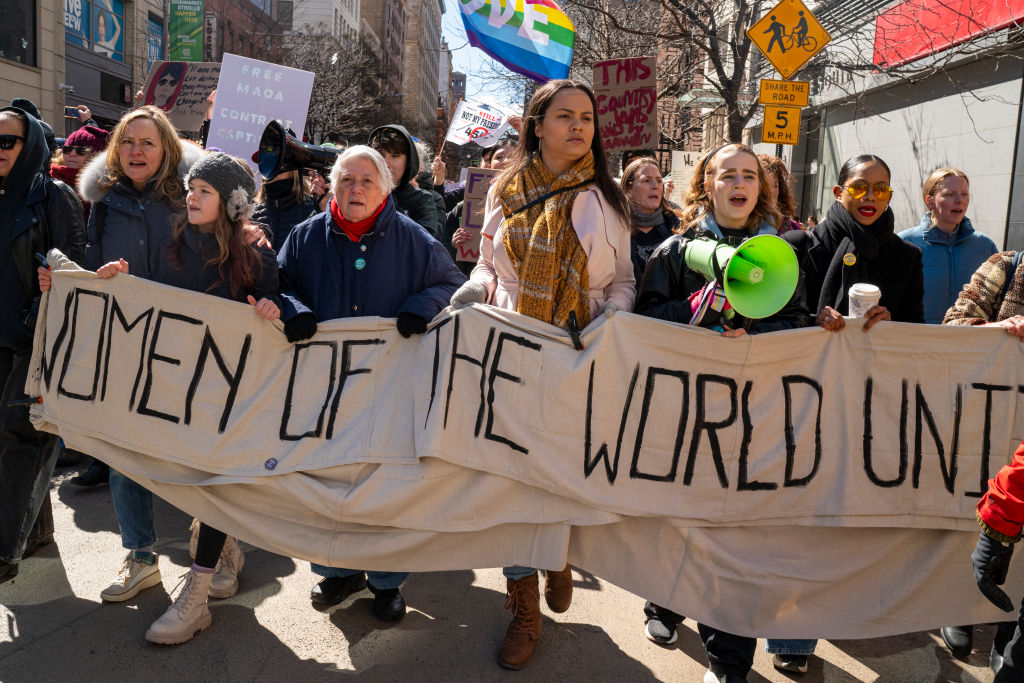
Demonstrators hold signs during a march honoring International Women’s Day on March 8, 2025, in New York City.

Demonstrators hold signs during a march honoring International Women’s Day on March 8, 2025, in New York City. (Robert Nickelsberg / Getty Images)


One of feminism’s most enduring contributions to political thought has been its insistence that personal life matters politically. Long before questions of identity, subjectivity, and everyday life became fashionable across the humanities and social sciences, feminists argued that political domination was reproduced through intimate relationships, family structures, social norms, and personal experiences. The slogan “the personal is political” captured a central feminist insight: social transformation requires more than changing institutions. It also requires changing ourselves.

This commitment to linking the subjective and the structural has shaped feminist theory and practice for decades. Feminists have often combined structural analyses of oppression with an interest in ethical conduct, personal experience, and self-transformation. Political emancipation has been understood not only as a collective project but also as a personal one. Feminism, in this sense, has never been concerned solely with changing the world. It has also been concerned with changing the self.

Today, however, this relationship between ethics and politics has become increasingly complicated. Over the past four decades, neoliberalism has transformed not only economies and states but also the ways individuals understand themselves and their responsibilities. As many critics have observed, neoliberalism encourages us to see ourselves as autonomous, responsible subjects whose successes and failures are largely products of our own choices. Social problems are increasingly interpreted as matters of individual responsibility rather than collective political concern.

Neoliberalism presents a peculiar paradox. It is often described as an amoral system in which economic rationality displaces all other values. At the same time, neoliberal societies are saturated with moral language. Individuals are constantly called upon to act responsibly, make the right choices, improve themselves, and account for their actions.

Neoliberalism thus appears both ethically impoverished and intensely moralizing. This paradox raises an important political question. What becomes of feminist ethical practices under neoliberal conditions? Do they provide resources for resisting neoliberal individualism? Or do they risk reproducing its underlying assumptions?

The Discipline of Hypercritical Propriety

These questions become particularly pressing because feminism has long contained a productive tension between ethics and politics. On the one hand, feminist movements have often emphasized individual responsibility, ethical reflection, and attentiveness to exclusion. On the other hand, feminism has also sought collective political transformation. The relationship between these impulses has never been simple. Under neoliberalism, however, it becomes increasingly fraught.

In interviews I conducted with Swedish left-wing feminists, this tension emerged repeatedly. The women I spoke to described feminism not only as a political commitment but also as a way of relating to themselves and others. Feminism appeared as an ethical practice, a mode of self-reflection, and a continuous effort to act correctly in relation to questions of power and oppression.

Criticism occupied a particularly important place within these accounts. Many interviewees described criticism as a defining feminist practice. They emphasized the importance of scrutinizing norms, questioning privileges, and critically examining their own behavior. Feminism was often presented as a project of becoming conscious — of identifying one’s own complicity in oppressive structures and of taking responsibility for one’s actions.

There is much to admire in this orientation. Political movements that are incapable of self-reflection often reproduce the very forms of domination they seek to challenge. Feminist critiques of everyday power relations have expanded our understanding of politics in invaluable ways.

Yet the interviews also revealed some of the difficulties that emerge when political questions become primarily ethical ones. Several participants described themselves as highly self-conscious political actors, constantly evaluating whether particular actions were sufficiently informed, inclusive, or politically correct. Freedom was often discussed in terms of making conscious choices rather than transforming the conditions within which choices are made.

This emphasis on individual responsibility mirrors broader neoliberal forms of subjectivity. Rather than focusing on the structures that shape possibilities for action, individuals are encouraged to focus on their own decisions within those structures. The result is not necessarily empowerment. In many cases, it produces anxiety.

The fear of acting incorrectly, of causing harm, or of being criticized by others can become politically paralyzing. One interviewee captured this dynamic succinctly when she explained that she would rather refrain from acting than risk doing something wrong. Such statements reveal an important contradiction. The ethical demand to act responsibly can, under certain conditions, undermine political action itself. This is not because ethical concerns are inherently conservative. Nor is it because criticism lacks political value. The problem is rather that individualized responsibility offers a weak response to problems that are fundamentally collective.

Neoliberalism’s Republic of Sovereign Selves

The contemporary subject is repeatedly told that she is responsible for changing the world while simultaneously possessing very limited power to do so. Under these conditions, self-criticism can easily become self-surveillance.

A similar tension emerged in discussions of inclusion and exclusion. For decades, feminist theorists have criticized political movements for presenting particular experiences as universal ones. Feminist, anti-racist, and queer critiques have shown how political projects often marginalize those who do not conform to dominant norms. Such critiques remain indispensable. Every emancipatory movement must remain attentive to its own exclusions. Yet the political context in which these critiques operate has changed significantly.

The neoliberal era has not been characterized by excessive collectivism. On the contrary, it has witnessed the erosion of many collective political institutions and identities. Trade unions have weakened, political parties have lost members, and social life has become increasingly individualized. In this context, an exclusive emphasis on criticizing political identities risks reinforcing rather than challenging the fragmentation of collective life.

The interviews repeatedly demonstrated the importance participants attached to questioning norms and resisting homogenization. These commitments are ethically and politically valuable. Yet they also raise questions. Can politics function without making general claims? Can political movements exist without constructing collective subjects?

Every political project requires some degree of commonality. It requires demands, goals, and identities that extend beyond individual experiences. While critique may reveal the limits of existing political formations, it cannot by itself provide an alternative. A politics that only deconstructs risks becoming politically impotent. This does not mean abandoning concerns about exclusion. Rather, it means recognizing that the contemporary challenge may be less about destabilizing collective identities than about constructing them. The problem confronting much of the Left today is not excessive political unity but an inability to formulate common political projects capable of mobilizing broad constituencies.

The tension between ethics and politics appears again in contemporary discussions of vulnerability. In recent years, vulnerability has become an increasingly important concept within feminist theory and the feminist movement. Against neoliberal fantasies of autonomy and self-sufficiency, vulnerability highlights human dependency, interconnection, and exposure to harm. This intervention has been politically significant. It reminds us that individuals are never fully autonomous and that responsibility for others remains a fundamental political and ethical question.

At the same time, vulnerability alone cannot provide a political perspective. The fact that human beings are vulnerable tells us relatively little about why some groups are more vulnerable than others or about how vulnerability is distributed across society. Without a political analysis of institutions, power, and material conditions, vulnerability risks becoming an ontological condition rather than a political category.

The challenge is therefore not simply to recognize vulnerability but to explain its production. Who becomes vulnerable? Under what conditions? Through which social and economic arrangements? Answering these questions requires politics rather than ethics alone.

Taken together, these tensions suggest that certain ethical tendencies within contemporary feminism have become increasingly compatible with neoliberal forms of subjectivity. A focus on individual responsibility risks reinforcing the individualization promoted by neoliberal ideology. A persistent suspicion toward collective identities can contribute to the fragmentation of political life. An emphasis on vulnerability may substitute ontological reflection for political analysis.

This does not mean that feminism should abandon ethics. Indeed, such a conclusion would be both politically and morally mistaken.

From Finger-Wagging to Freedom

Ethical commitments continue to play an indispensable role in political life. Collective action often begins with ethical impulses: concern for others, outrage at injustice, and a desire to alleviate suffering. To dismiss such motivations would be to embrace a form of political cynicism that the contemporary left can ill afford. Moreover, abandoning ethics would amount to conceding one of the central ideological battles of the neoliberal era. Neoliberalism does not simply individualize responsibility. It also seeks to narrow the range of values through which social life can be understood. Against the neoliberal insistence that economic rationality should govern all spheres of life, the Left must continue to defend values such as solidarity, care, and mutual responsibility.

In this sense, we may need more ethics rather than less. But it must be a different kind of ethics. The task is not to intensify the moralization of individual conduct. It is to develop ethical commitments that support collective political action rather than substitute for it. An ethics capable of challenging neoliberalism must direct attention toward the material conditions within which people act. It must ask not only how individuals ought to behave but also what social arrangements make ethical action possible. Political transformation ultimately requires changing those conditions.

The question is therefore not whether feminism should be ethical or political. It is how ethics can be articulated in ways that strengthen rather than weaken collective politics.