Parsing Fact From Fiction on Ireland’s Magdalene Laundries
The last of Ireland’s Magdalene laundries, workhouses for “morally wayward” women, closed in 1996. Since then, the institutions’ many horrors have come to light, but misinformation has also been endemic. A new book provides a granular, factual account.
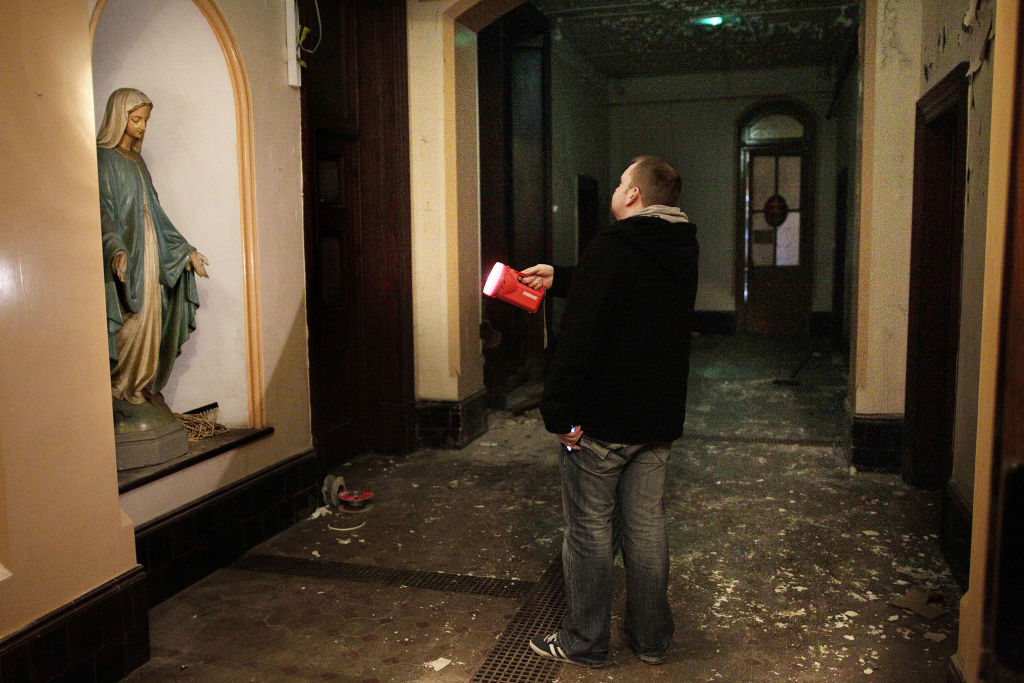
A Dublin City Council worker shines a torch in the corridor of the now derelict Sisters of Our Lady of Charity Magdalene Laundry on Sean McDermott Street in Dublin’s north inner city on May 2, 2013. (Julien Behal / PA Images via Getty Images)
According to a 2013 Irish government report, more than ten thousand women and girls passed through Ireland’s Magdalene laundries. Primarily run by Roman Catholic orders in Ireland, the laundries were institutions where women and girls deemed “wayward” were incarcerated and subjected to forced labor. These included unmarried mothers, women who had been sexually abused, women considered too flirtatious or promiscuous, and girls referred simply for being poor, orphaned, or difficult to manage.
But like so much else about the laundries, that number is disputed. The Catholic orders that ran most laundries remain under no legal obligation to open their archives, and the 2013 figure excluded those who entered before 1922, among other gaps. Some researchers and advocacy groups estimate that it may have even exceeded 30,000. The ending of Small Things Like These, a 2024 cinematic adaptation of a novella by Claire Keegan about the laundries, dedicates the film to the “more than 56,000 young women who were sent to the Magdalene Laundries” and “the children who were taken from them.”
“Upon seeing that erroneous fact projected on a big screen in a packed cinema,” writes Louise Brangan in her new book, The Fallen: The Lost Girls of Ireland’s Magdalene Laundries and a Legacy of Silence, “I felt my mind listing, as if I had vertigo.” The book offers many such correctives in an effort to develop an accurate portrayal of what Brangan calls Ireland’s “main carceral institution” for much of the twentieth century.