The Hollow Egalitarianism of LA's Revamped Art Museum
At the redesigned Los Angeles County Museum of Art, the art-world tradition of mistaking spiritual anti-hierarchy for class politics is alive and well. LACMA treats labor as a source of authenticity but ignores its own workers’ demands for a living wage.
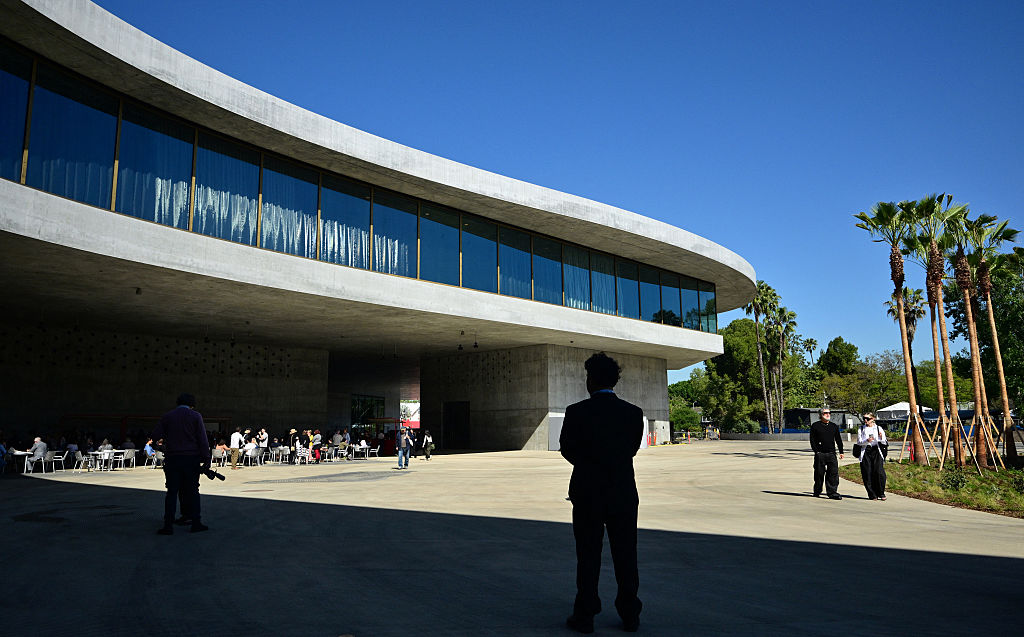
The revamped Los Angeles County Museum of Art imagines itself to be demolishing social hierarchies. But its romantic fantasy of labor has little to do with actual workers — like its own employees, who are fighting for adequate compensation. (Frederic J. Brown / AFP via Getty Images)
Peter Zumthor, the architect of the controversial new Los Angeles County Museum of Art (LACMA), wants to make one thing very clear: that “this building never looks down on you.” His sentiments are vaguely populist: the building “should be open to the people.” It’s a building type, he says, that “treats everybody equal” and “lets you have your opinion. Follow your own path.” Michael Govan, the equally controversial museum director who has steered this project since its inception in 2006, mirrors the architect’s vision: “You make your own path, you decide” where to go. The gallery guide is called “Wander.”
The former building, designed in 1965 by William Pereira, arranged works along chronological, geographic, and cultural lines, creating a multifloor, “hierarchical” structure. The new museum is organized across a single level elevated thirty feet in the air around four major bodies of water: the Atlantic, Indian, and Pacific oceans, and the Mediterranean Sea. The 347,500-square-foot structure made of raw, unpigmented, board-formed concrete contains 110,000 square feet of display space and exhibits about 2,500 pieces of ancient and modern art, mixing new and old, high and low, East and West, and everything in between. At a cost of $720 million (and rising), the design was funded with a mix of sources from Los Angeles County and a few ultrawealthy megadonors.
If there is one point that is stressed in every press release and architectural statement, it’s the idea that the “building de-emphasizes structural hierarchies.” One story tall, it has no high or low, no front or back. Govan speaks of a “mingling of objects and influences ever on the move,” a space “where you have inherently baked in it these areas of crossings, connections, diasporas.” He describes his vision as creating “an equitable organization of cultures, equally accessible” to all. A New Yorker puff piece makes the design’s basic aim explicit: “The idea was to abolish the hierarchies inherent in the old museums, which offered prime real estate to European painting and shunted other cultures and their artifacts aside.”
Since its unveiling in 2013, the building has received an inordinate amount of criticism, some of it deserved, some not. The core concerns focus on a few areas including reduced gallery capacity (11,000 fewer square feet of exhibition space), less flexible spaces (the galleries are fixed), disorienting navigation with minimal labeling, lack of public input in the process, and massive cost. No doubt these are significant issues, but they don’t address what I take to be the most glaring problem: a romantic fantasy of the laborer as craftsman, one that bears no resemblance to the lived reality of workers today.
The Raw and the Slick
Zumthor and museum management defend the price tag by pointing to the fact that the building is intended to last forever. Zumthor took his cue from the “primordial quality of the tar pits” adjacent to the site. The concrete structure “should look old, excavated rather than superimposed — something that ‘feels like it was there forever and should be there forever.’”
As Zumthor sees it, the problem with most architecture is its “slickness” — his catchall term for the consumerist worldview he despises — and he fashions himself by contrast as a simple artisan. As a critique of capitalism, “slick” is empty; it is about as sophisticated as thinking the problem with rich people is their McMansions. Zumthor sees the building as a challenge to the slickness that Los Angeles embodies. He is on record describing the city with a world-class cliché: “green lawns and bushes in the front yards of the houses look as if they were made of plastic.”
Rather than a manufacturer of glossy cubes, Zumthor offers himself as a simple laborer, a common man of the people. “The German word Baumeister,” he says, “is a beautiful word. When you call me a Baumeister, it will make me happy.” He is a simple craftsman “without a diploma.” He “trusts non-architects more than he trusts architects.”
Yet it is hard to imagine a more abstracted fantasy of labor than Zumthor’s. He speaks of the objects in the museum as displaced peoples, as objects that “speak,” if only we had ears to listen. Zumthor shows remarkable contempt for educators. Our ears are blocked up with the voices of “schoolteachers pinning everything down.” He hopes “there won’t be any tags” placed on the works by these repressive schoolteachers. So far, he has succeeded: his walls are stripped clean of nearly all information.
His antidote to the schoolteachers and the slicksters is an army of (partially undocumented) laborers, whom he fantasizes as simple artisans plying their trade. From the beginning, he “imagined Mexican workers doing the ground” of the museum (a concrete artwork entitled Feathered Ground), “something done by hand. Indigenous knowledge, people who have been there for a long time.”
Obviously Zumthor does not mean these workers have lived for a “long time” in the area but rather that they carry in their blood an attachment to ancient soil — that their indigenous experience can give the “homeless” objects their voices back. The objects in LACMA’s collection were deracinated, Zumthor explains, cut loose from their contexts and histories. “I think this could be my task, to create a new home, a temporary home for these homeless pieces,” he concludes.
Needless to say, his concern is not about such crass material things as wages, labor practices, or worker protections but rather with “how labor is hidden.” How these indigenous workers can show Americans “respect for tools, for work.” His aesthetic attraction to cracks — evident throughout the museum — is an expression of his desire to express labor rather than “conceal it.” Zumthor imagines that “revealing” labor rather than “concealing” it serves some unspecified political purpose.
Architecture as Anti-Hierarchy
Zumthor belongs to a long tradition that treats architecture as a critique of hierarchy and an embrace of the spiritual ideal of the laborer. Walter Gropius, in his famous 1919 Bauhaus Program, announced his desire to “create a new guild of craftsmen without the class distinctions that raise an arrogant barrier between craftsman and artist!”
For the Bauhaus generation, breaking down the walls between classes was the highest form of political achievement. Its architects were inspired by the infamous utopian writer and romantic antiauthoritarian Paul Scheerbart, who fantasized a world where “kings walk with beggarmen, artisans walk with men of learning.” For Scheerbart, the craftsman had no interest in the debased socialist ideal of improved conditions. “New social welfare organizations, hospitals, inventions, or technical innovations and improvements,” Scheerbart proclaimed, will not “bring new culture” — only a new architecture could. Neither Scheerbart nor Gropius had any interest in ridding the world of either beggars or kings, only in fostering mutual respect between them and, by the same stroke, naturalizing their class positions.
Scheerbart’s anti-hierarchical program shaped a range of influential practices including Bruno Taut’s The City Crown of 1920. Taut’s “non-political socialism” sought to “bridge every gap between fighting classes.” Taut sought “a better future, in which man will stand with mankind . . . without the barriers of the classes.” Like Zumthor, Taut regarded “comfort” (his version of “slickness”) as capitalism’s overarching vice. “Good Living, Education — knife and fork, railways and bathrooms, what do those bring us?” he wondered. Nothing but “guns, bombs, instruments for killing!”
The problem was not that the world was full of rich and poor, capitalists and laborers, but how these groups saw each other. His aim was to preserve those differences while ridding the world of the “arrogant” boundaries between them.
Erich Baron, another “socialist” writing in The City Crown, saw all the people of earth united in their “suffering,” including “emperor, king, gentleman, peasant, burgher, and beggar.” It went without saying that “cultural progress” could not “be measured by how the poor climb into higher classes.” Here the architects were in harmony with contemporary fascist economists, who, alongside Baron, insisted that “the notable increase of wages was not accompanied by greater civilization.”
The Reality of Labor at LACMA
The Bauhaus vision of anti-hierarchy is alive and well in Zumthor’s design and in the visual display. Contemporary museum directors, curators, and architects hold hands in their united vision of a world without barriers and in their celebration of craft labor — just so long as you don’t have to pay those craftsmen a living wage. According to the Los Angeles Times, more than 25 percent of full-time LACMA workers do not make a living wage, a figure that spikes to 69 percent for entry-level employees.
In December 2025, over three hundred LACMA workers formed a union, LACMA United (affiliated with the American Federation of State, Municipal and County Employees District Council 36), seeking better pay, expanded benefits, and more transparency. Workers pushed for unionization to address what they described as widespread burnout, high turnover, and inadequate compensation as they faced pressure to complete the David Geffen Galleries.
In October 2025, Govan and museum leadership roundly declined to voluntarily recognize the union (putting them at odds with other recent unionization efforts at LA cultural institutions such as the Museum of Contemporary Art and the Academy Museum). Museum management instead insisted on a formal election before recognizing the union. Following a secret-ballot election, an overwhelming 96 percent of participating LACMA employees voted in favor of unionizing.
In a letter to management, LACMA United spelled out what they saw as the basic contradiction between the cultural critique of hierarchy and the capitalist reinforcement of class barriers:
We celebrate LACMA’s reimagining of the encyclopedic museum, presenting a more interconnected and inclusive narrative of artistic expression. As the museum evolves, we believe that this vision should extend beyond rethinking hierarchies of display to include prioritizing the people who bring its mission to life.
LACMA exemplifies a larger trend in museum design in which rethinking hierarchies of display serves as a smokescreen for exploiting the people who bring the mission to life.