Nurses Are at the Heart of the US Labor Movement

Nursing in the US is highly unionized, well-paid, and increasingly central to the economy. Rank-and-file nurses are well-positioned to fight for common good demands and for a broader revival of the labor movement.
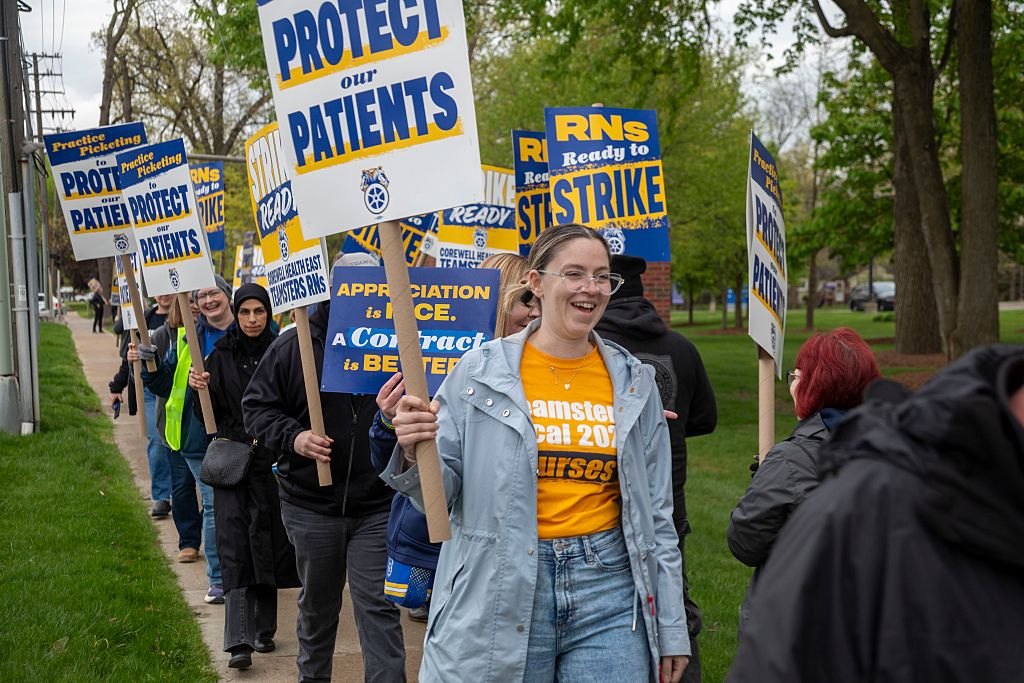
Teamster nurses "practice picket" at Corewell Health East in Dearborn, Michigan, on April 29, 2026.

Young Americans face an increasingly tough labor market. But well-paid union nursing jobs continue to be plentiful — and offer crucial opportunities for those looking to join the labor movement. (Jim West / UCG / Universal Images Group via Getty Images)


Labor unions have historically played an essential role in the fight for democracy and workers’ rights. Yet they have largely retreated during Donald Trump’s second presidency in the face of his administration’s vicious attacks on organized labor.

In 2025, the number of strikes in the United States declined by 36 percent from their uptick in 2023, the year of the United Auto Workers’ “stand-up strike” against the Big Three automakers and of a number of other major strikes across the country. Although union density increased by 1 percentage point last year, and unionized workers engaged in important efforts from launching rank-and-file caucuses to organizing against Immigration and Customs Enforcement (ICE), unions increasingly neglected one of their most powerful tools: withholding their labor.

Health care unions are an important outlier in this national story of union retreat, however. Public and private sector health care unions drove 29.4 percent of all strikes and twelve out of the thirty-one major strikes (those involving more than one thousand workers) in 2025. Much of this activity was led by nurses. Thanks to their leverage in a growing health care industry in need of their skilled labor — and their willingness to take collective action — many nurses won impressive improvements to patient care through safe staffing as well as workplace safety measures, income increases, and other gains.

Today, following in the footsteps of prior generations fighting for economic and social justice, many young people are pursuing the “rank-and-file strategy” to reestablish broken connections between labor and the Left and to revitalize ossified, complacent unions. An important aspect of this strategy is “industrializing”: taking unionized rank-and-file jobs in strategic firms and sectors to help rebuild the labor movement from the bottom up. Because it is highly unionized, offers decent pay and job security, and is ever more central to the US economy, nursing is an especially promising destination for would-be shop-floor organizers.

Leverage on the Job

Alongside efforts to “salt” large nonunion employers like Starbucks and Amazon, rank-and-file organizers can play an essential role in transforming existing unions toward greater militancy. We have seen workers do this time and again in teachers’ unions over the past decade and a half, and as reformers in the United Auto Workers did in 2023, setting the stage for the historic stand-up strike and the union’s aggressive new push to organize the South.

In recent years, members of the Democratic Socialists of America (DSA) and fellow travelers in groups like the Rank & File Project have sought rank-and-file jobs in industries including public education, logistics, construction, and health care. These sectors are each potentially strategic sites for young activists to get union jobs for different reasons. Delivery drivers, truckers, warehouse workers, and others who power our logistics economy have an enormous amount of leverage when they strike and bring the flow of goods to a halt. Meanwhile, although public school teachers may not directly confront capital in the same way, they are strategically placed to fight to defend public education from privatization and austerity — as we saw with the 2012 Chicago teachers’ strike and the ensuing teacher strike wave across both red and blue states.

Like the school and the warehouse, the hospital has increasingly defined this country’s employment landscape amid the offshoring and automation of manufacturing in the late twentieth century. Today the hospital is akin to the factory or steel mill of earlier eras of capitalism, bringing together large numbers of workers under one roof and presenting geographic opportunities for class solidarity.

Nurses, like teachers, are often on the front lines of fights for the common good and against the interests of moneyed elites. In the public sector, nurses are well-positioned to make demands on the state to use public funds to expand and improve health care and other common goods rather than give tax breaks to the rich. And in the private sector, nurses confront highly lucrative enterprises in their fight for patient care. Despite its nonprofit designation, NewYork-Presbyterian, for example, had a net income of $1.4 billion in 2024. And in the first quarter of 2025, the hospital reported an almost $97 million surplus and $2.7 billion in revenue. Executives at private hospitals like these make money on par with the CEOs of major S&P 500 firms; some of these hospital systems are not just in the business of medical care but also run venture capital firms and real estate holding companies worth billions.

A Growing Sector of Well-Paid, Long-Term Jobs

Those interested in becoming rank-and-file organizers should consider becoming nurses for a few other reasons too. Nursing will be one of the fastest-growing occupations in the United States in the coming years, in no small part because it is resistant to automation and outsourcing, and the high demand for nurses’ skilled labor means that the job pays a comfortable salary.

It is harder and harder for young people to find a job in today’s economy. At the end of 2025, the unemployment rate for college graduates between the ages of twenty-two to twenty-seven rose to 5.6 percent. Yet health care resists these trends. As a New York Times article put it, health care is the “lifeblood of the labor market,” adding 693,000 positions last year. If not for that job growth, the economy would have lost 570,000 positions in 2025 as other industries contracted. And while nurses work long hours and deal with understaffing, workplace violence, and other issues, nursing also offers job stability and six-figure incomes. It’s no wonder the Wall Street Journal recently described nursing as a “surefire new path to American prosperity.”

The rank-and-file strategy depends on activists committing to their jobs for the long term so they can form relationships and help build durable shop-floor organization. The material benefits of nursing make such a commitment feasible.

Militancy on the Rise

Those who become nurses have the chance to join a vibrant network of skilled and increasingly class-conscious organizers. The historic 2026 New York City nurses’ strike by the New York State Nurses Association (NYSNA) at three of the city’s biggest hospitals was led by experienced unionists (many of whom led the successful 2023 strike against two of the same hospitals), who are furious with the Epstein class that has been diminishing patient care to line its own pockets.

In their fight to win enforceable safe staffing ratios, hundreds of rank-and-file nurses took the initiative to organize a march to New York Governor Kathy Hochul’s Manhattan office, where they protested her executive orders that enabled hospitals to more easily hire scab labor. They also organized a civil disobedience action, linking arms outside the Manhattan office of two pro-hospital lobbying groups, chanting, “No hate, no fear, immigrants are welcome here” before arrest in a moment that drew connections between their own working conditions and the international working class. And when top NYSNA leadership forced a vote on a tentative agreement their bargaining committee had previously voted down, NewYork-Presbyterian nurses voted overwhelmingly to reject that contract and stay out on strike.

Building Power in the Workplace

In recent years, socialists, progressives and antiestablishment figures have built a presence in city and state governments across the country, including in New York City, where Zohran Mamdani’s stunning victory constituted a real electoral breakthrough. But winning elections is only part of the battle. Unless organizers build a real, enduring presence in working-class neighborhoods and associations, especially unions — and a fighting labor movement that can force concessions from corporations and the ultrarich — these elected officials will have limited room for maneuver, and their victories will be vulnerable to capital’s counterattacks.

That is why getting involved in and helping revitalize labor is a central task for the Left today. And getting jobs as union nurses may be one of the best ways for young activists to make headway on it.