Lower the Voting Age
There’s no good reason not to change the US voting age from 18 to 16. Expanding the franchise isn’t just good for democracy — it offers the Left a significant opportunity to build its forces.
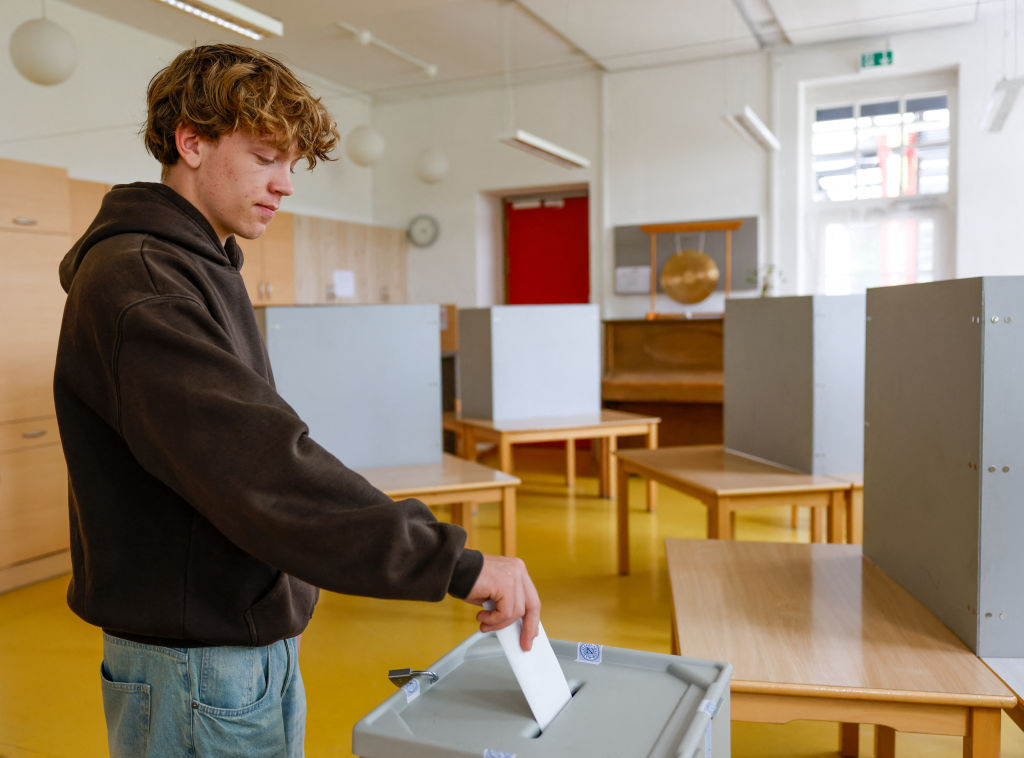
The movement to change the voting age to 16 is gaining momentum across the world. Doing the same in the United States is a no-brainer. (Alexandra Beier / AFP via Getty Images)
When Aleksi Toiviainen was fifteen, he led a protest against changes in his school’s curriculum that removed content on LGBTQ and indigenous communities. Aleksi rallied over five hundred students to walk out against these curriculum changes, yet follow-up actions that attempted to protect this content failed. In the wake of this defeat, Aleksi felt powerless.
His experience is common for young people trying to engage in politics on a larger scale, too. Young people have taken to the streets and gained national attention protesting around issues like gun control and preventing climate change, yet progress remains elusive. Youth activists like Greta Thunberg garner global media coverage, yet the world is on track to miss Paris Agreement emission goals, and the United States has expanded oil drilling and defunded climate change research.
The 2025 Harvard Youth Poll found that only 13 percent of young Americans believe the country is headed in the right direction. They are worried about the state of the economy and their future opportunities, given the rise of artificial intelligence. And while more young voters align with the Democratic Party than with the Republican Party, both sets of voters view their own parties negatively.
When Aleksi reflected on the failure of youth protests to lead to changes in policy, he came to the conclusion that “structural incentives aren’t in place for politicians to really give them the time of day.” He wasn’t just relying on anecdotal evidence; a 2015 study in Canada found that while younger people are more likely to talk about politics, only 52 percent of young Canadians reported being contacted by political parties, compared to 83 percent of older voters.
The structural incentive Aleksi was referring to, of course, is the right to vote.
Lower the Voting Age
This experience inspired Aleksi to found Canada’s Vote16 organization, focused on extending the right to vote to sixteen- and seventeen-year-olds. His organization was part of a movement that had established a foothold in countries across the world. The UK government recently introduced legislation to change the voting age to sixteen for all elections, following the passage of such laws in Wales and Scotland in Britain, as well as in Austria, Brazil, and parts of Germany.
In many of these countries, such legislation was controversial. Skeptics asked: Are sixteen-year-olds mature enough to vote? Are they too easily influenced by their parents or by social media propaganda? Will they disproportionately vote for “radical” politicians? When the policy was proposed in Scotland, Jan Eichhorn, associate professor of social policy at the University of Edinburgh, had the same questions. Eichhorn has since become a leading researcher on the topic, attempting to answer the questions the policy raises.
A decade of research has led Eichhorn to a solid conclusion: “In no context has anything negative happened.” Research generally suggests that there’s no difference in the quality of the vote between the youth and their older counterparts. Sixteen- and seventeen-year-olds are as knowledgeable on politics as adults, vote in an ideologically coherent manner, and are not disproportionately influenced by their parents’ votes.
On the other hand, expanding the vote to younger people has plenty of upsides. For one thing, decreasing the voting age to sixteen may lead political parties to pay more attention to the concerns of young voters. Vote16 may be the solution to this lack of attention from politicians, as Eichhorn has found that, when the voting age is lowered, “politicians become more responsive to young people . . . [making] them more visible in the political process.”
When given the opportunity, research suggests, sixteen- and seventeen-year-olds vote at higher rates than adults and use their newfound political power to exert influence outside of simply voting. As a result, a study in Latin America found that satisfaction with democracy and trust in national institutions increase once the voting age is lowered.
Eichhorn has observed these young people advocating for their interests within political parties, pushing politicians to shift policies on issues like climate change to address the needs of the youth. In Germany, he found that lowering the voting age helped move young people past issue-based politics and into positions of power within political parties. As younger voters were paid more attention by their politicians, they began engaging in debates over policy. Not only did the Green Party in Germany begin advocating for more radical climate change reform, but the Conservative Party also began taking climate change more seriously for a time.
What Vote16 Achieved in Canada and Scotland
Changing the voting age will not solve the problems young people face today, as Aleksi admits: “No policy is a panacea. No policy is a silver bullet.” However, lessons from Canada suggest that giving young people the right to vote has impacts beyond elections. Since Aleksi founded Vote16 Canada, the organization has expanded to become a movement that has passed motions in twenty-two municipal councils and school boards, with progress across every province in Canada. After introducing Bill S-222 in Canada’s Senate, Vote16 expanded their fight for democracy: they’ve won the ability to vote in neighborhood referenda in Toronto and have started pushing for youth seats on advisory councils in Port Hope. Progress has continued with M-99, in which a Senate committee has committed to studying broadening democratic inclusion, including youth voting rights.
“I think one of the main things that this campaign has taught me is the value of . . . local democratic innovations,” says Aleksi. These innovations can go beyond youth-related issues to policies such as ranked-choice voting or increasing transparency in municipal politics.
Local changes that increase democratic control by the youth also affect school curricula, where discussions about democracy become more consequential. Eichhorn found that when Scotland changed their voting age, “the role of schools is really important in terms of enhancing these positive effects,” because they allow young people to debate politics with classmates in a safe environment. “Research suggests [increased civic education doesn’t] bias young people, but [helps] them become interested and seek out more information.”
Vote16 in the United States
The movement for a lower voting age in the United States has not achieved the same size or influence it has in other countries. The last US constitutional amendment was passed in 1992, and a lower voting age is unlikely to be the next one. Instead, the United States’ Vote16 organization has adopted a decentralized approach, targeting policy on a city-by-city basis.
While changing the voting age to sixteen is not officially supported by any major party, legislation in numerous municipalities in Maryland, New Jersey, and Vermont has extended the right to vote to sixteen- and seventeen-year-olds in local elections, and Berkeley and Oakland, California, have given sixteen- and seventeen-year-olds the right to vote in school board elections. These policy changes reflect the work of thousands of high schoolers creating campaigns in over twenty-five states. While roles in policymaking are generally reserved for experts with greater experience, high schoolers themselves hold key leadership roles in Vote16 USA, testifying in local committees, conducting academic research, and mobilizing campaigns of other students. Young people want to be heard, and once they win the right to vote, we can expect their voices to get louder.
Vote16’s municipal strategy aligns well with the American left’s recent focus on municipal politics. Zohran Mamdani became mayor of New York City advocating for local reforms such as rent freezes and citywide free childcare. Socialists on the whole have been building power across the country, winning local elections from New York to Atlanta, Minneapolis, Detroit, and elsewhere. Socialist organizations like the Democratic Socialists of America, incorporating Vote16 policies into their platform, could bring more young people into left-wing politics — not simply gaining their votes but encouraging them to lead their own movements and gain experience in local government.
Why the Left Should Support Changing the Voting Age
In the United States, the youth is politically frustrated with both parties. Beyond simply being more likely to talk about politics, as the 2015 study in Canada found, one in every five young people have attended a protest, and high schoolers consistently draw headlines by leading school walkouts, encampments, and other forms of protest. This outrage is not simply directed at the current presidential administration but expresses discontent with our current system and its inability to make real progress on the existential crises facing our young people.
But this frustration does not necessarily translate into a coherent political strategy. In 2024, Gen Z swung strongly toward the “protest candidate” Donald Trump. After seeing Trump fail to deliver the change they desired, young people have returned to heavily favoring the Democratic Party. For young people to become coherent political actors, rather than simply reactive protest voters, early education about democracy is key. Having the right to vote while still in high school can lead to better civic education, as observed in Scotland by Eichhorn, and even ultimately result in youth being more involved with politics within the party, as observed in Germany. By gaining the right to vote, young people can lead the change they wish to see within their parties.
In the United States, students are lobbying policymakers directly at the local level and seeing their voices transformed into an actual policy change. By learning that their opinion matters, young people learn to demand more from the system and can continue to be at the forefront of demanding reform.
Lowering the voting age is no panacea. And there is some worrying evidence from Austria that the boost in election turnout associated with expanding the franchise may be short-lived. Changing the voting age can be a tool to engage the younger generation and place political power in an oft-overlooked demographic. Keeping young people involved in politics and increasing public participation in the democratic process more broadly, however, requires political parties and politicians to offer voters substantive agendas that speak to their material interests and deepest aspirations. Politicians cannot simply lower the voting age and continue to ignore the youth. But socialists are well positioned to offer a substantive vision that appeals to voters across generations — and if they can link up ambitious Mamdani-style governance projects with efforts to bring younger people into politics, they may both expand the electorate and grow their own base.
In an era of increasing political nihilism, changing the voting age may be a first step to break through the political frustration. Advocating for a lower voting age in municipal councils throughout the country can reinvigorate a new generation of activists and elevate young people to positions of leadership in which they’re taken seriously. This simple change of an eight to a six can be a boost in the fight to expand democracy at a time when antidemocratic forces are on the rise.