To celebrate Bastille Day, get a yearlong Jacobin print subscription for $7.89!

Aliens Gave Us One of Hollywood’s Great Working-Class Heroes

When James Cameron’s Aliens was released 40 years ago, film critics dismissed it as a dumb blockbuster, a defense of patriarchy, and a reflection of US scorched-earth military policy. They were wrong on all counts.
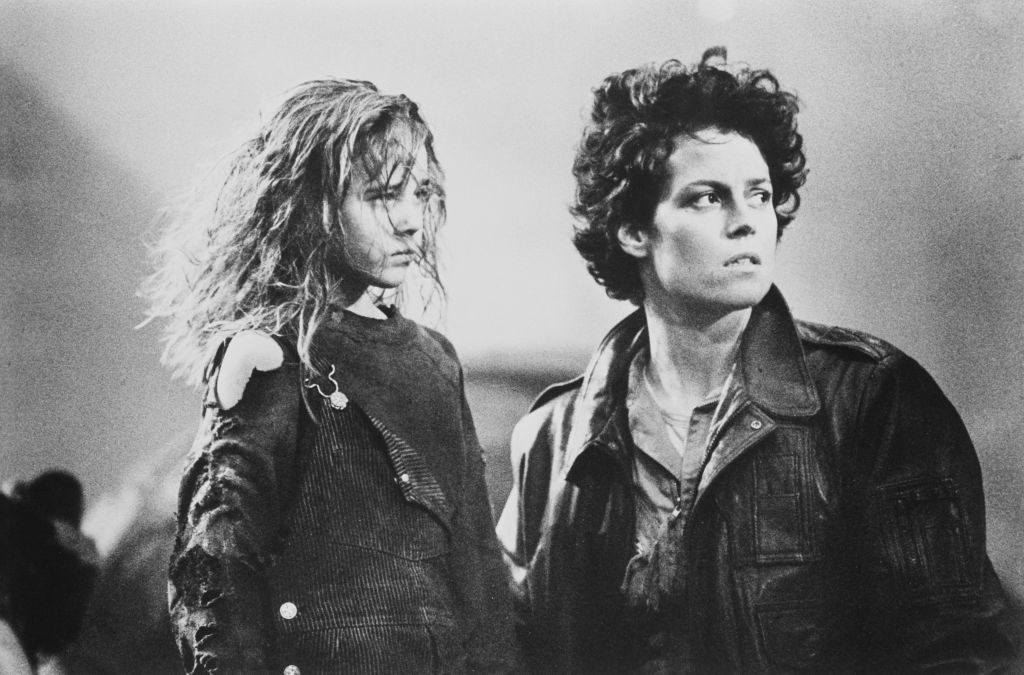
Sigourney Weaver and Carrie Henn are photographed on the set of the film Aliens.

As Aliens marks its 40th anniversary, we honor Ellen Ripley, the forklift-certified tradeswoman and fearless single mother who fought to save the human race from a predatory megacorporation in space. (Bob Penn / Sygma via Getty Images)


James Cameron’s Aliens (1986) celebrates its fortieth anniversary this July. For generations, the groundbreaking action-horror masterpiece has won over fans with its effortlessly quotable band of hard-up marines and its fierce, iron-willed protagonist — Sigourney Weaver in the role of Ellen Ripley.

However, Aliens has also been divisive. Critics like Pauline Kael, Roger Ebert, Sheila Benson, and Richard Schickel were split over how to interpret the film’s then-curious mixture of action and horror. Even those who praise its undeniable thrills and action chops regard it as the mere crowd-pleaser sequel to the far artier original film, Ridley Scott’s Alien (1979).

Writers have also been obsessed with reading secret political messages into the movie. Aliens has been cast as everything from a detailed work of Marxist theory and a subversive queer allegory to a Reaganite attack on immigrants and a defense of civilian massacres during the Vietnam War. But the movie doesn’t need a magic cypher; it’s all right there on the surface. It’s a working-class epic — monsters, machine guns, and all.

Aliens tells the story of a group of working-class people who are treated like disposable resources, sent into hell, and left to fend for themselves. In spite of it all, they come together, a powerful display of solidarity driven by their fearless leader Ripley.

Forty years later, that image remains timely as ever. Yet here’s what the film’s critics of 1986 wrote — and what Aliens really has to say.

The Case Against Aliens

Critics never really knew what to do with Aliens. The great writer Pauline Kael was among the early doubters, dismissing the movie as an “inflated example of formula gothic” with “the look of a comic book for adults.”

Meanwhile, Roger Ebert wrote about Aliens with stunned admiration, confessing the “movie is so intense that it creates a problem for me as a reviewer.”

A significant portion of the debate over the film centered on the shift from the subtler horror devices of Ridley Scott’s original to the more frenetic action of the sequel. As one critic observed, the film is “blaster action, not Gothic future-horror,” as “empty as it is fast and noisy.” According to another, Cameron was the “expert craftsman” to Scott’s “artist.”

Aliens has also attracted detractors for its gender politics, becoming a recurring touchpoint in feminist film criticism. While some writers have appreciated Weaver’s powerful lead, the movie has also been interpreted as “the conservative marking of Ripley as feminine, based on her maternal feelings for the girl Newt.”

The seeming militarism of Aliens has especially perturbed critics who see the movie as a blanket endorsement of unchecked technological violence. Kael saw the film as “addicted to ‘advanced’ weaponry and military hardware,” and another interpreter noted Cameron wrote the first draft of Rambo: First Blood Part II (1985) — a film that saw Sylvester Stallone mowing people down as he rescued Vietnam War POWs.

One of the more strident critiques of Aliens’ militarism comes from an essay by Noah Berlatsky, who sees the entire film as a Vietnam allegory. Recycling an old claim first put forth in 1987 by Jim Naureckas, Berlatsky claims Cameron transposes the conflict between the United States and Vietnam to the fight between the marines and alien creatures.

“The United States couldn’t conquer Vietnam,” he writes. “But it could conquer the memory of Vietnam and create movies in which the war was not an embarrassing and bungled exercise in imperial overreach, but a victorious struggle against inhuman adversaries.”

Berlatsky’s strange contention is that high-minded viewers ought to side with the aliens, who “repeatedly sacrifice themselves to damage the invaders, spraying their acid blood on their attackers in a final, gallant act of defiance.”

Aliens as a War Film

While Aliens has its detractors, many leftists have also defended the film. At least one critic has claimed the film is an out-and-out work of Marxism, while another contends the first two Alien films “provide commentary about both the Ayn Randian ideology on the Right. . . .  and the Posadist ideology on the Left.”

Aliens is hardly a Marxist film, let alone one that gets specific enough to advocate for galactic communism and weigh in on Trotskyist debates. But it also isn’t the warmongering shoot-’em-up that other critics suggest.

In fact, the movie is far more nuanced about war than may appear at first blush.

There is zero evidence to indicate Cameron intended the film as an extended allegory for violence against Vietnamese civilians — especially since his basic premise is that a group of people go to rescue literal civilians from a conflict zone.

Even so, Cameron has linked the film to the Vietnam War, comparing the marines’ helplessness with the misguided faith that sheer military might could win the war for the United States: “Their training and technology are inappropriate for the specifics, and that can be seen as analogous to the inability of superior American firepower to conquer the unseen enemy in Viet Nam: a lot of firepower and very little wisdom, and it didn’t work.”

Even so, Cameron made it clear that Aliens isn’t an endorsement of unchecked violence. He’s repeatedly distanced himself from Rambo: First Blood Part II, which was significantly rewritten by conservative Sylvester Stallone after he left the project. Talking to Starlog in September 1986, Cameron explicitly positioned Aliens as the antidote to that project:

After Rambo, I’m not that interested in making a film where people are running around shooting each other, and getting into the moral complications of saying, ‘Well, just because they’re wearing a different uniform from another country, it’s OK,’ in order to feel absolutely lily-white and clean about the havoc that’s wrought on their bodies by high velocity ballistic weapons. So, no human being kills another human being in this movie.

Of course, it’s still easy to see Vietnam parallels in Cameron’s marines: dropped in a faraway land, repeatedly walking into ambushes in which their superior firepower is of little help. Simply saying they’re just following orders would do little to isolate the film from the militarism critique.

But Cameron’s marines don’t just follow orders. They learn the company that sent them intends to use these creatures as powerful bioweapons, presenting unlimited danger to Earth and its billions of civilians. In the end, their choice to destroy the aliens from space is an act of defiance, a refusal to follow orders that will inevitably put innocent humans in the crossfire.

Ripley as Working-Class Hero

As potent as that decision is, Aliens is most powerful for its engagement with class. But that engagement dates back to the original film, with its unique depiction of commercial “space truckers” hauling ore across the galaxy; its crew members complaining about “the bonus situation.” In 1979, both critics and audiences couldn’t help but notice. In his review in the New Yorker, Brendan Gill, a Yale-trained Skull and Bones member, suggested that space was ill-suited to a “person of breeding,” sneering at the focus on “slobs and blobs” who use “swear words very like those currently to be met with in Times Square.”

Of course, Aliens even more than Alien is, in fact, the perfect film for anyone who sympathizes with those “slobs and blobs” who haul raw materials, fight wars on behalf of others, and suffer in the process.

This class engagement is particularly triangulated through its protagonist, Lt. Ellen Louise Ripley.

Fakhry Al-Serdawi has questioned Ripley’s status as a member of the working class, instead grouping her with the “administrators of the Nostromo. . . .  the button pushers of this major operation of industrial capitalism.”

But Ripley is a warrant officer, part of that strata of what Vivek Chibber calls “exalted workers” — typically, they’re enlisted tradespeople who’ve been elevated to manage technical operations on ships. And by the time of Aliens, Ripley’s been demoted to a warehouse employee who has nothing but the Class 2 rating that lets her operate power loaders. She’s a model 1980s American worker: a downwardly mobile tradeswoman fighting just to get by.

Ripley’s class character becomes explicit through her conflicts with the omnipresent “Company,” the multinational Weyland-Yutani. Throughout Aliens, we see them as the extension of a corporate power that is indifferent to life and fixated on profit — a paradigmatic monopoly enterprise that has encroached on nearly every aspect of human life. Under their dominance, man, woman, child, and creature alike have become disposable resources to fuel their drive for expansion.

In the original Alien, it’s this context that ultimately motivates Ripley’s actions, which often lead her into conflict with the Company and their agents above her: Dallas (Tom Skerritt) and Ash (Ian Holm) in the first film, Burke (Paul Reiser) and Lieutenant Gorman (William Hope) in the second.

Much has been made over Ripley’s supposed attempt to be one of the boys or, to the contrary, her feminine need to symbolically restore the nuclear family. Now, I don’t think there’s anything particularly troubling about Ripley going toe-to-toe with the fellas or being a maternal figure; in fact, there’s actually something potent about the simultaneous juxtaposition of two seemingly conflicting tropes. As Sheila Benson glibly put it in her 1986 LA Times review, “she’s become an image ripped from today’s statistics: the Single Parent Triumphant. . . .  Supermom in excelsis.”

But Ripley does more than swing around her huge gun and nurture a child. Speaking on Ripley’s power in 1986, Weaver explained she’s driven by a desire to help others: “Ripley still feels responsible for what happened on the Nostromo. . . .  There are so many ghosts in her life. And yet she agrees to face the horror once again.”

As Benson aptly put it, the Ripley character stands out most of all for her “compassion for other human beings.”

This has always been the power of the Alien franchise, which boldly wrestles with humanity’s ills — greed, inequality, cowardice, brutality — and comes out squarely in defense of the good inside of working-class people.

Why Aliens Endures

In the end, Aliens is not some work of Marxist scholarship disguised as cinema — go watch the best of Costa-Gavras or The Battle of Algiers if that’s what you’re looking for.

But neither is it a reactionary parable. Nor is Aliens just a “crowd-pleasing” sequel to a supposedly superior art-house original. It’s the rare Hollywood blockbuster that is deeply sympathetic to the working class and its pains.

Writing for Time in 1986, Richard Schickel zeroed in on what makes the film so exceptional in the genre; as he saw it, Aliens stood for “the restoration of something like an adult sensibility to the action movie, a belief, shared by such classicists of the genre as John Ford and Howard Hawks, that besides telling a rattling good yarn at a nerve-busting pace, pictures of this kind can carry a theme, even — shocking word these days — a moral.”

That moral endures today, especially as the Left is still asking the media to take working-class people seriously. Aliens and its protagonist still speak to us — not in metaphors or secret codes, but clearly and directly.

Ripley is a badass, forklift-certified single mother who shoves off into space to rescue innocent civilians, risking her life along the way. She leads with equal parts brains, brawn, sarcasm, and sensitivity, refusing rigid gender roles and superficial subversions thereof.

Despite the voice in her head telling her to protect herself, Ripley is the perfect figure of solidarity. She unites a ragtag troupe of shell-shocked marines and a courageous child to defy a titanic megacorporation that would happily toss them all into the meat grinder — saving the whole of humanity from a terrifying threat in the process.

In this house, Ripley is a working-class hero. End of story.