Trump’s Bet on Stablecoins Puts the Financial System at Risk
US government enthusiasm about the cryptocurrency known as stablecoins is about more than Trumpian corruption or industry lobbying. It’s an attempt to lower federal borrowing costs — one that may undermine the financial system’s stability in the long run.
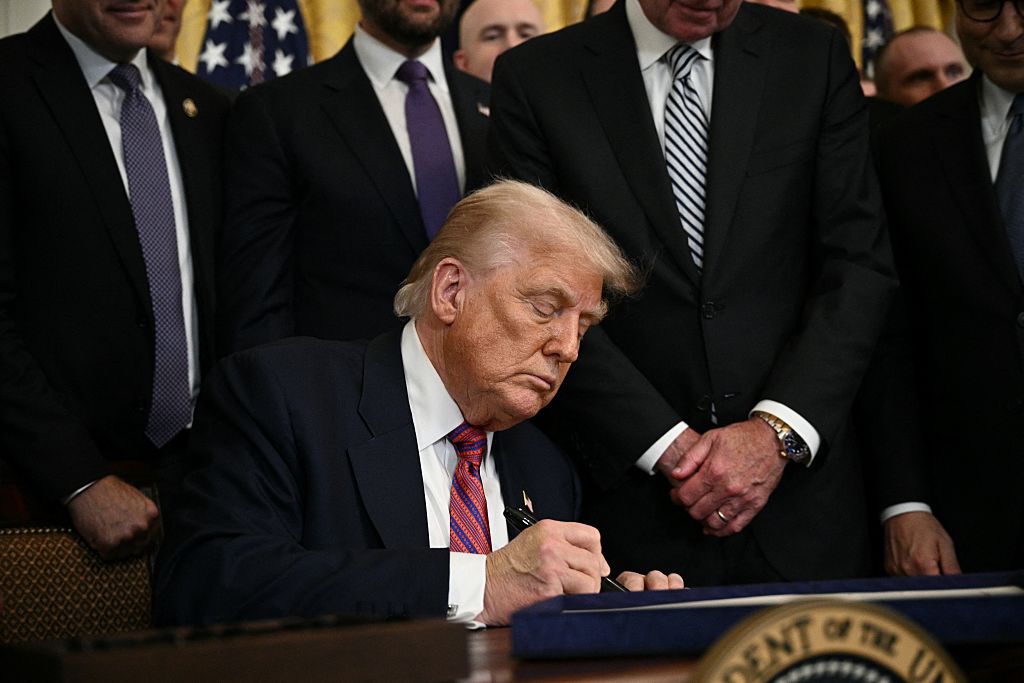
Donald Trump signs the GENIUS Act, which codifies the use of stablecoins — cryptocurrencies pegged to stable assets like the US dollar or US bonds — in the East Room of the White House in Washington, DC, on July 18, 2025. (Brendan Smialowski / AFP via Getty Images)
A new form of cryptocurrency called “stablecoins” has exploded onto the global financial scene. Created just over ten years ago, the industry’s expected growth sets it on a path to rival some of the largest players in finance. Analysts expect it to grow to $1.6 trillion by 2030, which would make it roughly equivalent in value to the total assets held currently at Citibank.
To explain stablecoins’ meteoric rise, most analysts have pointed to the self-dealing ways of the Trump administration. President Donald Trump has frequently used the presidency for his own personal benefit, and cryptocurrency is no exception. In May of 2025, the Trump family launched a stablecoin (USD1) through their cryptocurrency company World Liberty Financial. Just two months later, Congress passed the Guiding and Establishing National Innovation for US Stablecoins (GENIUS) Act, providing a regulatory framework for stablecoins and unleashing a torrent of investment into the sector. After the acts’ passage, USD1 grew to nearly a $3 billion market cap in a few months — lining the Trump family’s pockets to the tune of $412 million.
The Trump administration’s corruption is an important factor in explaining the government’s support of the stablecoin industry. Yet as an analytical lens, it has its limits. How, for example, do we explain the fact that the GENIUS Act passed through both houses of Congress with veto-proof, bipartisan support? There was something that compelled many Democrats — even some of President Trump’s harshest critics like Senators Adam Schiff, Cory Booker, and Kirsten Gillibrand — to vote for the bill.
And while corporate interests are often able to get their way in American politics, the corporate sector was by no means unified. Commercial banks opposed key sections of the bill and have lobbied to ensure that the stablecoin industry does not become a meaningful competitor.
The stablecoin industry’s rapid growth has another foundation that is often ignored in contemporary analyses: the federal government’s need for cheap borrowing to finance its spending. Through the GENIUS Act, the federal government has created another statutory incentive for financial institutions to lend to it.
A historical perspective reveals how the government’s need for cheap borrowing has often functioned as a catalyst to transform the US banking system in ways that sow the seeds for financial crises down the line. While past examples of incentivizing cheap lending to the government were often done as a means of last resort during wartime, there was no comparable justification when the GENIUS Act was passed. In this case, the Iran war has made the need for cheap borrowing even more pressing, although the original motivation was a risky ploy to finance tax cuts for the wealthy.
If we want a stable financial system that serves the interests of the public rather than corrupt politicians and the ultrarich, two major reforms are needed. First, to reverse the financialization of the US economy over the past sixty years, we must ensure that money creation is conducted solely by regulated banks. As part of this reform, the Federal Reserve, Treasury, and Congress must commit to regulating new financial entrants that look like banks but are not — like stablecoins — even if that means higher borrowing costs for the government. And second, to ensure that regulators do their jobs, we must eliminate the incentive for them to look the other way: we need to rein in the federal deficit.
Understanding Stablecoins
Unlike more volatile cryptocurrency assets like Bitcoin, stablecoins are, as their name suggests, designed to be stable — most are “pegged” to the US dollar. While the terminology can be confusing, they operate quite like banks. As with banks, people deposit their dollars with a stablecoin issuer, and they receive a cash equivalent in return — in this case a “stablecoin” instead of a deposit.
After the passage of the GENIUS Act, stablecoin issuers are required by law to hold certain public assets like Treasury securities in back of their coin issuance. One of the goals of the act was to make stablecoin issuers safer by regulating the assets they could hold, just like the government has often done with banks throughout US history.
While requiring stablecoin issuers to invest in public assets increased stablecoin stability, it accomplished another, equally important priority for the feds. Through this statutory change, the federal government created a legal incentive for financial institutions to lend to it, thereby driving down the price of government borrowing.
With a fiscal deficit hovering around $1.8 trillion and Trump’s tariff policies wreaking havoc on the bond market last year, it was no surprise that the administration came out strongly in favor of the GENIUS Act. The administration recognized the connection between stablecoin growth and the Treasury market, referring to the GENIUS Act as a way to “reinforce dollar supremacy” (read: deepen the Treasury market and ease financing costs).
More broadly, the federal government’s voracious appetite for cheap debt can help explain why the bill passed overwhelmingly with bipartisan support in both the House and the Senate. A cosponsor of the GENIUS Act, Senate Democrat Kirsten Gillibrand, praised the bill for safeguarding “dollar dominance,” mimicking the administration’s own language.
Historical Parallels
This exact phenomenon — elevating new financial interests because they cheapen government borrowing during moments of fiscal uncertainty — has a long precedent in US history.
In 1863, during the Civil War, financing government spending was a matter of life and death for the Union. Running out of money and increasingly frustrated with the inflationary effects of printing fiat money (“greenbacks”) to finance the war, the Union desperately looked for a way to get more people or businesses to lend to the federal government. The existing banking system — often called the Free Banking system (1837–1863) — with its patchwork of state regulations and no national currency, was not a productive source of borrowing for the federal government. This was because states did not always require banks to hold federal debt on their balance sheets.
Looking to fill the Treasury’s coffers in ways other than printing money, Secretary of the Treasury Salmon Chase proposed a new “national” bank system. Not to be confused with First or Second Bank of the United States, the proposed system would enable new nationally licensed (but entirely private) banks to deposit federal bonds with the government to back their banknote issuance. Like today, Chase looked to incentivize new financial institutions to lend to the government through regulatory changes.
Despite opposition to the plan from the existing state banking system, Republicans in 1863 had no other choice. The fate of the Union was at stake. In a vote that relied heavily on partisan loyalty, the national bank system was passed in early 1863, stabilizing the bond market and decreasing the country’s borrowing costs so the Union could fight the Civil War. The federal government’s need for cheap borrowing encouraged a fundamental redesign of the country’s banking system that legally incentivized investors to lend to the government.
What are the implications of building a banking system on the back of government debt as Republicans did with the national bank system? While it is not as safe as today’s Federal Deposit Insurance Corporation (FDIC) system, in which bank deposits are federally insured up to $250,000, it is not the worst option. Nowadays Treasuries are considered to be very safe and highly liquid, meaning that few would question the quality of the banks’ underlying assets, diminishing the chances of a run on the bank.
Yet there are clear dangers as well. By connecting the fiscal with the financial, policymakers tied the fate of the national bank system to the vicissitudes of public finance. What happens, for example, to the banking system when the total quantity of public debt changes? History again provides a guide.
After the huge deficits of the Civil War, during Reconstruction policymakers raised taxes and cut spending, producing a federal government surplus. While federal government surpluses are often thought of as an unqualified positive, they can have undesirable economic effects. Because of the surplus, the Treasury began to retire debt instead of issuing more, decreasing the total quantity of public debt in existence.
Yet because financial regulation dictated that national banks were required to purchase federal debt to issue banknotes, as federal debt became less available, banks began to adapt: they began to change their monetary instruments entirely, relying more and more on bank deposits rather than notes. The issue here was that, unlike banknotes, bank deposits were not required to be backed by public debt and could instead be backed by private debt.
This ensuing deposit-based banking system backed by private debt, encouraged by the government’s fiscal changes, turned out to be very fragile. This deposit-based system in the late nineteenth and early twentieth centuries saw frequent banking panics, culminating in the worst banking crash in US history in the Great Depression.
The creation of the national bank system was not the only time the federal government redesigned the financial system to encourage cheap borrowing with disastrous consequences down the line. As I have detailed elsewhere, the “repo” market — a key component of the shadow banking system that crashed in the great financial crisis of 2007–8 — was created to help cheaply finance government debt during the Cold War. Public debt was again allowed to be used as collateral in a new form of banking to push investors to lend to the government. Yet when the Clinton administration in the 1990s ran a federal government surplus for the first time in nearly thirty years, these “shadow banks” began to replace public debt with private debt as their collateral — mortgage-backed securities (MBS) in particular.
The usage of private housing debt to underpin the monetary system proved highly unstable. When the housing bubble burst in 2007, it affected not only real estate but spilled over into the financial system, producing bank runs and an economic catastrophe.
Will Stablecoins Be Stable?
What does this history tell us about cryptocurrency and stablecoins? First, while many contemporary commentators have compared the rise of stablecoins and the GENIUS Act to the Free Banking system because of the growth of privately issued money, the emerging stablecoin industry is more similar to the national bank system because of its relationship with the Treasury market.
Precisely because of this relationship, in the short run stablecoins may be more stable than most commentators suggest. That is simply because their deposits are backed by public debt. The value of public debt, sustained by frequent Federal Reserve intervention, is unlikely to collapse in the near future. While this system is not as safe as deposit insurance — in which bank deposits up to a certain quantity are backed by the “full faith and credit of the United States government” — it has proven to be more stable than monetary systems backed by private debt alone.
However, like the national bank system and the repo market after it, with the GENIUS Act policymakers have tied the fate of this new banking system to the fortunes of public finance. A future decline in the quantity of public debt, while a laudable goal from one perspective, could have severe impacts on the financial system absent other reforms. While it is unlikely that the federal government enters a surplus in the coming years due to the sheer magnitude of the deficit, it is a stated intention of the Trump administration’s tariff policy.
Yet if the federal budget entered into surplus, stablecoin issuers would undoubtedly begin to look for something else to back their deposit issuance, as the supply of Treasuries would decline. At this point, there would be huge structural pressure for deregulation to allow stablecoin issuers to back their coin issuance with other forms of private debt that are much less secure, again producing the conditions for another financial collapse.
Considering these risks to the financial system, what are the purported benefits of tying the US fiscal system to stablecoins? In the past, governments have had at least facially plausible public interest rationales for taking this gamble. In 1863, Republicans redesigned the banking system to borrow cheaply in order to defeat the South and end slavery. In the 1940s and ‘50s, the Federal Reserve created and deregulated the repo market to finance Cold War expenditures. Most would agree the risk was worth it in the first case; and the second was at least an attempt at a serious justification, even if it was mostly an alibi for US imperial aggression. But the rationales for more borrowing today — financing regressive tax cuts and stabilizing a bond market shaken by the administration’s tariff policy and now ill-conceived military adventurism — don’t rise to even a minimal level of plausibility.
In sum, cryptocurrency’s transition from the digital fringe to the bright lights of mainstream finance has followed the exact path of the traditional financial institutions it loves to criticize. Like the repo market and national bank system before it, stablecoins have been grafted onto the state’s fiscal machinery as a way to cheapen government borrowing. As history shows, these fiscal-financial entanglements do not provide long-term financial stability. Far from liberating the American people from the unholy alliance of banks and the state, stablecoins have simply gotten in on the action.
How to Rebuild Our Financial System
Taking this history into account, the first of two planks of commonsense financial reform is the following: redesign the financial system to ensure that money creation is conducted by regulated banks only. Morgan Ricks, in his book The Money Problem, provides a detailed overview of how such a transformation could take place, including an “unauthorized banking” law that prevents new financial players like stablecoin issuers from acting like banks without any of their regulatory safeguards (such as deposit insurance).
Such a reform would not only stabilize the financial system; it would also begin to reverse the tremendous growth of the financial sector relative to other sectors of the economy since the 1960s. This dynamic, also known as “financialization,” has contributed to many of the issues — skyrocketing inequality, asset inflation, and financial crises — that plague the United States today.
Yet the key to the success of this reform is to ensure Congress and the Fed uphold their end of the bargain. The Fed must regulate new financial entrants that look like banks but are not, even if those financial institutions help cheapen the cost of government borrowing. Congress, for its part, must be a better watchdog over the Fed than it has been in the past.
That leads us to the second plank of commonsense financial reform. In order for the Fed and Congress to monitor the financial system effectively, the incentives for the public sector to look the other way in exchange for cheap borrowing must also be removed: the federal deficit must be shrunk.
Accomplishing this latter task is easier said than done. In the twenty-first century, calls to shrink the budget deficit have mostly been rhetorical cudgels of the minority party against the party in power, rather than reflecting a genuine governing strategy. Democrats, and the Left more broadly, have often embraced the view that the federal debt is minimally harmful and in fact increases the state’s capacity to finance progressive priorities. Republicans similarly ignore the debt when in power, preferring to cut taxes for the wealthy.
Despite the acceptance of the national debt as a permanent fixture in US policymaking by elites of both parties, debt reduction is incredibly popular with the public. For the last fifteen years, supermajorities say that they personally worry about the federal debt either “a great deal” or “a fair amount.” While such concerns are often dismissed by economists as irrational, history suggests that the public does understand its own interests, even if it cannot explain exactly what is troubling about the debt. That is because, at its core, the issue of debt is simple. Creditors have power and debtors do not. The public may not know who exactly owns the debt, but they know it is not them. As Sandy Hager has found, the ownership of the public debt is highly unequal: in 2013, the top 1 percent wealthiest individuals in the United States owned 56 percent of the US public debt.
Cutting the debt need not mean fiscal austerity either. Instead, making the tax system more progressive can decrease the debt while also funding other policy agendas most Americans feel favorably toward, such as minimizing income inequality through raising taxes on the wealthy. In New Jersey, for example, a recent poll of registered voters found that 77 percent agreed that differences in income in the nation were too large, including 56 percent of Republicans.
As the Left attempts to build a broad coalition to beat back Trumpism and advance badly needed reforms, a debt-reduction and tax-the-rich platform is a potential avenue forward. Besides being popular with the American public, this platform would put our financial system on more stable footing — guarding against the sort of crisis that has been so destructive for working-class families and for our national politics.