Getting Beyond the Politics of Powerlessness

Too many of us in left politics today have a deep-seated resistance to seeking, taking, and wielding power. We have to overcome that resistance.
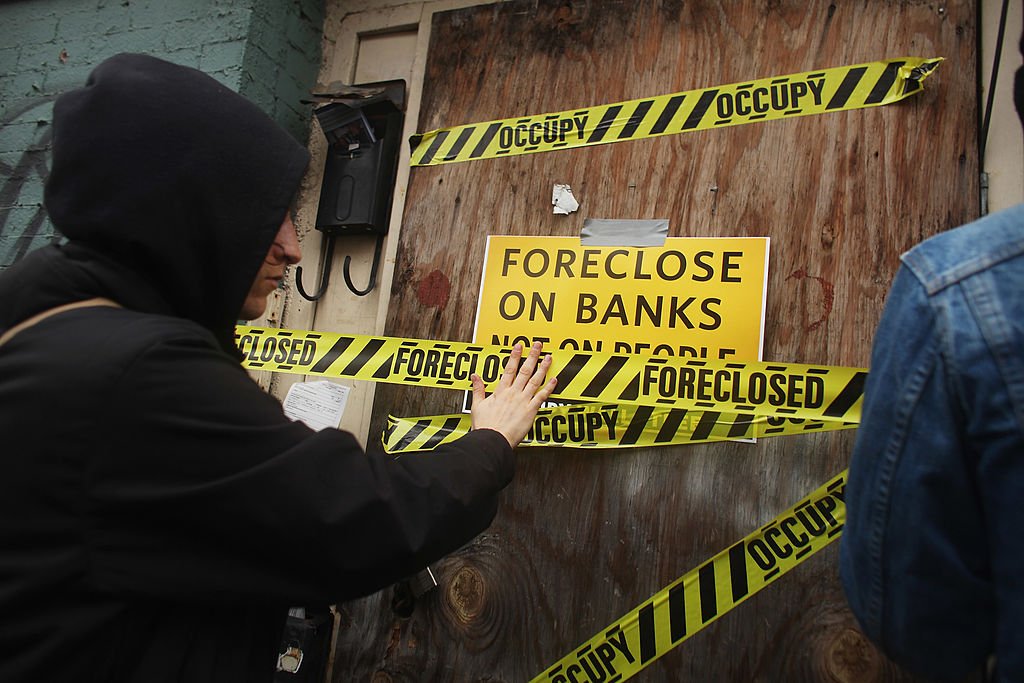
A member of the Occupy Wall Street movement places tape over a window of a forclosed home during a march in the neighborhood of East New York to draw attention to foreclosed homes in the community on December 6, 2011, in Brooklyn, New York. (Spencer Platt / Getty Images)


It’s October 2013, and here in Minnesota it’s already chilly, the leaves changing in dramatic colors that belong on a postcard. Ileia and I are at a Mexican restaurant in Minneapolis with Cat and Nick from Occupy Homes, one of the many organizations that has emerged from the magic and the rubble of Occupy Wall Street.

Occupy Homes has been organizing poor and working-class people to use direct action to resist the evictions and foreclosures sweeping the nation and devastating their neighborhoods.

When the sheriff comes to carry out an eviction order, people from all over the community come and help the family stay in their house, defy the eviction, protect their home. It’s heroic and incredible, and also hard and full of loss.

Ileia and I are here as part of an organization we founded together with a few others, the Wildfire Project, which supports new groups like this one emerging from movement moments with long-term training and support and connects them to one another to help them become greater than the sum of their parts. We’re tired from a big weekend but also relieved. The participants left more connected, inspired, committed, clear. We practiced doing one-on-one organizing conversations, studied the systems that drive the foreclosure crisis, made a timeline of future activity out of sheet after sheet of giant poster paper taped together around and around all four walls of the cabin the organizers had borrowed from a mentor.

I was struck by the combination of bold vision and relentless practicality they displayed in their planning. When Nick said they’d occupy and ultimately win back ten homes over the next year, that a mayor of the movement’s choosing would be elected in a decade, that they would champion congresspeople of and for the movement, I couldn’t tell if he was a dreamy prophet or a hard-nosed general or a madman. Most likely, he was all three, and we were all bewitched by it.

Now it’s just the four of us: Cat and Nick, Ileia, and me. We’re giving and receiving feedback in a little booth with brown vinyl seats, and it’s my turn to receive. Cat has a reputation for no bullshit. She is kryptonite to what is referred to around here as “Minnesota nice,” and now she puts the palms of her hands on the table between us, drops her shoulders, looks me in the eye with an upturned brow and a deadpan face. “You were invisible,” she says.

I don’t quite know what she means. Obviously I was there. I did my job, planned and facilitated the activities, wrote down the things they shouted out on the timeline. I say as much, but she cuts me off: “Yeah, but that’s bullshit. We can write stuff down on the timeline ourselves.”

I look away at the others, then back at her, smiling sheepishly and pleading a little with my eyes as if begging for mercy, but she doesn’t rescue me, and neither does Nick. They have been trained in an organizing tradition that calls this agitation — feedback that’s hard and meant to push me toward greater leadership, higher sacrifice, deeper reckoning. They let the silence hang there, crushing me.

After a minute that feels like a year, they continue together. They point out that I told the group almost nothing about myself, neither to share experiences from Occupy and the other movement work I’ve done, nor to be vulnerable with them about failures, fears, and the stakes. When they were being unrealistic, or skating over misalignment, or avoiding a clear decision, I didn’t intervene and force them to reckon with each other. I had evaded every opportunity to offer opinions on their strategic plan, even when asked, and deferred to the group on everything. I wasn’t even, they noted, very funny, which they knew me to be in real life. It felt to them like, beyond my basic presence as a custodian moving the retreat along, I wasn’t really there.

After this, and some more silence, their voices soften a bit. They ask me questions: Where is the Yotam we met at Occupy Wall Street?” “Why are you showing up in this small version of yourself?” “What are you afraid of?” They say they know I have more to offer; that they asked me to come here because they trust me, even admire me. They want me to be bigger, bolder, to take up more space, offer more guidance, tell more stories, make more interventions. They want me to tell them when I think they’re going off the path, tell them what I would do in their shoes, challenge them.

They remind me, with some annoyance, that I helped lead the biggest movement moment of our collective political lives, which was what opened the space for them to do the work they’re doing in the first place; that I have planned and executed mass actions for thousands of people, written and spoken compellingly about this moment and what’s at stake and what’s possible, built organizations, made shrewd and calculated decisions in the eye of the storm. They want to trust me, but it’s hard if they can tell I’m holding back.

You have things to offer, things we need,” Nick says, looking in my eyes. “And we are not afraid of you.”

Cat says it’s a mistake for me to shrink, that I have got to shed this thing in me that compels me to do it. She says I owe this to myself, but even more, I owe it to them.

I feel chills. They remind me that they are poor and working-class people, being kicked out of their homes, fighting tooth and nail. They put great effort toward scraping together tiny bits of money to pull together this training because they wanted it — needed it — to level up their leaders so they can take back their homes, so they can win, so they can survive.

This feedback, they explain, is an investment of time and energy, a precious gift, one they are giving me because they need me to be my most powerful self, so I can support their members in that same transformation, and so I can go out and help build a powerful network for them to be a part of.

“We don’t have time to f — k around,” they say. They want me to go home and do the work to overcome whatever it is that is compelling me to shirk this responsibility and miss this opportunity and waste this potential, mine and theirs. They want me to be powerful; they demand it, even.

Don’t Run From Power

I can’t remember the last time anyone told me they wanted me to be powerful. I have long made war against the part of me that wants to be big — to be seen and heard and maybe even admired and celebrated — because I have long worried that this part of me is the remnant of the oppressor still lingering inside me. I want to slide off the seat and under the table to hide.

And then I find myself suddenly transported back to Occupy, remembering viscerally the feeling of being called to leadership, and how those bursts of leadership were always coupled with bouts of shrinking and hiding just after. I well up now with a sudden bitterness I hadn’t expected, not only about Michael Bloomberg and the cops and Barack Obama and capitalism and all the forces that made the world so f — ed-up, and then f — ed Occupy up, too.

No, my bitterness in this moment is about my friends at Occupy Wall Street, about myself.

It feels plainly visible to me now that right alongside the hopeful, radical, near-messianic belief that we could entirely transform the fabric of society was a deep-seated resistance to seeking, taking, and wielding power. A substantial chunk of Occupy’s leadership, myself included to some extent, was allergic to power. We displayed this in how we related to leadership and other core elements of Occupy, in the slogans we repeated about power corrupting, in the positions we espoused in essays and interviews defending a retreat from the contest over it, in how we punished one another when we got too close to the light. We wanted power in some ways, of course; but we were afraid of it, too, ambivalent about it whenever it was in our hands, and we wrecked ourselves over it.

I wonder, maybe for the first time, whether this powerlessness was not just an accident or coincidence, not just a series of disparate acts, but something coherent, even by design. Was this not part of the same worldview I had encountered in other activist spaces for years, even practiced myself? The preference for performing radicalism over being strategic, for being pure and right over winning real gains, for being small and homogenous over being big and popular?

Had I not already seen and felt this same phenomenon in the small groups on the periphery of the dying antiwar movement that I had been initiated into, and the student movement I had played a part in? These ways to feel powerful in our own little corners without taking on the challenge of actually contesting for power in the big wide world where we need it; this shrinking of the frame to a smaller, more manageable sandbox inside which we can exert power on one another?

It is the first time that I think of the phrase the politics of powerlessness.

The Politics of Powerlessness

The politics of powerlessness was not unique to Occupy. It is a force we must contend with in

the movements and organizations around us today as well.

The politics of powerlessness is a set of ideas and behaviors based on an ambivalence toward power. It can show up as a propensity to attack leaders or pretend we don’t have any, instead of a deep reverence for the craft of leadership and the structure it requires; a way of relating to identity as fixed and static and focused on individual behavior rather than one that is systemic and disciplined and aimed at transformation in us and the world around us; a type of belonging that is more about keeping things enclosed and safe and comfortable rather than one geared toward growth both individual and collective.

It is made possible by dishonesty and conflict avoidance, which make it hard to craft good strategy and build healthy groups. It is often driven by fear and despair, which incentivize turning inward toward each other and prioritizing performing our radicalism over turning outward and taking effective action to win the world we’re after. It is reinforced by ideas that are easy to reach for even if they are thin, and by habit and routine. It goes hand in hand with an instinct to turn away from the brokenness in each other rather than a commitment to turn toward one another.

All of these patterns come from somewhere deeply understandable. If they are driven in part by fear and despair, that is because fear and despair are reasonable reactions to this world and the struggle to change it. If they are held up by conflict avoidance, that is because conflict is difficult and can tear our groups apart, because being honest about our problems will be exploited by our enemies, because we are woefully out of practice at being in healthy conflict with each other, and because there is risk in stepping outside the bounds of permissible critique.

Besides, we rarely understand ourselves to be in open retreat. We tend to see the behaviors of the politics of powerlessness as defiance of the status quo, a refusal to be bought or bent, a discipline to strike at the roots and forge our own path, a defense against tendencies that will take our eyes off the prize. And that’s true too. All of the things that unraveled Occupy had their source in something real and wise and courageous. All of the ways we hurt ourselves and each other in our movements today are likewise an attempt to meet real needs and overcome real problems.

The politics of powerlessness is sometimes defended actively as a worldview by some fringes of the Left, as it was by some of the people who led Occupy Wall Street. But much more often, it consists of ideas and behaviors that come and go in parts, rarely all at once as a whole, and often not even on purpose.

The politics of powerlessness is not a conscious attempt to be or feel powerless; after all, people despise feeling powerless and naturally do almost anything they can to avoid it. In a way, the politics of powerlessness is the opposite: a reaction to our perceived powerlessness in the face of the systems we are up against that makes us feel powerful without having to risk as much. This is what movement strategist and leader Maurice Mitchell calls elevating “the small war.” It is a choice to shrink the playing field, sometimes without even noticing, so that it’s small enough to exert our limited power over.

It is understandable, but it is a mistake. Because when we are guided by the politics of powerlessness, we take our eyes off the prize, turn on one another instead, and a great many of those people who we will need to organize to make the system that exploits them come to a screeching halt, grow tired, and leave. This is what happened at Occupy, and it happens in many of our movements and organizations still. The people go home, and we lose.

The truth is, our world is anything but neat, and one thing we can be confident about is that it will become more challenging, more volatile before it becomes anything else, if it becomes anything else at all. Even winning, should we be so lucky, is going to be painful. We will still lose plenty, still have to mourn what is already long lost. And if we do bring this empire down, it will fall at great cost. It is a powerful beast, and it will do everything it can to cling to what it has plundered.

There is so much we don’t control. But with our very real limitations as tiny human beings, with the heartbreak of this, with the real violence of the systems we hope to tear down, with the uncertainty, there is still choice. There is still the responsibility to take care of what we love and the task of figuring out how to do it. There is still the hard work of taking agency over what is — or might be — in our hands, and finding our role within the great challenge of rescuing the potential of this world. There is still the grand invitation for each of us to take our place inside of movements, which are our best vehicles for winning the world we all deserve.

The politics of powerlessness turns us toward smallness. It plays out prominently around issues of leadership, identity, and belonging, among other things. It is, at least in part, driven by fear and despair, supported by ideas that are easy to reach for, protected by habit. We have to contend with it, because it meets a need — for some semblance of control and relative safety and the mirage of certainty in a world that often denies us all these things and more. But there are other ways to tend to those needs, other ways out: Multiracial working-class movements genuinely striving for power and willing to shape themselves in the ways required to fight for it, get it, wield it to bring about a world for all of us.

We have all witnessed and tasted them, practiced and benefited from them; they almost always begin with turning toward one another, instead of away, and telling the truth. There is no substitute for it, for facing the ways we are holding ourselves and each other back; confronting and overcoming but also loving the parts of ourselves that make us less than our most powerful selves on our own, and less than the sum of our parts when we are together. This is what leads to powerful leadership, to groups that want to be big more than they want to be pure, to movements that know the odds are against us but that the future is still unwritten. It’s what leads to good strategy, and to groups healthy enough to carry it out.