No Illusions and No Retreat for Union Militants at Labor Notes

Nearly 5,000 workers packed Labor Notes’ biennial conference outside Chicago last week. The mood was sober, the challenges immense, and the appetite for organizing as large as ever.
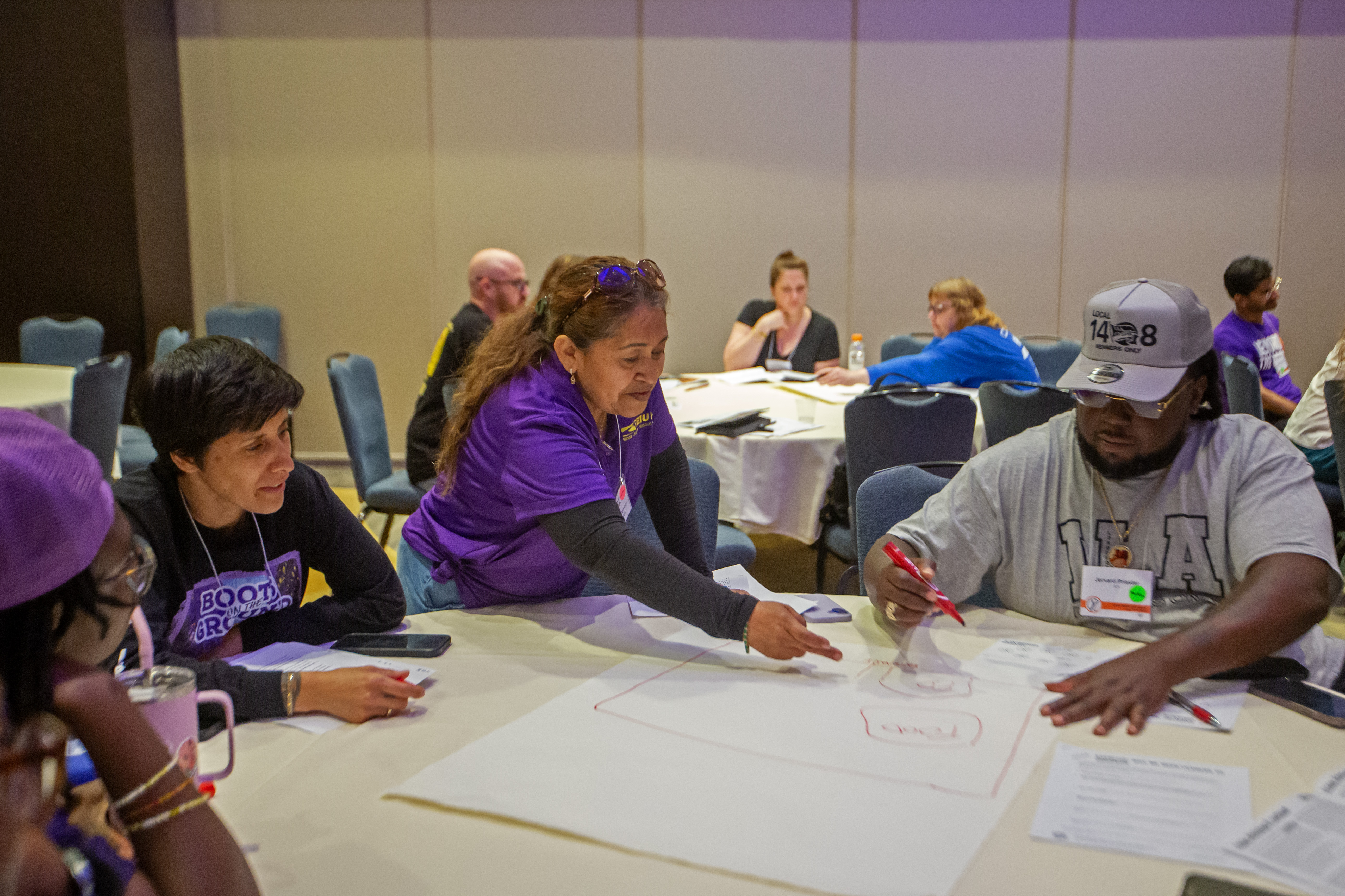
Union activists at the 2026 Labor Notes conference in Chicago, Illinois.

Whether labor is on the march or in a defensive crouch, Labor Notes remains the place where union militants go to learn how to strategize and fight back. (Jim West / JimWestPhoto.com)


Labor Notes’ biennial conference used to be the sort of gathering where veteran attendees could recognize many of the others in attendance. Barry Eidlin, a labor sociologist at McGill University who first attended Labor Notes in 1998, remembers a conference that felt very different. “I think they broke a thousand, and that was crazy,” he told me. “I remember the Labor Notes staff just being gobsmacked by that attendance.”

Back then, the conference occupied a much smaller corner of the labor movement. “There was a much sharper divide” between the Labor Notes crowd and much of organized labor’s official leadership, Eidlin recalled.

“It used to be that the UAW [United Auto Workers] and Teamsters and SEIU [Service Employees International Union] would send pickets to the Labor Notes conference,” said Eidlin. “We haven’t seen that in a while.” A lot has changed since those years. These days, the UAW, Teamsters, and SEIU all have leadership affiliated to varying degrees with the project, both at the international and local levels.

Labor Notes is the creation of rank-and-file labor militants. It’s partially an organizing project, partially a publishing one. As its tagline goes, Labor Notes is “the voice of union activists who want to put the movement back in the labor movement.” It publishes both a print paper and online articles as well as books and pamphlets, with an emphasis on reports by workers themselves on fights in which they are engaged.

The goal is to build up workers’ ability to win power on the job — see, for instance, Labor Notes’ long-running “Steward’s Corner” column, which offers practical advice on how to turn grievance handling into a tool for building shop-floor union power. The publication feeds into the organizing, connecting and building relationships with rank-and-file workers who are leading struggles — to unionize, to strike, to reform their unions — in hopes of better cohering the militant, democratic wing of the labor movement.

“A publication was needed that, while critical of contemporary union leadership, saw its main task as educating, connecting, and animating a layer of labor activists whose main task was to build effective rank-and-file unions capable of fighting the boss on a sustained basis,” wrote labor historian Nelson Lichtenstein in a 2019 reflection on Labor Notes for Jacobin. The diminishment of open hostility toward the conference by many union leaders speaks to Labor Notes’ success in spreading its approach over the years.

Roughly 4,700 people attended this year’s gathering at the Hyatt Regency O’Hare in Rosemont, Illinois, making it the largest conference in Labor Notes’ history and forcing organizers to move to a larger venue in Downtown Chicago for the next convening. Registration reached capacity long before the conference began, leaving many would-be attendees unable to secure spots. Aspiring attendees in my own life asked me for any workarounds for getting off the waitlist the way a band’s rabid fans might for a sold-out concert.

The growth was visible everywhere: packed workshops, crowded hallways, standing-room-only sessions. Yet the most striking shift from the prior few iterations of the conference was not about size. Workers arrived in Rosemont facing a hostile political environment, employer offensives across industries, unresolved organizing battles, and growing questions about how workers should respond to artificial intelligence, climate change, immigration enforcement, and elected leaders hell-bent on war. The atmosphere reflected that reality.

The Terrain Has Shifted

The dominant tone of the conference was one of sober seriousness, a reflection of how much the political landscape had changed since the last few conferences.

During Joe Biden’s administration, workers gathered at Labor Notes amid a series of headline-grabbing breakthroughs: Starbucks workers were unionizing stores across the country, Amazon workers had won a union election at JFK8 in Staten Island, reform caucuses were winning elections inside major unions, the United Auto Workers had just won their 2023 “stand-up strike,” and new organizing drives were gaining a foothold in Southern auto plants. The atmosphere was one of labor on the march.

This year, workers arrived under a Trump administration that has intensified immigration enforcement, targeted universities and activists, and encouraged a broader climate of employer offensives. Most questions I heard workers ask in panels and workshops began with “How do we”: How do we organize under these conditions? How do we defend our members and our communities? How do we win?

The conference’s scale was visible not only in the workshops but in the combinations of people it brought together. At one panel, I found myself seated at a table with a social worker from a New York hospital, a researcher for a white-collar union, a grocery worker, a public sector worker who was a member of the American Federation of State, County and Municipal Employees (AFSCME), and a member of the Union of Southern Service Workers. Such an array is typical of and unique to the conference.

The conversations themselves reflected the moment labor confronts. One of the recurring themes throughout the weekend was that workers across the country are now inescapably drawn into political conflicts that extend well beyond the workplace. At a gathering of media workers, participants discussed colleagues who had been shot while reporting, lawsuits involving union members, and the growing difficulty of separating labor questions from broader political conflicts.

Employers increasingly operate as political actors; so, too, must workers and their unions. If employers throw their weight behind war, repression, labor-replacing technology, or attacks on civil liberties, why would workers and their unions pretend they can avoid these questions? After all, the only way to ensure you lose a fight is not to hit back.

Those discussions acquired additional urgency on Monday morning, after the conference ended, when news broke that federal authorities had indicted and arrested fifteen Minnesota activists, including five union members: a union carpenter, an electrician, a teacher, a university staff member, and a nursing-home worker — two of whom attended the conference. Throughout the weekend, Labor Notes highlighted Twin Cities organizers who had helped mobilize workers against immigration raids and featured discussions examining how labor could respond to Immigration and Customs Enforcement (ICE).

One of the conference’s Troublemaker Awards, presented Saturday night, honored “the Twin Cities Workers Who Turned Back the ICE Surge.” The award citation celebrated the way “ordinary working people stood up in solidarity to defend their neighbors caught up in the racial-profiling dragnet” and praised workers who took part in a statewide day of “no work, no school, and no shopping” to demand “ICE Out of Minnesota!” Less than forty-eight hours later, federal authorities had arrested five union members from that same movement.

A delegation of workers from various unions and worker centers collectively accepted a Troublemakers Award on behalf of “the Twin Cities Workers Who Turned Back the ICE Surge” at this year’s Labor Notes Conference.
A delegation of workers from various unions and worker centers collectively accepted a Troublemakers Award on behalf of “the Twin Cities Workers Who Turned Back the ICE Surge” at this year’s Labor Notes Conference. (Jim West / JimWestPhoto.com)

New Problems, Familiar Questions

If the conference’s mood was serious, it was hardly inward-looking. Some of the most interesting discussions centered on questions that barely registered at previous Labor Notes gatherings.

One packed panel examined the explosive growth of data centers and the tensions emerging between labor, climate politics, and local communities. Data centers accounted for roughly 70 percent of the increase in private nonresidential construction spending between March 2024 and March 2025, with the projects driving a boom in construction work.

One electrician, steward, and member of the International Brotherhood of Electrical Workers (IBEW) Local 666 in Virginia, described how data center growth had transformed his local. When he entered the apprenticeship in 2021, he said, the Facebook data center under construction employed more workers in one place than any project in the local’s history. Older members told him that the years before the boom had been bleak. Membership had fallen to roughly eight hundred, and many electricians were forced to travel out of state for work.

“Traveling is a good way to get a divorce and a good way to not see your kids,” said the electrician. (In the spirit of allowing workers to speak freely with one another throughout the conference, Labor Notes discourages quoting panelists by name).

The data center boom helped more than double the local’s membership, which now exceeds 2,300 workers. It also created jobs large enough to sustain long-term organizing.

“What we’ve been able to do with that is secure up and educate our membership,” he said. “Never before have we been on the same job site with each other for as long.”

Another panelist, a researcher from Cornell University’s Climate Jobs Institute, offered a different perspective. Data centers may be powering construction growth nationally, he said, but they are also generating unusually broad public opposition. Communities have pushed back over water consumption, energy demand, pollution, noise, and increasingly AI itself.

Citing recent polling, he noted that “55 percent of Americans who are registered to vote strongly oppose data centers being built in the community that they live in.” This year alone, he said, at least twenty projects had already been canceled because of public opposition.

The exchange revolved around a problem likely to become increasingly common for organized labor: how to create good jobs while responding to environmental and community concerns that cannot be waved away, and how to win the subset of workers who benefit from societally deleterious projects away from supporting them, which will require taking their concerns seriously rather than ignoring them entirely.

Union activists at the 2026 Labor Notes conference.
The growth of the Labor Notes conference was visible everywhere: packed workshops, crowded hallways, standing-room-only sessions. (Jim West / JimWestPhoto.com)

Amazon workers offered another glimpse of a labor movement entering a more mature phase. This year’s conference included the largest Amazon contingent in Labor Notes history, around two hundred warehouse workers and delivery drivers. Their discussions focused less on headline-grabbing organizing drives than on the practical challenges of sustaining worker organization inside a company built on turnover and surveillance. Workers described warehouses where seasonal hiring, injuries, layoffs, firings, and increasingly precarious forms of employment constantly reshuffle the workforce.

As one worker from Amazon’s JFK8 warehouse in Staten Island put it, organizers often spend months building relationships only to watch coworkers disappear: “You build a relationship with somebody, they trust you, they believe in the fight, they’re ready to take action — boom, they’re gone the next day. Now you’ve got to start from scratch again.” Yet he argued that even workers who leave carry organizing lessons with them that can bear future fruit. “Plant the seed, plant the seed, plant the seed,” he said.

The conference’s closing plenary struck a similar tone. Alexandria Hall, an Oregon nurse, described how a forty-six-day statewide strike against Providence Health & Services, the large nonprofit health system that operates hospitals across Oregon, Washington, Alaska, California, and several other Western states, exposed frustrations with her union’s internal functioning and led nurses to organize a reform caucus.

During the strike, Hall said, members encountered what they saw as inadequate communication, insufficient member involvement in bargaining, and a union structure that often seemed to react to events rather than shape them. The experience convinced many nurses that reform was necessary.

“So, like the good union people we tried to be, we stopped bitching about it and actually did something about it,” Hall recalled.

Nurses from across the state formed the Caucus for Powerful Reform, ran for leadership positions, and won fifteen of twenty-one contested seats on their statewide union’s board, securing a supermajority.

“We are under no illusion that this will be easy,” Hall said. “Or that we will not face resistance.” But, she added, members remained committed to building “the union the members deserve.”

Emily Lumpkin, an electrician and member of the Caucus of Rank-and-File Electrical Workers (CREW), a reform caucus in the IBEW that was noticeably well-represented at this year’s conference, offered a similar account. Two years ago, she told attendees, she came to Labor Notes alone and frustrated by what she saw as a lack of democracy and member participation in her union. This year, she addressed the closing plenary as a leader of a reform effort in the building trades.

“We are not professionals,” Lumpkin told the audience. “We are construction workers.”

The line drew one of the loudest responses of the session. It also captured something singular about Labor Notes itself. Few labor gatherings are built so completely around and by rank-and-file workers. Workers mostly led panels and workshops; on occasion, their elected leaders could be found in the audience.

Labor Notes’ Role Remains Unchanged

Outside the meeting rooms, the conference lobby functioned as a sort of labor movement commons. Tables for Jacobin, In These Times, and Long-Haul magazine sat a few feet from Railroad Workers United, the cross-union alliance of rank-and-file railroad workers organizing across craft and union lines, left book publishers like Haymarket and Pluto, and university worker-education programs like the City University of New York’s School of Labor and Urban Studies. Workers drifted between tables collecting newspapers, pamphlets, books, caucus flyers, and contact information.

Labor Notes also felt different demographically than in prior years. Some of the veteran Teamsters for a Democratic Union activists and older UAW reformers who once formed a conspicuous part of the gathering were less visible. Part of that may have been timing: both the Teamsters and UAW conventions began immediately afterward, drawing away some attendees. More broadly, the conference increasingly reflects the composition of the labor movement itself, where much of the recent growth and activity has come from education, health care, logistics, and other sectors rather than the older industrial unions that once defined Labor Notes’ core.

What has not changed is the role Labor Notes plays for workers who arrive from isolated workplaces, small locals, or nonunion shops. The conference has always offered practical things: contract campaigns, strike preparation, caucus-building, workshops on “Assertive Grievance Handling,” “Fight ICE, Build the Union,” “Approaches to Bargaining Over Tech Changes,” “Can Political Strikes Restore Labor’s Power?,” and even “What to Do When the Union Breaks Your Heart.” But its appeal has never been entirely practical.

The conference program included Eva Lopez, a member of SEIU Local 26, whose eight thousand members — janitors, security, airport workers, and rideshare drivers — helped organize a general strike in Minneapolis that forced ICE to back down from its venomous raids on the city that killed Renée Good and Alex Pretti. (Pretti himself was a union nurse.) It also included Nathaniel Mann, a Haitian meatpacking worker fresh off a strike in Greeley, Colorado, part of a workforce who speaks fifty-seven languages.

That feat sounds almost impossible, yet Labor Notes is full of people describing how to accomplish organizing tasks that most people would consider impossible: organizing Amazon warehouses, reforming entrenched unions, confronting ICE raids, building solidarity across dozens of languages and nationalities, or carrying out strikes against some of the largest employers in the country. One reason that so many people go to Labor Notes is it offers direct access to people who have actually done those things, who are not only willing but eager to talk to you about how you can do them too. It is one thing for a worker in a small town or an isolated workplace to know abstractly that she is part of a movement; it is another thing for her to experience proof of it.

This year’s conference did not project certainty. The dominant mood was more sober than in recent years. The challenges facing workers were constantly present in conversation. Yet the conference’s size is a reminder that workers are looking for places to not only talk about those challenges but collectively strategize about how to overcome them. Sobriety and hope might be thought of as opposites. At this year’s Labor Notes conference, they could be found alongside each other.